Home › Garden pests › Lawn grubs
Garden pests
Lawn grubs
Phyllopertha horticola, Heteronychus arator, Popillia japonica and related scarab beetles · Insect
Also called curl grubs (Australia), white grubs (USA), chafer grubs (UK).
Illustration
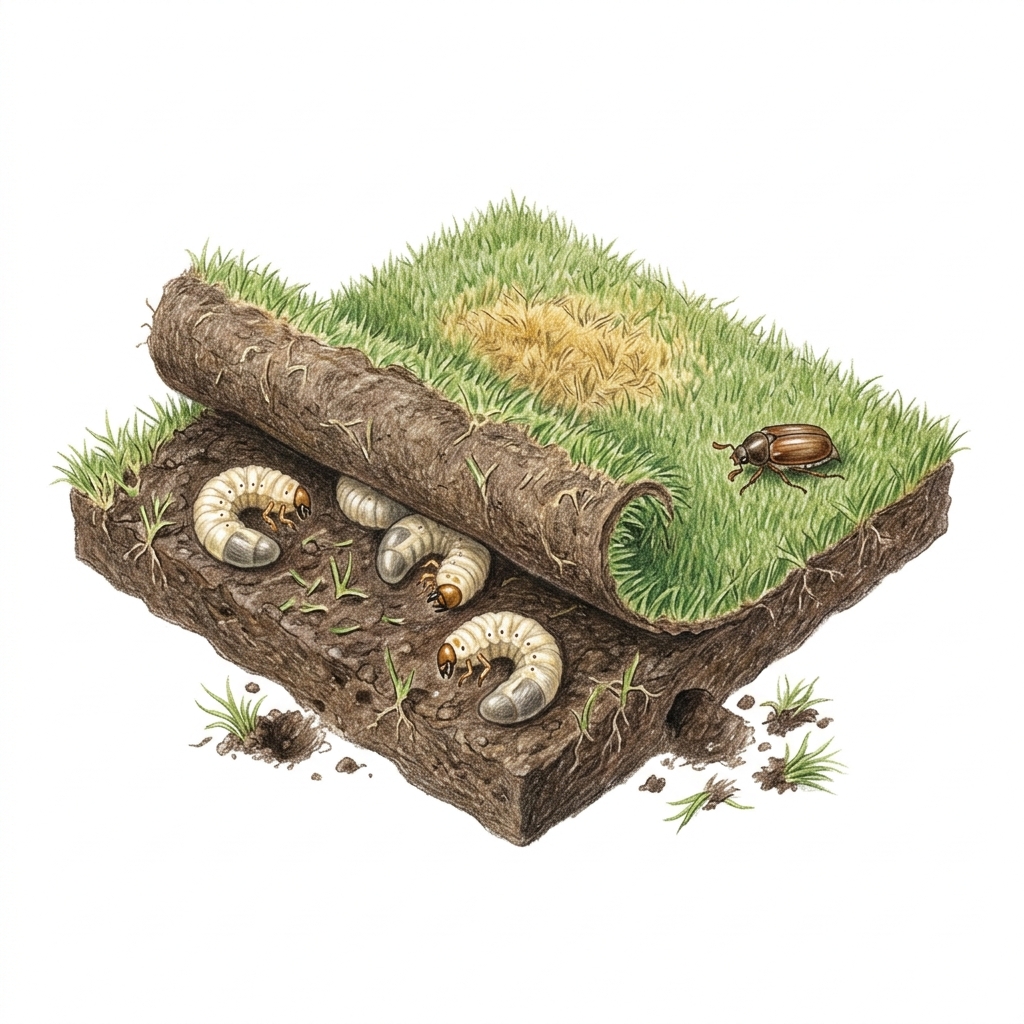
Plump, creamy-white, C-shaped beetle larvae that eat grass roots, leaving yellow or brown patches that lift like a carpet. Birds and animals digging up the turf are often the first sign.
How to spot it
- Plump, creamy-white grubs curled in a C shape, with a brown head and three pairs of legs near the head, just under the turf.
- Yellow or brown patches that look like drought, and turf that feels spongy underfoot.
- Dead turf that lifts and rolls back like a carpet because the roots have been eaten.
- Animals digging for them: crows, magpies, badgers and foxes in the UK, skunks and raccoons in North America, bandicoots in Australia.
Easily confused with
Leatherjackets
Grey-brown, legless tubes with no obvious head and a tough skin; they are crane fly larvae, not beetles.
Cutworms
Caterpillars that also curl up when disturbed, but have rows of stubby extra legs along the body as well as three pairs near the head.
Drought
Dry grass stays firmly rooted; grub-damaged turf lifts easily, with grubs underneath.
Where it's a problem
- Australia: Curl grubs, the larvae of scarab beetles, are the usual lawn grubs. In Western Australia the African black beetle attacks lawns, where it is known as the black lawn beetle. Bandicoots dig small holes, about 10 cm deep with a mound of soil beside them, hunting for curl grubs.
- North America: White grubs of Japanese beetles, masked chafers and green June beetles are common. Damage shows mostly in spring and in late summer to autumn.
- United Kingdom: Chafer grubs (C-shaped, with legs) and leatherjackets (legless crane fly larvae) both kill patches of lawn. Chafer damage is worst from autumn to spring, when birds, badgers and foxes tear up the turf to reach them.
What to do
- Lift a 30 cm square of turf, 5 to 10 cm deep, in several places and count the grubs. US extension services suggest control may be needed at about 5 to 10 grubs per square.
- To check for leatherjackets, cover a damaged patch overnight with black plastic; if they are the cause, many will be on the surface next morning.
- In the US, Penn State suggests keeping the lawn dry in July and early August, when the beetles lay their eggs.
- Biological control nematodes, watered into moist, warm soil, can reduce grubs. The RHS times them for July to September for chafer grubs, and September to early October for leatherjackets.
- Repair bare patches by reseeding or returfing in mid to late spring, when chafer grubs have moved deeper to pupate.
If you use an insecticide, choose one labelled for lawn grubs and follow the label and local rules. Sources say lawn grubs can usually be managed without insecticides, and any treatment has to be timed to the grubs' life cycle.
Free account, no card needed. You sign up or sign in first, then the scanner opens.
Sources
- RHS: Chafer grubs in lawns
- RHS: Leatherjackets
- RHS: Cutworms
- Penn State Extension: White grubs in home lawns
- University of Maryland Extension: White grubs in lawn and garden soil
- DPIRD Western Australia: African black beetle in vineyards
- Australian Museum: What animal made this hole?
Facts checked Sunday 27 September 2026. General guidance only: follow your local council, agency and product label.