Home › Garden pests › Fall armyworm
Garden pests
Fall armyworm
Spodoptera frugiperda · Insect
Also called FAW (Worldwide).
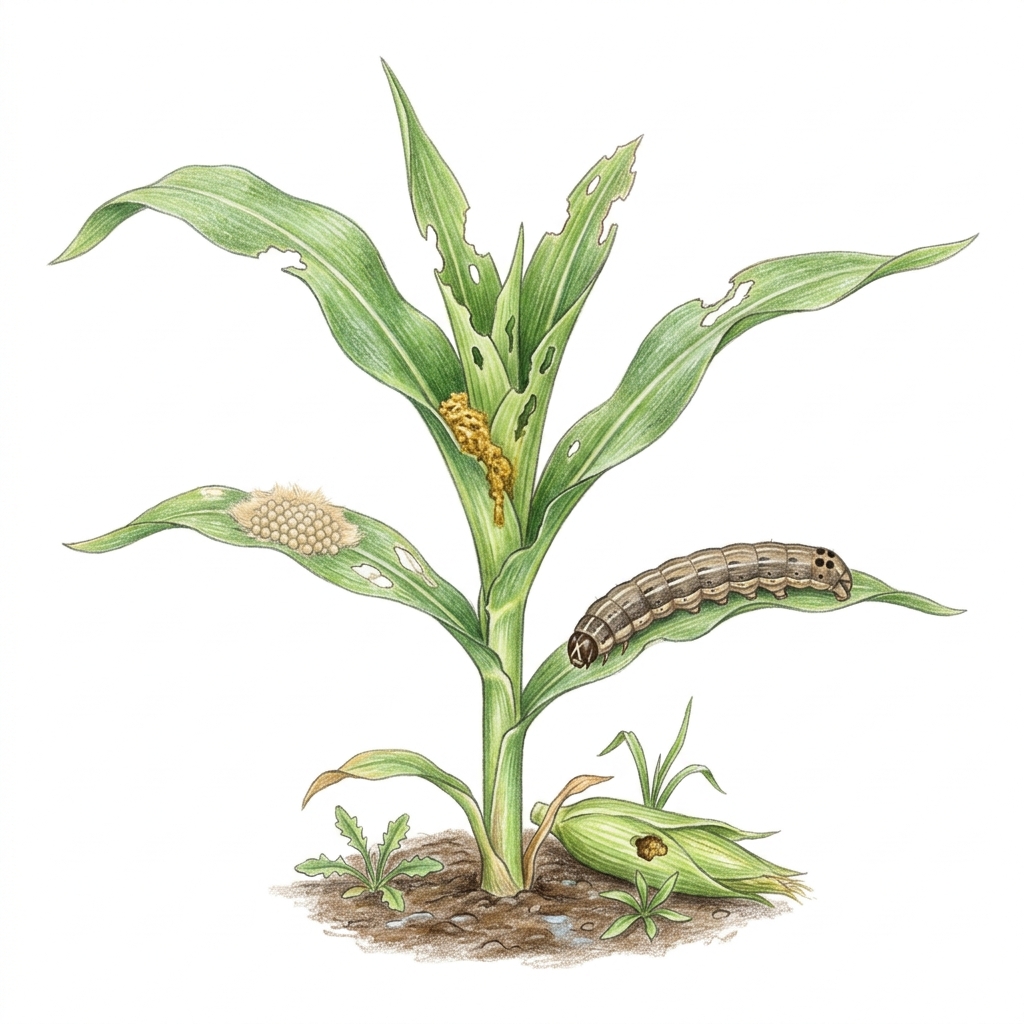
Illustration
A caterpillar from the Americas, now in Australia, New Zealand and parts of Europe, that shreds the leaves of young sweet corn from inside the whorl and then bores into the cobs. Check young corn every week and act while the caterpillars are small; where it isn't established, such as the UK, report it instead.
How to spot it
- Clusters of 50 to 150 eggs on the leaves, covered with pale, furry-looking scales.
- See-through 'windows' on young leaves where tiny caterpillars have scraped the surface.
- Ragged holes in the leaves as they unfold from the whorl, and a plug of yellowish-brown droppings in the whorl, with the caterpillar hiding beneath.
- Caterpillars up to 40 mm (1½ in) long, light tan to black, with pale stripes down the back, a pale upside-down Y on the dark head, and four dark spots in a square on the top near the tail end.
- Later, holes chewed into the tassels and cobs.
Easily confused with
Corn earworm
Has a plain yellow or light brown head with no Y. It lays single eggs on the silks and feeds at the tip of the cob, not in the leaf whorl.
European corn borer
Pale, with rows of small dark spots. Its early leaf damage looks similar, but it tunnels into the stalks, which fall armyworm doesn't.
Other armyworms and caterpillars
Other armyworms look very similar, and cluster caterpillar egg masses look like fall armyworm's. An expert may be needed to be sure, so photograph the head and tail end.
Where it's a problem
- Worldwide: Native to North and South America. It was first found in Africa in 2016, and has since spread across India, Southeast Asia and into Australia. It survives the winter only in warm places, but migrates very long distances in summer.
- Australia: Arrived on the mainland in early 2020 and has spread across much of northern and eastern Australia. Expect it all year in warm areas and for part of the year further south. Most damage has been to maize and sweet corn.
- New Zealand: Now found across the country, and it can't be eradicated: it still turns up in small numbers, more often in later-sown maize in Northland. Its unwanted organism status was revoked in May 2023, so reporting finds is no longer compulsory, but the Foundation for Arable Research still asks to hear of significant finds.
- North America: Survives the winter only in the far south, such as along the Gulf Coast, and moths fly north in stages each summer. Late-sown corn is most at risk.
- United Kingdom: Not established. If you suspect it, report it: in England and Wales to APHA on 0300 1000 313 or planthealth.info@apha.gov.uk. Scotland and Northern Ireland have their own contacts.
- Europe: First confirmed in the EU in Cyprus in January 2023, and later that year in Greece, Portugal and Romania. It is one of the EU's priority plant pests: report suspected finds to your national plant protection authority.
What to do
- In the UK, and where it isn't established in Europe, don't treat it: photograph it and report it straight away (contacts under Where it's a problem).
- Where it is present, check young corn from the time it comes up, at least once a week until harvest: look for egg masses on the leaves, see-through windows, ragged holes and sawdust-like droppings in the whorl.
- Act early, while the caterpillars are small: crush egg masses and pick off young caterpillars by hand. Big ones hide deep in the whorl or inside the cob, where little reaches them.
- Sow early: late-sown corn and late-maturing varieties are the most likely to be attacked.
- Check the tassels and cobs as the plants flower, as older caterpillars move into them.
In the UK, and where it isn't established in Europe, report it rather than treating it. Elsewhere, if you use an insecticide, choose one labelled for fall armyworm and follow the label and local rules. Sources say sprays only work while the caterpillars are small, and that resistance to insecticides is a concern.
Vegetables it affects
Free account, no card needed. You sign up or sign in first, then the scanner opens.
Sources (6, from Business Queensland, University of Kentucky Entomology, Defra Plant Health Portal and others)
- Business Queensland: Fall armyworm
- University of Kentucky Entomology: Fall armyworm in corn (ENTFACT-110)
- Defra Plant Health Portal: Pest alert, Spodoptera frugiperda
- Foundation for Arable Research (NZ): Fall armyworm update, 12 May 2023 · Fall armyworm update, 14 March 2025
- European Commission CORDIS: Spotlight on plant priority pest fall armyworm
Facts checked Wednesday 28 October 2026. General guidance only: follow your local council, agency and product label.