Home › Garden pests › European corn borer
Garden pests
European corn borer
Ostrinia nubilalis · Insect
Also called ECB (USA and Canada).
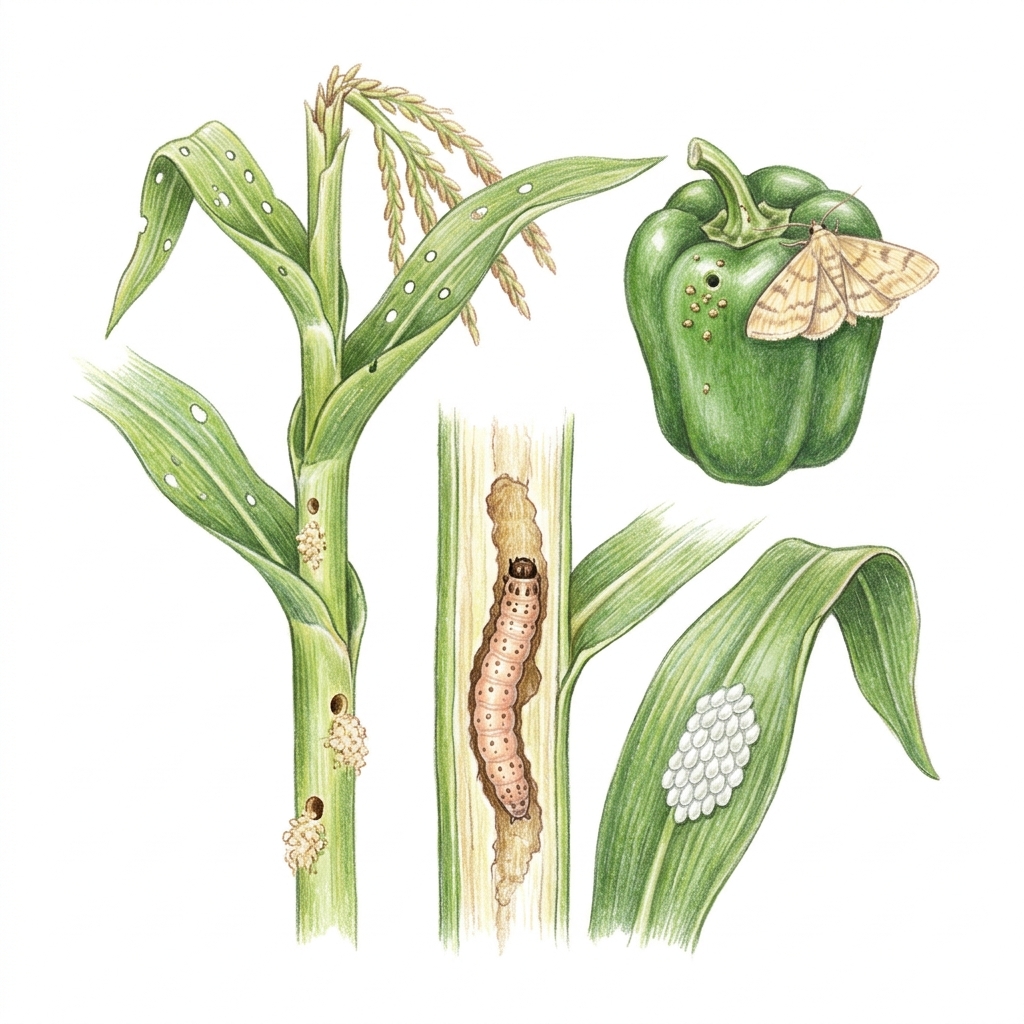
Illustration
A pale, spotted moth caterpillar that tunnels into the stalks, tassels and cobs of sweet corn, and into capsicum fruit, so tassels and stalks break and cobs are spoiled. Check plants from midsummer, and after harvest pull out and destroy or shred the old stalks, where the caterpillars spend the winter.
How to spot it
- Small 'shot holes' in the leaves of young plants as they unfold.
- Bent or broken tassels and stalks, with small holes in the stalk and droppings at the holes, where the caterpillars have tunnelled in.
- Caterpillars inside stalks, cobs or fruit: flesh-coloured to whitish, with rows of small dark spots and a dark brown head, up to about 2.5 cm (1 in) long.
- Flat clusters of 5 to 50 overlapping white eggs on the undersides of leaves, turning amber before they hatch.
- In capsicum, a pinhole entry wound in the fruit, covered in droppings.
Easily confused with
Corn earworm
Striped rather than spotted, with a plain yellow or light brown head. It feeds at the tip of the cob through the silks and doesn't tunnel in the stalks.
Fall armyworm
Has a pale upside-down Y on its head and four dark spots in a square near the tail. It shreds the leaves in the whorl but doesn't bore into the stalk.
Asian corn borer
A close relative recorded in Australia and across Asia: pinkish-brown, spotted caterpillars that bore into stems and cobs in much the same way. Telling the two apart needs an expert, so photograph it and report it if you're unsure.
Where it's a problem
- Europe: Native to Europe, where it is widespread on the Continent and a common pest of maize.
- United Kingdom: Present in England, but only in a few places.
- North America: First found in Massachusetts in 1917, it has spread across the United States as far west as the Rocky Mountains, and into Canada. There are one to three generations a year.
- Australia/New Zealand: Not recorded in Australia or New Zealand. A close relative, the Asian corn borer, is recorded in Australia and does similar damage to sweet corn. If you suspect European corn borer, report it: in Australia to the Exotic Plant Pest Hotline on 1800 084 881, in New Zealand to MPI on 0800 80 99 66.
What to do
- In Australia and New Zealand, where it isn't recorded, don't treat it: photograph a suspected find and report it (contacts under Where it's a problem).
- From the time the young plants have a whorl of rolled-up leaves in the centre, check every week for shot holes in the leaves and for egg clusters under the leaves, and crush any you find.
- Look for broken tassels and small holes with droppings in the stalks and capsicum fruit.
- Leave natural enemies to work: tiny Trichogramma wasps lay their eggs in borer eggs, and heavy rain washes many young caterpillars off the plants.
- At harvest, cut away any damaged part of the cob: the rest is fine to eat.
- After harvest, pull up the old corn stalks and other crop remains and destroy or shred them, and dig the bed over, as the caterpillars spend the winter inside them.
In Australia and New Zealand, report a suspected find rather than treating it. Elsewhere, if you use an insecticide, choose one labelled for European corn borer and follow the label and local rules.
Vegetables it affects
Free account, no card needed. You sign up or sign in first, then the scanner opens.
Sources (6, from Cornell University IPM, University of Illinois Extension, University of Wisconsin–Madison Extension and others)
- Cornell University IPM: European corn borer (vegetable IPM fact sheet)
- University of Illinois Extension: European corn borer
- University of Wisconsin–Madison Extension: Corn earworm
- EPPO Global Database: Ostrinia nubilalis, distribution
- Purdue University Extension: European corn borer (E-17-W)
- Pacific Pests, Pathogens and Weeds (ACIAR): Asian corn borer
Facts checked Wednesday 28 October 2026. General guidance only: follow your local council, agency and product label.