Home › Plant diseases › Septoria leaf spot
Plant diseases
Septoria leaf spot
Septoria apiicola (celery and celeriac), Septoria petroselini (parsley) and Septoria lycopersici (tomatoes) · Fungus
Also called celery leaf spot (UK and Australia), late blight of celery (USA and Canada).
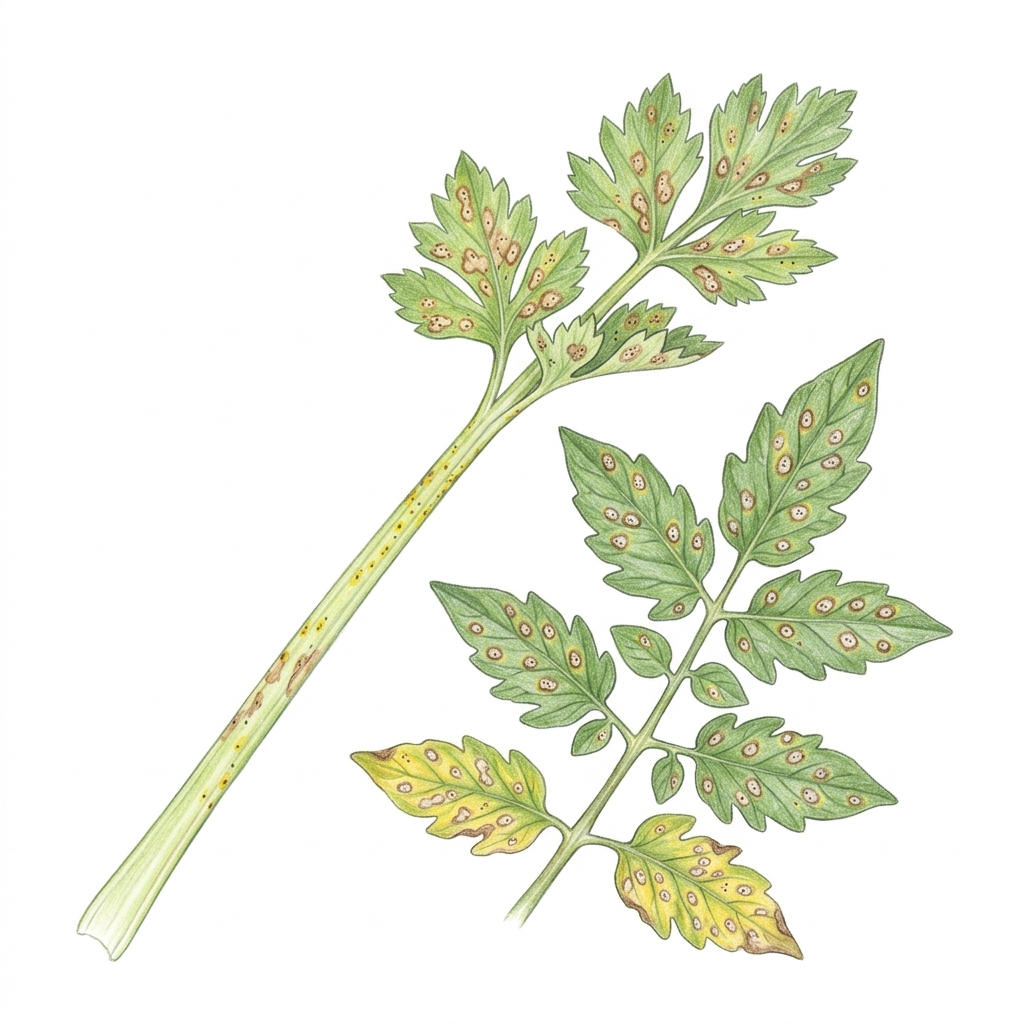
Illustration
Small yellow-to-brown leaf spots dotted with tiny black specks, on celery, celeriac, parsley and tomatoes; on celery it is usually called celery leaf spot. Clean seed, leaves that stay dry, picking off spotted leaves and a break of a few years from the same crop keep it in check.
How to spot it
- On celery and celeriac, small yellow spots on the leaves and leaf stalks that turn brown, then tan and papery as they grow and join up.
- Tiny black dots, like grains of pepper, inside the spots: the surest sign. They hold the spores.
- On parsley, small, angular, grey-brown to tan spots on the leaves, and small oval spots on the stalks.
- On tomatoes, many small round spots, mostly under 3 mm (⅛ in) across, with a pale tan to grey centre, a dark brown rim and often a yellow halo, starting on the lowest leaves and climbing up. The fruit is rarely touched.
- Badly spotted leaves yellow, die and drop.
- Worst in mild to warm, wet weather: rain, heavy dew, fog and sprinklers all spread it.
Easily confused with
Early blight
On tomatoes, fewer, larger, darker spots with target-like rings, rather than many small pale spots with black specks.
Grey leaf spot
On tomatoes, very similar small spots with light centres, but the centres crack or fall out.
Alternaria leaf blight
Dark brown to black spots with a yellow halo, mostly on carrots, starting at the edges of the oldest leaves, rather than paler spots dotted with black specks.
Where it's a problem
- Worldwide: Each crop has its own Septoria fungus, found wherever that crop is grown. It is worst in humid, rainy summers.
- United Kingdom: Celery leaf spot is the most destructive disease of celery grown outdoors.
- Australia: Here for a century: celery leaf spot was first recorded in Western Australia in 1923, and by the 1960s that state's agriculture department called it the most serious celery disease there, worst in crops grown through the cold, wet winter months.
- North America: On celery it's called late blight, but it has nothing to do with the late blight of tomatoes and potatoes. On tomatoes it can cut yields sharply in mild, rainy summers.
What to do
- Buy seed from a reliable supplier: seed is the main way it reaches a garden. Plant only healthy, spot-free seedlings.
- Water the soil, not the leaves, in the morning, and space plants so the leaves dry quickly.
- Pick off spotted leaves as soon as you see them, and keep out from among the plants while they are wet: spores travel on hands, clothes and tools.
- On tomatoes, stake the plants, mulch to stop soil splashing up, and pick off spotted lower leaves, without stripping too many. On parsley, some varieties resist it.
- Pull weeds of the tomato family, such as nightshades, which can carry the tomato fungus.
- At the end of the season, clear away or dig in the old plants: the fungus survives in leaves that haven't rotted.
- Keep celery, celeriac and parsley out of that bed for at least three years, and tomatoes for at least two.
If you use a fungicide, choose one labelled for septoria leaf spot and follow the label and local rules. Sprays only protect healthy leaves, so official guides start them at the first spots, or earlier where it comes back every year.
Follow your local council's guidance for disposing of diseased plant material.
Vegetables it affects
Take care: Celery and parsley sap can make skin redden and blister in sunshine. Wear gloves and long sleeves when clearing the plants, and wash your skin afterwards.
Free account, no card needed. You sign up or sign in first, then the scanner opens.
Sources (6, from AHDB Horticulture, University of California IPM, Pacific Northwest Plant Disease Handbook and others)
- AHDB Horticulture: Celery leaf spot
- University of California IPM: Celery late blight
- Pacific Northwest Plant Disease Handbook: Parsley, Septoria leaf spot
- NC State Extension: Septoria leaf spot of tomato
- Department of Agriculture, Western Australia: Leaf spot of celery
- DermNet: Phytophotodermatitis
Facts checked Wednesday 28 October 2026. General guidance only: follow your local council, agency and product label.