Home › Plant diseases › Scurf
Plant diseases
Scurf
Monilochaetes infuscans · Fungus
Also called sweet potato scurf (Worldwide).
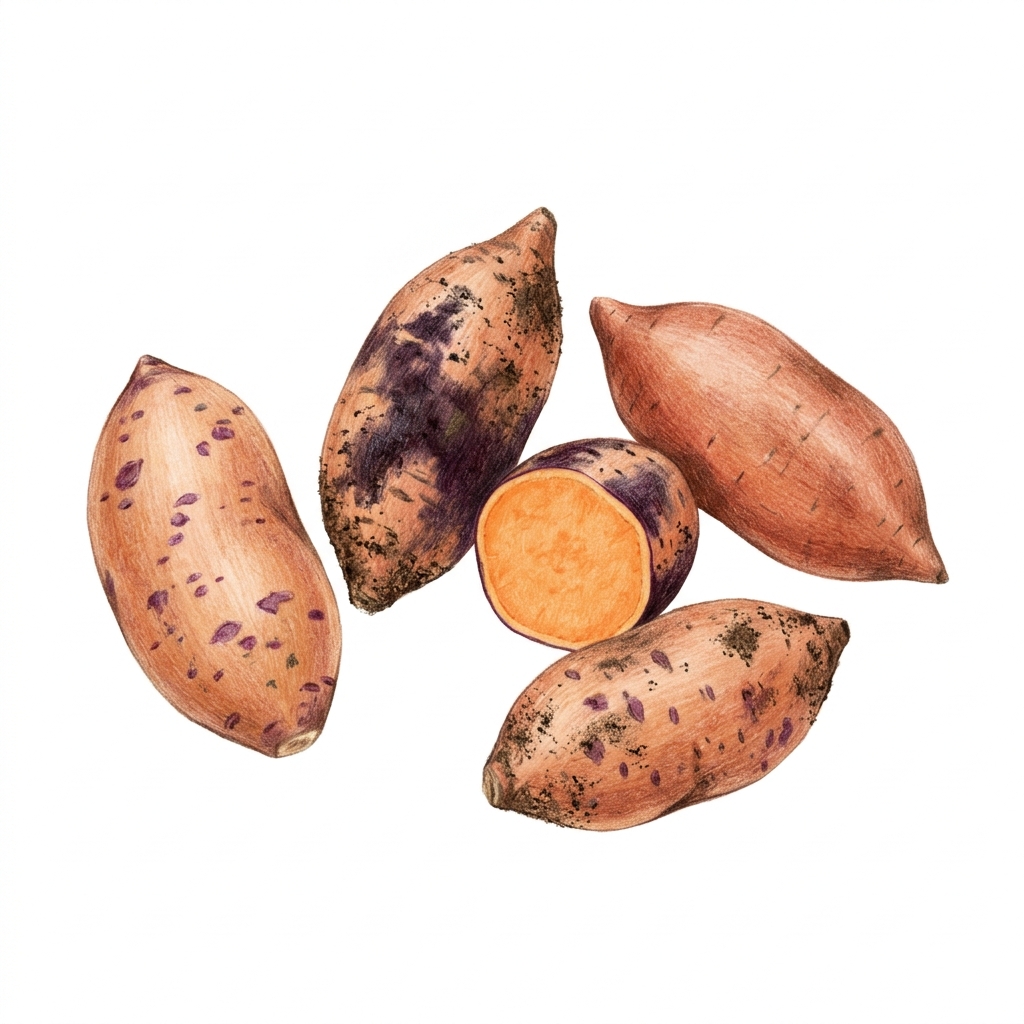
Illustration
Purple-brown to black stains on the skin of sweet potatoes, caused by a fungus that comes in mostly on infected planting material. It is only skin deep and the roots are fine to eat; next time, grow slips from clean roots, cut them above the soil and move the bed.
How to spot it
- Purplish-brown, grey-brown or black patches on the skin of the roots; greyish on some varieties, darker on orange-fleshed ones.
- A few scattered patches, or in bad cases patches that join up to cover most of the root.
- Only skin deep: the flesh underneath is sound.
- Only the parts below ground are marked, so the leaves look healthy and it shows at harvest.
- Patches that keep spreading slowly while the roots are stored.
Easily confused with
Sweet potato weevil
Holes and tunnels into the flesh, not a stain on the skin.
Wireworms
Small, round holes bored into the root by thin, shiny larvae.
Where it's a problem
- Worldwide: Common wherever sweet potatoes are grown, and worst in wet seasons and in heavy soils rich in organic matter.
- United States: Widespread, and mainly a problem of looks: marked roots are harder to sell, but they taste the same.
- Australia: Recorded in New South Wales, Queensland and South Australia.
- New Zealand: Present, and recorded on kūmara in Auckland, Northland and Gisborne.
What to do
- Grow slips only from sweet potatoes with clean, unmarked skins, or buy certified ones.
- Cut slips at least 2.5 cm (1 in) above the soil rather than pulling them, so the fungus in the soil doesn't come with them.
- Plant in a bed that hasn't grown sweet potatoes for 3–4 years; on light, sandy soil 2–3 years can be enough.
- Don't add manure where scurf has been a problem: it can make it worse.
- Pull out morning glory weeds nearby, which can carry the fungus.
- After harvest, clear away the vines and any leftover roots.
- Store the crop in clean boxes, and use the marked roots first: the patches keep spreading in storage, but the flesh is fine to eat.
There's no spray for scurf in a home garden: Clemson Extension says no chemicals are available for home use. Prevention is the answer: clean slips, cut above the soil, planted in a fresh bed.
Follow your local council's guidance for disposing of diseased plant material.
Vegetables it affects
Free account, no card needed. You sign up or sign in first, then the scanner opens.
Sources (6, from NC State Extension, Clemson University HGIC, Penn State Extension and others)
- NC State Extension: Sweetpotato scurf
- Clemson University HGIC: Irish potato and sweet potato diseases
- Penn State Extension: Scurf on sweet potato
- EPPO Global Database: Monilochaetes infuscans, distribution
- Pacific Pests, Pathogens and Weeds: Sweetpotato scurf
- Manaaki Whenua Landcare Research: Monilochaetes infuscans
Facts checked Wednesday 28 October 2026. General guidance only: follow your local council, agency and product label.