Home › Garden pests › Sweet potato weevil
Garden pests
Sweet potato weevil
Cylas formicarius · Insect
Also called sweetpotato weevil (Australia and USA (agencies' spelling)).
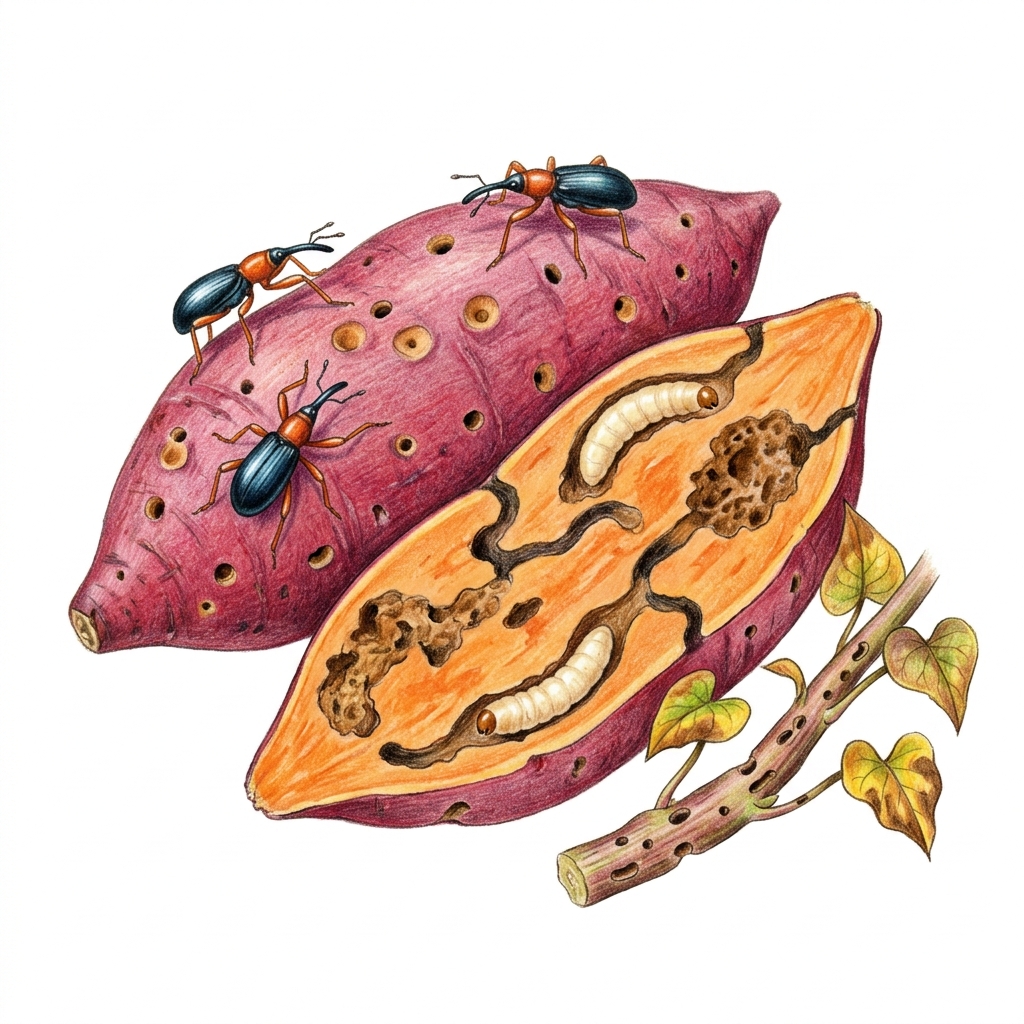
Illustration
A slender, ant-like weevil, blue-black with an orange-red middle, whose white grubs tunnel through sweet potatoes and the base of the vines, leaving the roots riddled and bitter. Plant clean tip cuttings, stop the soil cracking, harvest on time, and destroy every leftover root and vine.
How to spot it
- Sweet potatoes riddled with tunnels and spongy, discoloured cavities; even a little feeding makes them taste bitter and smell off.
- Small holes in the skin, and shallow pits where adults have fed.
- A tunnelled vine base with exit holes, sometimes rotting; in bad attacks the vines yellow and collapse.
- Legless white grubs with a brown head, up to 8 mm (⅓ in) long, inside the roots and stems.
- Ant-like adults 5–7 mm (¼ in) long, with a long snout and long legs: bluish-black head, snout and rear, and an orange-red middle and legs.
- Worst in dry weather and light, sandy soil, where cracks let the weevils reach the roots.
Easily confused with
Wireworms
Thin, hard, shiny larvae with three pairs of short legs that bore shallow holes into the roots from the soil; weevil grubs are legless and live inside the root.
Whitefringed weevil
C-shaped, legless grubs up to 15 mm (⅝ in) that live in the soil and chew shallow holes in the roots; the adult is grey-brown with a white stripe along each side and a short snout.
West Indian sweetpotato weevil
A stout, reddish-brown, bristly weevil under 4 mm (⅙ in) long whose grubs leave larger holes. It is not in Australia: report it to the Exotic Plant Pest Hotline on 1800 084 881.
Where it's a problem
- Worldwide: A pest of sweet potato through the tropics and subtropics of Asia, Africa, the Americas, the Caribbean and the Pacific Islands.
- Australia: Found in Queensland, New South Wales and the Northern Territory, at any time of year.
- New Zealand: Not established: it has only been intercepted at the border. Report a suspected find in kumara to MPI on 0800 80 99 66.
- United States: Found in the southern states, including Florida, Louisiana, Texas, Georgia, the Carolinas and Hawaii. California has a quarantine against sweet potato plants, roots and morning glories from those states, so check the rules before moving slips or roots.
- Europe and United Kingdom: Not established. It has only been intercepted in imported produce in Europe.
What to do
- Start with clean planting material: take tip cuttings 25–30 cm (10–12 in) long from fresh young growth, never from old vines or damaged roots.
- Don't grow sweet potatoes in the same spot two years running; once every three to four years is best.
- Hill soil up around the plants and mulch, and keep the soil moist, so it doesn't crack and let the weevils down to the roots.
- Dig the crop as soon as the roots are a good size, rather than leaving them in the ground.
- After harvest, gather and destroy every leftover root, vine and scrap. Sources call this the most important step.
- Pull out morning glories nearby, which the weevil also lives on, and don't move roots or cuttings from a weevil-affected garden.
If you use an insecticide, choose one labelled for sweet potato weevil and follow the label and local rules.
Vegetables it affects
Free account, no card needed. You sign up or sign in first, then the scanner opens.
Sources (6, from Pacific Pests, Pathogens and Weeds, Queensland DAF and Hort Innovation, EPPO Global Database and others)
- Pacific Pests, Pathogens and Weeds: Sweetpotato weevil
- Queensland DAF and Hort Innovation: Pests, diseases and disorders of sweetpotato, a field identification guide
- EPPO Global Database: Cylas formicarius, distribution
- California Department of Food and Agriculture: Sweet potato weevil quarantine (3257)
- Australian Government DAFF: Report a pest or disease concern
- MPI: Report a pest or disease
Facts checked Wednesday 28 October 2026. General guidance only: follow your local council, agency and product label.