Home › Plant diseases › Parsnip canker
Plant diseases
Parsnip canker
Itersonilia, Mycocentrospora, Cylindrocarpon and other fungi · Fungi
Also called Itersonilia canker or black canker (USA).
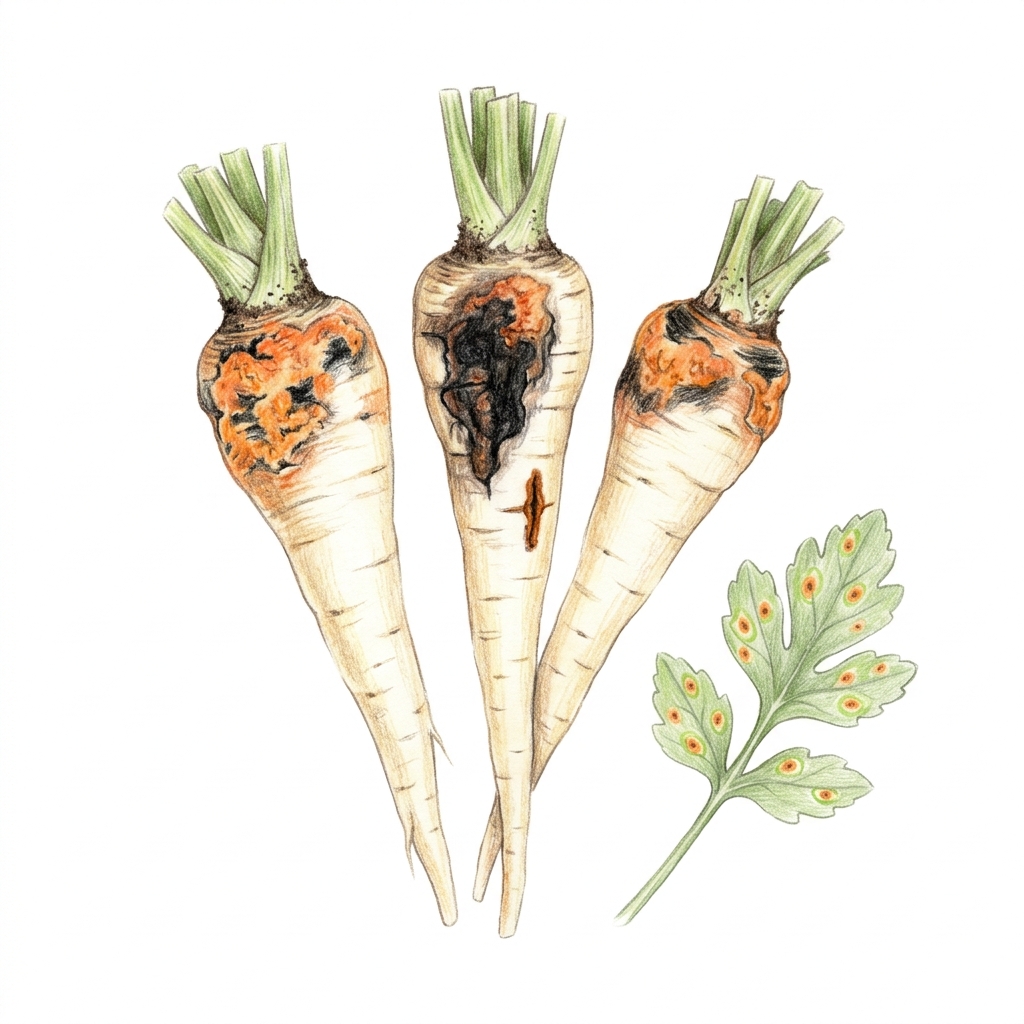
Illustration
Orange-brown to black rotting patches on the shoulders of parsnip roots, caused by several fungi that get in most easily where the root is damaged. Grow a resistant variety, keep the roots from being nicked or tunnelled, and keep soil over their shoulders.
How to spot it
- Orange-brown, reddish-brown or black patches on the shoulder and crown of the root, at or just below soil level.
- Patches that start on the skin, then rot deeper as other organisms move in.
- Damage often starting where the root was already hurt, such as a carrot fly tunnel or a nick from a hoe.
- Small orange to brown spots on the leaves, each with a pale green halo; they can join up.
- Worse in cool, wet weather and on roots left in the ground late into the season.
Easily confused with
Carrot fly
Narrow, rusty-brown tunnels running into the root, sometimes with small cream maggots inside. Their damage can also let canker in.
Wireworms
Small, round holes bored deep into the root by thin, shiny larvae, rather than a rotting patch on the surface.
Split fruit and roots
A clean crack along the root from uneven watering, not a dark, rotting patch on the shoulder.
Where it's a problem
- Worldwide: Found wherever parsnips are grown, and worst in cool, wet weather and in crops lifted late.
- United Kingdom: A common problem, which UK research has linked to several different soil fungi. The RHS advises growing a canker-resistant variety and weeding by hand.
- Australia: Studied in Victoria, Western Australia and Tasmania, where several fungi were found that could be responsible.
- North America: Usually called Itersonilia canker or black canker; a serious problem in late-harvested crops.
What to do
- Sow a variety described as canker-resistant.
- Grow parsnips in free-draining soil that isn't compacted.
- Cover the crop with fine insect mesh from sowing, so carrot fly maggots can't damage the roots.
- Weed close to the roots by hand rather than with a hoe, so the tops of the roots aren't nicked.
- Draw soil up over the shoulders of the roots through the season.
- Don't leave the crop in the ground longer than you need to: canker is worst on roots lifted late.
- After harvest, clear away all roots and leaves, and grow parsnips in a different bed for several years.
Fungicide sprays don't control the root cankers, says UMass Extension. Prevention is the answer: a resistant variety, undamaged roots and soil over their shoulders.
Follow your local council's guidance for disposing of diseased plant material.
Vegetables it affects
Free account, no card needed. You sign up or sign in first, then the scanner opens.
Sources (6, from RHS, UMass Extension, Pacific Northwest Plant Disease Management Handbook and others)
- RHS: How to grow parsnips
- UMass Extension: Carrot and parsnip, Itersonilia canker
- Pacific Northwest Plant Disease Management Handbook: Parsnip, Itersonilia canker
- Connecticut Agricultural Experiment Station: Parsnip
- University of Warwick (thesis, 2016): Characterisation of parsnip canker pathogens
- AUSVEG: Identification of the extent and cause of parsnip canker (Victorian DPI project)
Facts checked Wednesday 28 October 2026. General guidance only: follow your local council, agency and product label.