Home › Garden pests › Wallabies and pademelons
Garden pests
Wallabies and pademelons
Bennett's wallaby (Notamacropus rufogriseus), Tasmanian pademelon (Thylogale billardierii) and other kangaroos and wallabies · Mammal
Also called red-necked wallaby (mainland Australia, for Bennett's wallaby), kangaroo (often said in Tasmania of Bennett's wallaby), rufous wallaby, rufous-bellied pademelon, or just wallaby (Tasmania, for the pademelon).
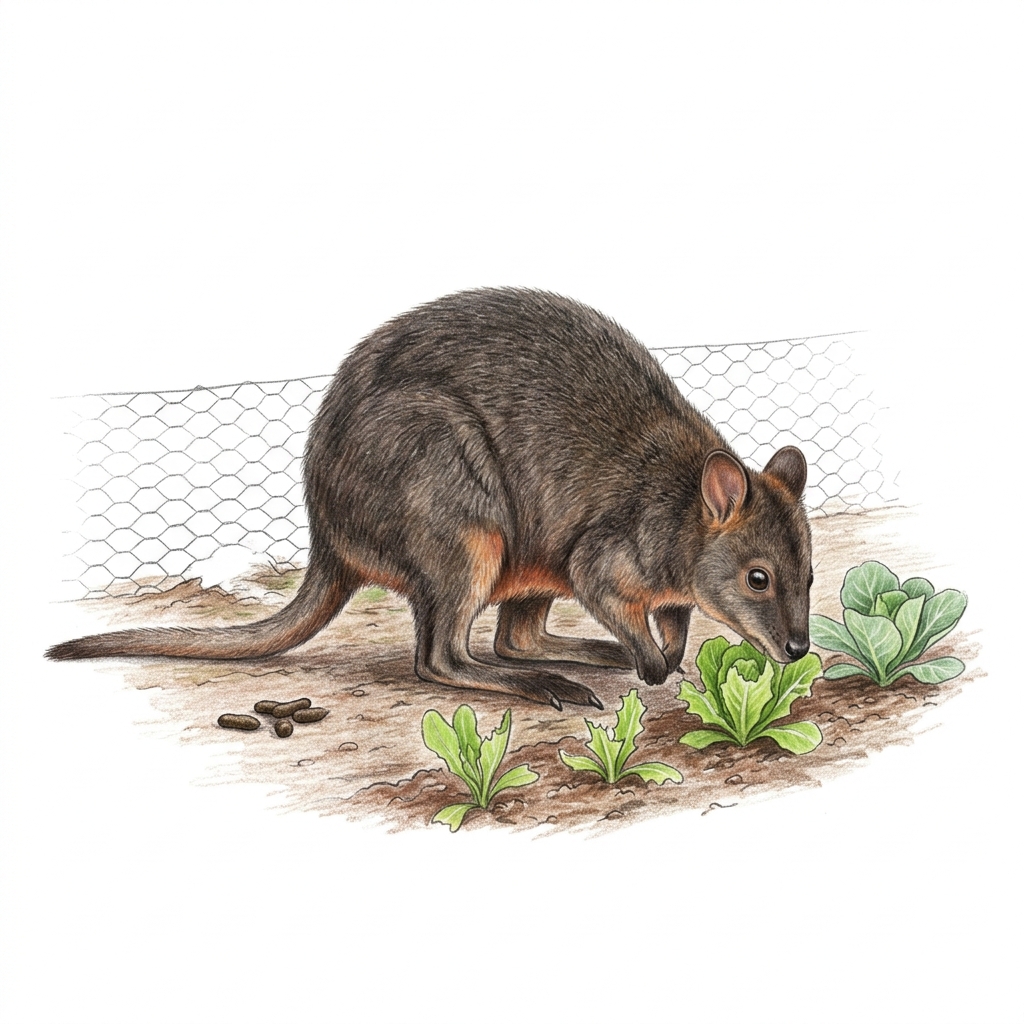
Illustration
Wallabies and pademelons come out of the bush at dusk and graze seedlings, soft plants and new shoots overnight, close to the ground. In Australia they are protected native animals, so the answer is a fence or cover sealed at the bottom: they go under a fence far more often than over it.
How to spot it
- Seedlings, soft leaves and new shoots bitten off low down overnight, leaving ragged, jagged edges rather than a clean cut.
- On young plants, pademelons tend to eat the side leaves and leave the top shoot; possums go for the top shoot first.
- Damage worst in beds near bush or thick scrub: pademelons rarely stray more than 100 m (330 ft) from cover.
- Droppings on paths and lawns: wallaby droppings are often tear-drop shaped, and pademelon droppings are often pressed together into a cigar shape.
- In soft soil, long, narrow hind-foot prints and a mark left by the tail; each print shows a big middle toe reaching past the outer toe.
- Worn runways and scraped gaps under fences, where they push through.
- Bennett's wallaby: about 1 m (3 ft 3 in) tall, big males over 20 kg (44 lb); brownish grey, with a reddish neck, pale belly, black nose and paws, black ear tips and a white stripe on the upper lip.
- Tasmanian pademelon: smaller and stockier, with a relatively short tail; it rarely stands upright. Dark brown to grey-brown with a reddish belly; males reach about 12 kg (26 lb), females about 4 kg (9 lb).
Easily confused with
Rabbits
Snip seedlings off cleanly near the ground, often leaving pieces lying uneaten, and leave small round droppings about 6 mm (1/4 in) across.
Possums
Climb, and take the top shoot of a young plant first; their droppings are cylinders about 2.5 cm (1 in) long, in groups.
Fallow deer
Jump ordinary fences, pull seedlings out of the ground, dig into root crops such as carrots and strip bark; their droppings are about 1 cm (3/8 in) long, a little smaller than a wallaby's.
Wombats
Mostly graze grass and dig: a hole under your fence is usually a wombat's, which wallabies then use. Their droppings are larger, about 4 cm (1.5 in) long.
Where it's a problem
- Tasmania: Bennett's wallabies and Tasmanian pademelons are common across the state and the Bass Strait islands, and both are partly protected; the bigger forester kangaroo, found mainly in the midlands and north-east, is protected. Shooting, trapping or poisoning them needs a permit or licence. Property Protection Permits from Game Services Tasmania are for owners or managers whose stock, crops or farm equipment are being damaged; the official pages don't cover home gardens. Trapping and moving wallabies is not recommended: a moved animal will most likely die. For a garden, fence it, and ask Game Services Tasmania if you need more help.
- Mainland Australia: Kangaroos and wallabies are protected. In New South Wales, harming one (killing, injuring or capturing it) without a licence is illegal. In Victoria, control needs an Authority to Control Wildlife, issued only once all practical non-lethal options have been tried. In Queensland, harming or killing one without a damage mitigation permit is an offence. Rufous-bellied pademelons are now found only in Tasmania; the mainland has other pademelons, swamp wallabies and grey kangaroos.
- Where kangaroos visit: Grey kangaroos (forester kangaroos in Tasmania) jump far higher than wallabies, and an ordinary wallaby fence won't stop them. Victoria's advice is a fence at least 1.8 m (6 ft) high; Queensland's is about 1.5 m (5 ft), with a gate so animals can get out, which usually stops only smaller kangaroos. Add white tape or white wire along the top so they can see it, and avoid barbed wire, which entangles wildlife. Some housing estates must keep wildlife corridors open, so check before fencing.
- New Zealand: Wallabies are introduced pests: Bennett's wallabies were released in South Canterbury in 1874, and dama wallabies near Rotorua in 1912. They compete with stock, damage crops and stop native bush regrowing, and they are spreading. It is an offence under the Biosecurity Act 1993 to move or release a live wallaby. Report any wallaby you see at reportwallabies.nz, and ask your regional council what the local rules require: in Otago, for example, land occupiers must deal with any wallaby on their land.
How to protect your plants
- Check who is visiting first: droppings, tracks and the kind of damage. If rabbits, possums or deer are the main problem, a wallaby fence alone won't help.
- Fence the vegetable garden. It is the only lasting protection. Pademelons don't jump well: wire netting 900 mm (3 ft) high keeps them out if the bottom is buried or pegged down. Where Bennett's wallabies visit, go higher: most can't jump a fence 115 cm (45 in) high, though some can from a downhill slope.
- A rabbit-proof fence also keeps wallabies out: rabbit netting 1.05 m (3 ft 5 in) high with a 4 cm (1.5 in) mesh, the bottom 15 cm (6 in) buried or laid flat on the ground. Use strong, galvanised wire with knots that don't slip: Bennett's wallabies push hard and can break light mesh.
- Seal the bottom. Wallabies go under a fence far more often than over it. Set the fence on level, firm ground, lay a skirt of mesh flat on the ground and peg it, and leave no gaps under posts, at corners or under gates. Young pademelons fit through ordinary gate mesh, so cover gates with fine mesh and hang them close to the ground.
- If you add an electric wire, keep the lowest live wire at least 25 cm (10 in) above the ground so echidnas can pass under, and check your council's rules first. If possums are a problem too, add a floppy top (see Possums).
- Walk the fence often, after storms and fallen branches too. Wombats dig under fences and wallabies then use the hole; blocking it usually just makes the wombat dig a new one. Where wombats cross, a wombat gate (a top-hung weldmesh flap 35 to 40 cm, 14 to 16 in, square, weighted with at least 3 kg, 7 lb) lets wombats through but stops most wallabies.
- For a few beds, cover them instead: a weldmesh cage wrapped in rabbit wire keeps wallabies off whatever is inside. If you use netting, choose a fine mesh, keep it taut and fastened down, and check it every day for trapped animals.
- Guard young trees and shrubs until they grow out of reach, which can take until they are 1 to 2 m (3 to 6 ft) tall. Tasmanian forestry advice is fluted plastic tree guards 1.2 m (4 ft) high.
- Plant bigger, hardened-off seedlings: they recover better from browsing, and hardened leaves are less tasty. Prickly or less tasty local natives help elsewhere in the garden; ask a local nursery or Landcare group, as no plant is safe from a hungry wallaby.
- Repellents help only a little, and only for a while. Egg-based ones work best, but protection lasts about 6 to 8 weeks, new growth isn't covered, and they can damage leaves. Tasmanian trials found some effect, but none that was reliable or lasting.
- Don't feed them or leave water out, and mow lawns often so there is less to graze.
Never use poison, traps or snares on wallabies, pademelons or kangaroos. In Tasmania they may be taken only under a permit or licence, and on the mainland harming one without a licence or permit is an offence. Protect your plants with fences and covers instead. In New Zealand, follow your regional council's rules.
Take care: Keep your distance from kangaroos and large wallabies, above all males and mothers with a joey, and keep dogs on a lead where they are about: kangaroos defend themselves vigorously against dogs. If you find one sick, injured or orphaned, or caught in a fence or netting, call a local wildlife rescue group.
Free account, no card needed. You sign up or sign in first, then the scanner opens.
Sources (18, from Tasmania NRE, Game Services Tasmania, Tasmanian Institute of Agriculture (University of Tasmania) and others)
- Tasmania NRE: Living with kangaroos and wallabies · Bennetts wallaby · Rufous-bellied pademelon · Wallaby fencing · Choosing appropriate mesh · Additional construction tips · Property protection permits · Living with wombats
- Game Services Tasmania: Browsing wildlife species
- Tasmanian Institute of Agriculture (University of Tasmania): Wallaby proof fencing, a planning guide
- Private Forests Tasmania: Browsing damage to seedlings
- Forestry Tasmania (Tasforests): Alternative fencing materials for blackwood swamp coupes
- NSW Environment: Licences to harm kangaroos
- Victorian Government: Kangaroo and wallaby wildlife management methods
- Queensland Government: Living with kangaroos and wallabies
- Whitehorse City Council (Victoria): Kangaroos and wallabies
- Otago Regional Council (NZ): Bennett's wallaby
- Bay of Plenty Regional Council (NZ): Dama wallaby
Facts checked Friday 13 November 2026. General guidance only: follow your local council, agency and product label.