Home › Garden pests › Rabbits
Garden pests
Rabbits
European rabbit (Oryctolagus cuniculus); in North America, cottontails (Sylvilagus species) · Mammal
Also called European rabbit, wild rabbit, feral rabbit (Australia, New Zealand and the UK), cottontail (North America).
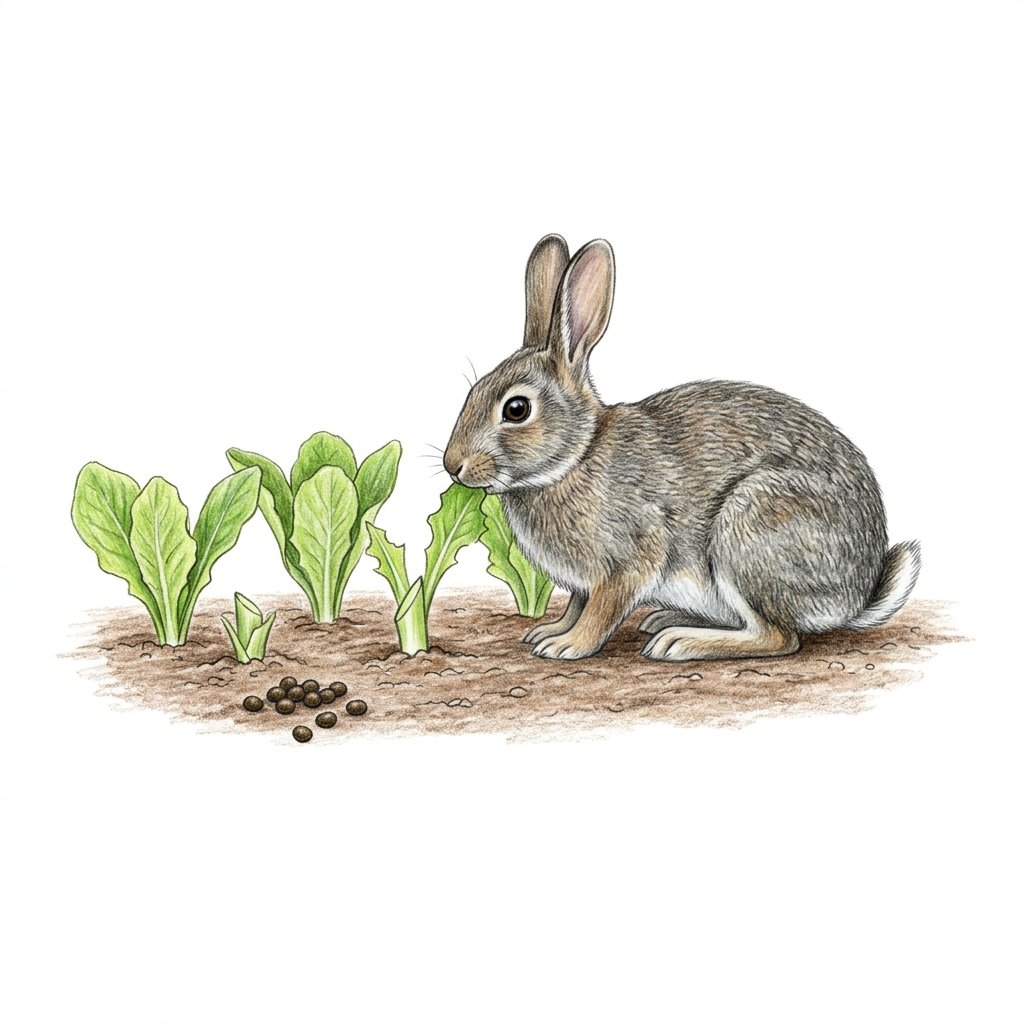
Illustration
Rabbits graze seedlings, leafy crops and flowers down to the ground, mostly from dusk to dawn, and gnaw the bark of young trees. A few soon become many, so the surest answer is to keep them out: a buried wire-netting fence round the vegetable garden, guards on young trees, and fewer hiding places nearby.
How to spot it
- Seedlings, leafy greens, herbs, carrots and young flowers eaten down to the ground, often overnight.
- Stems and twigs cut off cleanly at a sharp slant, about 45 degrees, as if snipped with secateurs, with no ragged edge.
- Damage stays low: rarely higher than about 50 cm (20 in), the height a rabbit reaches standing on its hind legs.
- Bark gnawed from the base of young trees and shrubs, mostly in winter when snow or frost covers other food.
- Small, round droppings in piles or scattered clumps, and scrapes and holes dug in lawns and beds.
- European rabbit: grey-brown back and pale belly, long ears, long hind legs and a short fluffy tail that flashes white underneath as it runs; adults 35 to 45 cm (14 to 18 in) long. In North America, cottontails look similar, often with a rusty-brown patch on the back of the neck.
Easily confused with
Hares (including jackrabbits)
Bigger, with longer hind legs and longer ears with black tips; they live alone above ground and never dig warrens.
Deer
Leave stems torn and ragged rather than cut clean, because they have no upper front teeth, and browse higher, above about 60 cm (2 ft).
Possums
Climb into trees at night and strip leaves, shoots and fruit high up; rabbit damage stays within about 50 cm (20 in) of the ground.
Slugs and snails
Ragged holes in the leaves and silvery slime trails, rather than stems cut cleanly through at a slant.
Where it's a problem
- Australia: Wild European rabbits are one of Australia's most destructive pests, and every state and territory has laws requiring landowners to take reasonable steps to control them on their land. In Victoria they are a declared established pest animal under the Catchment and Land Protection Act 1994; in New South Wales, controlling them is part of every landholder's General Biosecurity Duty. Rabbits rarely travel more than 200 m (650 ft) from their warren and do most of their feeding within 25 to 50 m (80 to 165 ft) of it, so the warren is usually close by: work on it with your neighbours, and check your state and council rules.
- Queensland: The rabbit is a restricted invasive animal under the Biosecurity Act 2014. You cannot keep one as a pet, and rabbits must not be moved, kept, fed, given away, sold or released. A rabbit-proof fence there should be wire netting with holes 40 mm (1 1/2 in) or smaller, at least 900 mm (3 ft) high and buried at least 150 mm (6 in).
- South Australia: Green Adelaide advises that wild rabbits can't be trapped and moved elsewhere: releasing one is illegal, steel-jawed traps are prohibited, and a trapped rabbit must be humanely put down, so arrange how before you set a trap. Rabbit bait in urban areas is restricted to larger blocks, over 1,000 m2 (about 1/4 acre), and must follow the label.
- New Zealand: Feral rabbits are a pest under regional pest management plans, and land occupiers (in Otago, renters included) are responsible for keeping numbers down; in Hawke's Bay a rule sets the level they must be kept to from mid-January to mid-August. Otago's council advises galvanised netting at least 600 to 900 mm (2 to 3 ft) high, with holes no larger than 40 mm (1 1/2 in), or 19 to 25 mm (3/4 to 1 in) to keep out young rabbits, and the bottom buried at least 150 mm (6 in) or bent outward as an apron and pegged down. Rifles can't be fired in town. Rabbit haemorrhagic disease, brought in illegally in 1997, knocks numbers back, but ongoing control is still needed.
- United Kingdom: Rabbits are thought to have been brought to Britain by the Romans and became established after the Normans brought more in the 12th century. In England (outside the City of London and the Isles of Scilly), the occupier must control rabbits on their land, or stop them damaging neighbouring crops, for example with rabbit-proof fencing, and can be prosecuted for doing nothing. If a neighbour's rabbits are the problem, talk to them first; if nothing changes, you can complain to Natural England. Traps and snares must be checked every day, self-locking snares are banned, and spreading myxomatosis on purpose is an offence under the Pests Act 1954. Rules differ in Scotland, Wales and Northern Ireland.
- United States: The rabbits in most gardens are native cottontails, which states such as Pennsylvania, Maryland and California class as game animals, so state wildlife rules apply. In California and Pennsylvania a landowner may control rabbits that are damaging the garden without a licence or permit, but the rules on trapping, moving and shooting differ by state and town: in California, releasing a trapped rabbit elsewhere needs written permission, and poisoning rabbits is not legal in Pennsylvania or Maryland. A 2 ft (60 cm) chicken-wire fence, with holes 1 in (2.5 cm) or smaller and the bottom tight to the ground or buried a few inches, keeps cottontails out; jackrabbits, which are hares, need 3 ft (90 cm). Check with your state wildlife agency.
How to protect your plants
- Fence the vegetable garden: it's the surest protection, and in towns often the only practical one. Use galvanised wire netting, as rabbits chew through plastic, and remember they can jump a fence 50 cm (20 in) high.
- Bury the bottom of the fence so they can't dig under it. The RHS advises 2.5 cm (1 in) mesh, 120 to 140 cm (48 to 54 in) high, with the bottom 30 cm (1 ft) below ground and the lowest 15 cm (6 in) of that bent outward, away from the garden. For a small vegetable patch, Green Adelaide in South Australia advises a fence 60 cm (2 ft) high, with mesh no wider than 30 mm (1 1/4 in), fixed to posts and buried 30 cm (1 ft) deep.
- Make gates rabbit-proof too and keep them shut. Walk the fence often, mending holes and filling any digging. Clear rabbits out of the fenced area first: a fence keeps them out, but doesn't get rid of the ones already inside.
- For single plants and small beds, a ring of wire netting about 90 cm (3 ft) high does the job, without burying.
- Guard the trunks of young trees and shrubs with a tree guard or spiral, or a cylinder of wire netting held 2.5 to 5 cm (1 to 2 in) out from the trunk and at least 90 cm (3 ft) tall, taller than any snow. Rabbits can gnaw through plastic, so plastic guards protect only for a while. A trunk chewed right round can die.
- Take away the cover rabbits hide and nest in near the garden: woodpiles, rubbish and brush heaps, dense weeds and thick low shrubs (prune up the bottom of hedges), and block gaps under sheds and other buildings.
- Repellent sprays that make leaves taste bitter can help on young trees and shrubs, but rain washes them off, new growth is left unprotected, and they work least well in a vegetable garden full of rabbits' favourite food. Choose one labelled for rabbits, follow the label, and don't use a bitter spray on food plants close to harvest. Noisemakers, flashing lights and ultrasonic devices generally don't work: rabbits learn to ignore them.
- No plant is rabbit-proof, but tomatoes, cucumbers and squash are usually left alone, while leafy greens, carrots, herbs and young flowers are favourites. Even plants rabbits normally ignore get eaten when newly planted or soft with spring growth, so protect new plantings.
- Talk to your neighbours: rabbits don't stop at boundaries, so control works far better when nearby properties act together.
- Keep a pet rabbit securely housed, and never let one go: escaped pets can start a wild colony.
Rabbit poisons, fumigants and traps are tightly controlled, and the rules differ from place to place: some may be used only by trained or licensed people, some traps are banned, and in many places a trapped rabbit may not be released elsewhere. In some US states, such as Pennsylvania and Maryland, poisoning rabbits is not legal at all. Check your state, council or wildlife agency rules first; where home use is allowed, follow your local agency and the label, and keep pets away from baits and poisoned rabbits.
Take care: If you have to handle a sick or dead wild rabbit, wear gloves and take care: in North America, rabbits can carry tularemia (rabbit fever), which people can catch through the skin from an infected animal.
Free account, no card needed. You sign up or sign in first, then the scanner opens.
Sources (16, from RHS, GOV.UK, legislation.gov.uk and others)
- RHS: Rabbits
- GOV.UK: Rabbits: how to control numbers
- legislation.gov.uk: Pests Act 1954, section 1 (rabbit clearance areas) · Pests Act 1954, section 12 (spreading of myxomatosis)
- PestSmart: Glovebox guide for managing rabbits · Rabbit biology, ecology and distribution
- Agriculture Victoria: European rabbit
- NSW Government: Wild rabbits
- Business Queensland: Rabbit
- Green Adelaide: Controlling rabbits in urban and urban fringe areas
- Otago Regional Council: Rabbit management
- Hawke's Bay Regional Council: Rabbit
- University of California IPM: Rabbits
- Penn State Extension: Cottontail rabbits
- University of Maryland Extension: Eastern cottontail rabbits in gardens and home landscapes
- CDC: How tularemia spreads
Facts checked Friday 13 November 2026. General guidance only: follow your local council, agency and product label.