Home › Garden pests › Deer
Garden pests
Deer
White-tailed deer (Odocoileus virginianus), mule deer (Odocoileus hemionus), roe deer (Capreolus capreolus), Reeves' muntjac (Muntiacus reevesi) and others · Mammal
Also called white-tailed deer, mule deer, black-tailed deer (United States), roe deer, muntjac, fallow deer, red deer (United Kingdom), feral deer, wild deer (Australia and New Zealand).
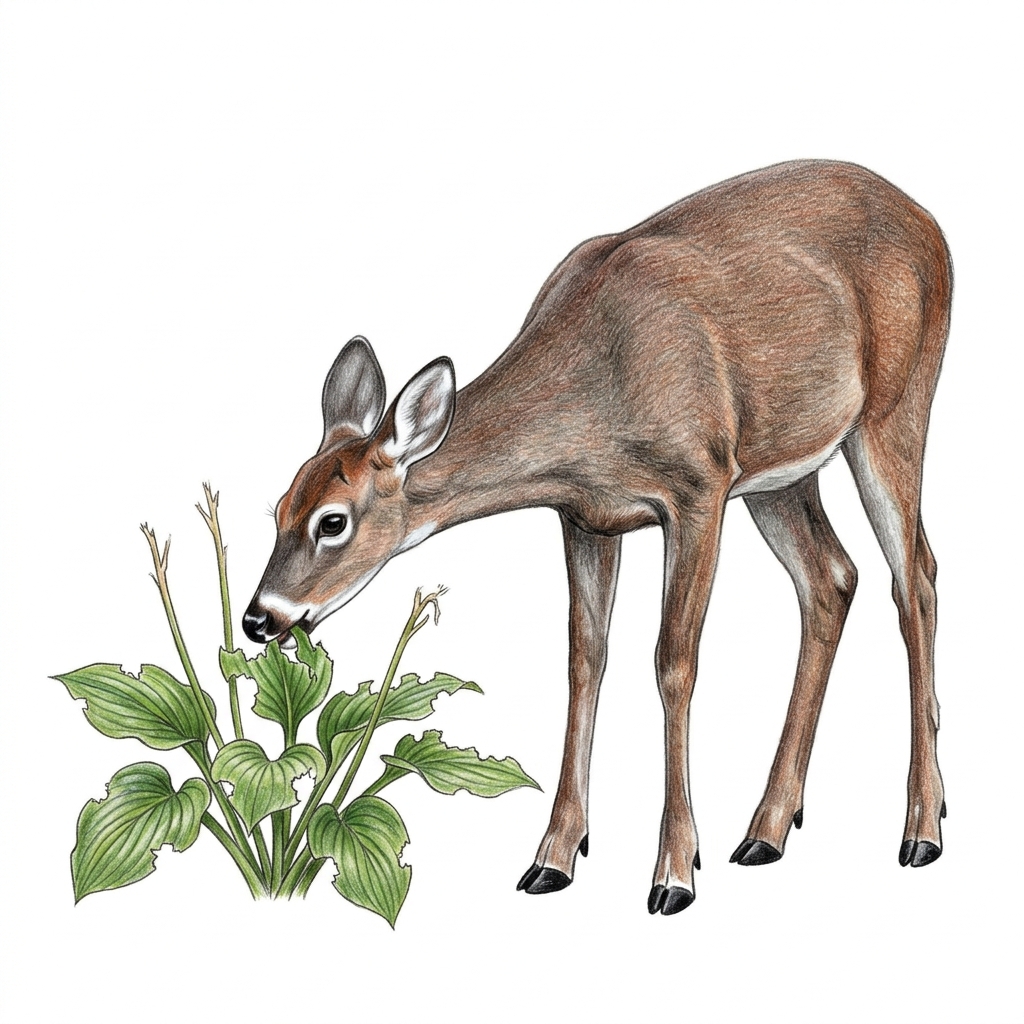
Illustration
Deer feed mostly from dusk to dawn, tearing leaves, shoots, buds and flowers from shrubs, bulbs, roses, vegetables and young trees, and males rub the bark off saplings with their antlers. No plant is deer-proof and scarers soon stop working: a well-built fence is the only sure protection, with tree guards, netting and repellents for smaller jobs.
How to spot it
- Leaves, shoots and buds torn off, leaving ragged, shredded ends: deer have no upper front teeth, so they tear plants rather than cut them.
- Damage high up as well as low down: North American deer browse up to about 1.8 m (6 ft). In the UK, muntjac reach about 1 m (3 ft) and red deer about 1.5 m (5 ft).
- Split hoof prints, pointed at the front (about 5 to 8 cm, or 2 to 3 in, long for North American deer), narrow trails, and droppings like jellybeans, in piles.
- Young trees with the bark rubbed raw from mid-summer, usually about 45 cm to 1.1 m (1½ to 3½ ft) above the ground, where males rub their antlers; bark may also be eaten in winter.
- Whole plants stripped overnight. Favourites include hostas, tulips, daylilies, roses, yews, strawberries, beans, lettuce and young fruit trees.
Easily confused with
Rabbits
Cut stems cleanly at a sharp angle, about 45 degrees, and only low down; deer leave torn, ragged ends and can feed up to about 1.8 m (6 ft) high.
Possums
Climb at night to strip shoots and fruit high in trees, leaving scratch marks on the bark; deer can't climb, and leave split hoof prints and piles of pellets on the ground.
Slugs and snails
Ragged holes low on the plant with silvery slime trails, rather than whole shoots, buds and flowers torn off.
Where it's a problem
- United States: White-tailed deer live in almost every state except Alaska and Hawaii; mule deer, including black-tailed deer, live mainly in the West, where a fence 2.1 to 2.4 m (7 to 8 ft) high is advised, and taller on slopes. Deer are protected outside legal hunting seasons. Where damage is severe, states can issue a permit to remove problem deer, but that starts with your state wildlife agency: in California, for example, a permit is needed and traps and poisons are illegal.
- United Kingdom: Roe deer and muntjac are the deer most often seen in gardens, and both are spreading; fallow and sika deer visit gardens in some areas. Of England's six wild deer, only red and roe are native, and muntjac are good at getting through fences, so the mesh must be small. In England, the Deer Act 1991 sets close seasons, and shooting a deer in the close season or at night needs a licence. In a garden, the answer is a well-built fence.
- Australia: Deer were brought in during the 1800s, and fallow, red, chital, rusa and sambar deer now run wild. In New South Wales they are a pest in most regions and browse garden plants such as roses and saplings; every landholder has a General Biosecurity Duty to reduce the risk they pose. In Victoria, deer occupy around 37% of the state, and are unprotected on private land but protected as game on public land. Rules differ between states, so check with your state agency or council, and report sightings on FeralScan.
- Tasmania: Fallow deer are the only wild deer, first brought from England in 1836, and now occupy at least 27% of the state, including some areas on the edges of towns, where the state aims to remove them with its own specialist staff. Tasmania's rules differ from the mainland's: fallow deer are partly protected wildlife, and may only be taken under a hunting licence or a permit, such as a Property Protection Permit from Game Services Tasmania, which an owner or manager holds to protect stock, crops or infrastructure. In a garden, protect your plants with fences, guards and netting, and ask Game Services Tasmania for advice.
- New Zealand: Seven species of deer live wild, descended from animals released from 1851. With no natural predators, they strip native forest, and near the bush they come into gardens. Releasing deer into the wild without a Department of Conservation permit is illegal. Regional councils treat feral deer as a pest in parts of the country, so ask yours what applies where you live.
How to protect your plants
- Put protection up before you plant, or at the first sign of damage: once deer have found a crop, they are harder to keep away.
- A fence is the only sure protection. In North America, make it at least 2.4 m (8 ft) high; in the UK, 1.5 m (5 ft) where only muntjac visit and 1.8 m (6 ft) for other deer. Use strong mesh, not chicken wire or light plastic, small enough that a head can't fit through: about 7.5 cm (3 in) for muntjac. Peg or bury the bottom, as roe and muntjac squeeze under gaps of 15 cm (6 in), and make gates as tall as the fence and keep them shut.
- A small bed needs less: a solid 1.8 m (6 ft) fence around an area under about 3 x 3 m (10 x 10 ft) is unlikely to be jumped.
- Or build a double fence: two fences about 1.2 to 1.5 m (4 to 5 ft) apart. Deer can't judge the depth of the jump, so they don't try. A slanted fence, with wires leaning outward at about 45 degrees and the top farthest from the plants, works the same way and needn't be as tall.
- Electric fencing gives mixed results. A temporary electric tape around a vegetable patch for the season can work, especially with peanut butter on foil tabs, so deer touch it with their noses and learn to stay away; ordinary livestock electric fences often fail. Run it only from a proper fence energiser, never straight from mains power, and keep weeds off the wire.
- Protect young trees with a cage: three or four stakes around the trunk, wrapped in strong wire netting at least 1.2 m (4 ft) high (taller where red or fallow deer live), far enough out that a deer can't reach through. Have it in place by mid-summer, when males start rubbing their antlers, until the trunk is about 8 to 10 cm (3 to 4 in) thick.
- Cover single plants, small clumps of flowers and new plantings with netting or a wire cage until they are established. Deer will eat anything that pokes out, but it cuts damage a great deal.
- Repellents help for a while, at best. Start before damage does, reapply after rain, heavy dew or watering and on new growth, and switch between types now and then, as deer get used to them. They fail when deer are hungry or numerous, and home remedies such as hair or soap last a few days, if at all.
- Scarers such as noisemakers, lights and ultrasonic devices stop working within days to a few weeks. Motion-triggered sprinklers work better for some gardeners, and deer avoid dogs, though they learn where a dog can't reach.
- Grow plants deer tend to leave alone, such as daffodils, lavender, rosemary, foxgloves, hellebores, peonies, barberry and box. Keep their favourites close to the house, where people are about, and away from woodland edges. No plant is deer-proof: hungry deer eat almost anything, and a plant left alone in one garden can be a favourite in the next.
- Never feed deer. If one is trapped inside your fence, don't try to chase it out: it is likely to panic and hurt itself.
If you use a deer repellent, follow the label and local rules: many must not be used on food crops. Trapping, poisoning or killing deer is controlled by law in every country, so check your state or local rules before doing anything beyond fences, guards and repellents.
Take care: Deer carry ticks. In the United States the blacklegged tick, also called the deer tick, spreads Lyme disease, and in England more deer can mean more ticks, which can carry it. After working in a garden that deer visit, check yourself, your clothes and your pets for ticks.
Free account, no card needed. You sign up or sign in first, then the scanner opens.
Sources (21, from RHS, British Deer Society, University of California IPM and others)
- RHS: Deer · Deer-resistant plants
- British Deer Society: How do I protect my garden from deer
- University of California IPM: Deer
- NYS DEC and Cornell Cooperative Extension: White-tailed deer
- Iowa State University Extension: How to protect gardens from deer
- University of Illinois Extension: Keeping deer out of the yard and garden
- Montana State University Extension: Minimizing deer damage to residential plantings
- Rutgers Cooperative Extension: Landscape plants rated by deer resistance
- Clemson HGIC: Deer management for home gardeners using a two-tiered fence system
- LSU AgCenter: Preventing deer damage in the garden
- Internet Center for Wildlife Damage Management: Deer
- CDC: Preventing Lyme disease
- GOV.UK: Deer impacts policy statement for England · Hunting and shooting wildlife: mammals
- NSW Government: Feral deer control
- Yarra Ranges Council (Victoria): Deer
- Department of Conservation (NZ): Deer
- Hawke's Bay Regional Council: Feral deer
- Tasmania NRE: Tasmanian Wild Fallow Deer Management Plan 2022-27 · Property Protection Permits
Facts checked Friday 13 November 2026. General guidance only: follow your local council, agency and product label.