Home › Garden pests › Vine weevil
Garden pests
Vine weevil
Otiorhynchus sulcatus · Insect
Also called black vine weevil (USA and Canada).
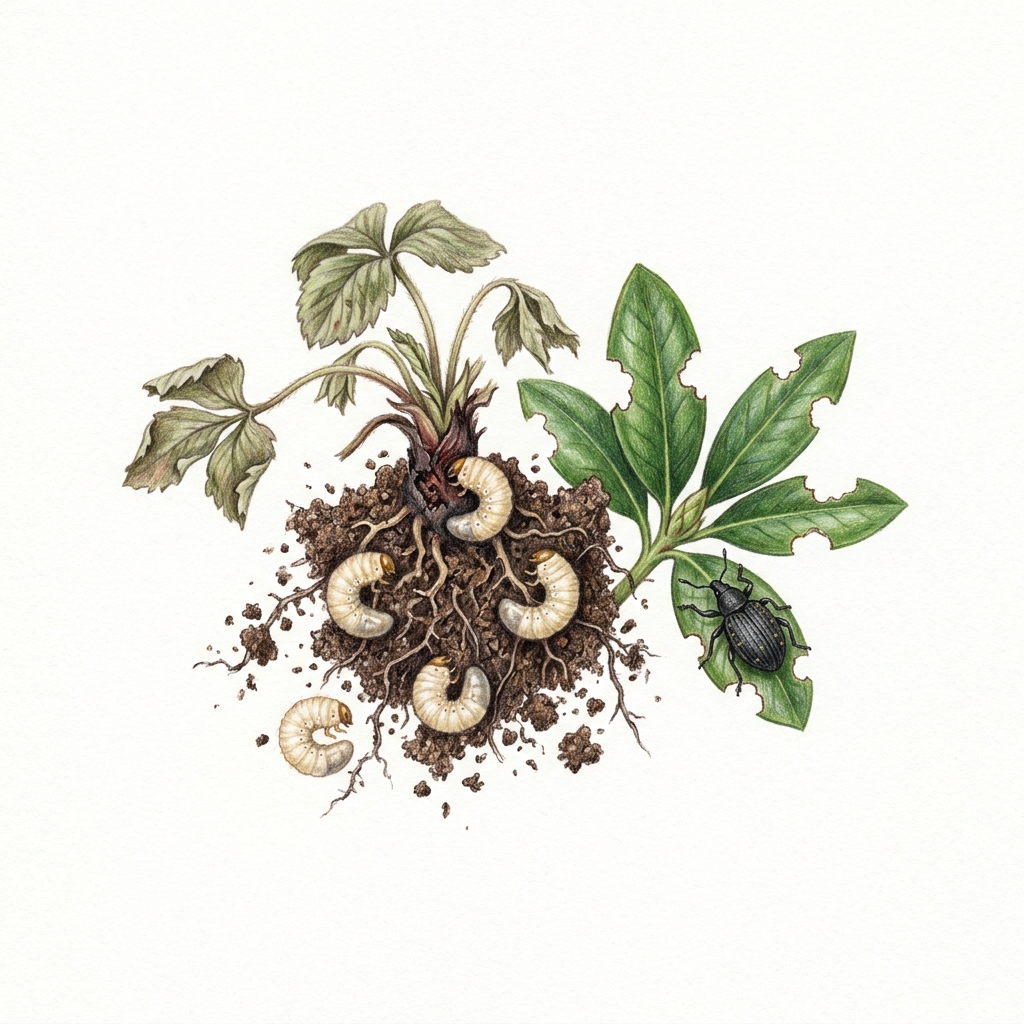
Illustration
A flightless black weevil whose adults notch leaf edges at night, while its white C-shaped grubs eat the roots of strawberries and pot plants, so they wilt and die, mostly from autumn to spring. Pick off adults by torchlight and, in late summer, water the soil with the tiny nematodes that attack the grubs.
How to spot it
- Irregular notches chewed from the leaf edges, most obvious on thick evergreen leaves such as rhododendron, and on strawberries.
- Plants, especially in pots, that wilt and die, mostly from September to March in the UK.
- Plump, white, legless grubs up to 10 mm (⅜ in) long, curled in a C, with a pale brown head, among the roots and in the potting mix.
- Roots eaten away, and grubs boring into strawberry crowns, cyclamen and begonia tubers and the stem bases of cacti and succulents.
- The adult: a dull black, pear-shaped weevil about 9 mm (⅜ in) long, with faint yellow flecks on the wing cases and a short, broad snout. It can't fly and feeds after dark.
Easily confused with
Chafer grubs (lawn grubs)
Also white and curled in a C, but with three pairs of legs near the brown head; vine weevil grubs have no legs.
Garden weevil
Smaller, about 5–6 mm (¼ in), greyish-brown, with a pale V-shaped band across the rear. A pest of vines, fruit and ornamentals in Australia and New Zealand.
Fungus gnats
Their larvae in potting mix are slender, see-through and up to 6 mm long, with a shiny black head, not plump white C-shaped grubs.
Where it's a problem
- Worldwide: Found across Europe and North America, and also in South America, Japan, Australia and New Zealand.
- United Kingdom: Very widespread. Adults are about from spring to late summer, grubs feed from summer to spring, and most plants are lost between September and March. Numbers can rebuild after seeming to disappear.
- North America: Called black vine weevil; widespread in the United States and more local in Canada. Adults come out in spring and feed for several weeks before laying eggs, doing most leaf damage in summer and early autumn.
- Australia: Present, but limited in where it is found, including Tasmania. The garden weevil, found in most southern states, does similar damage.
- New Zealand: Widespread.
What to do
- Tolerate light notching of leaves: it's the grubs that kill plants.
- On mild spring and summer evenings, search plants by torchlight and pick off the adults, or shake shrubs over an upturned umbrella or sheet.
- In greenhouses, look under pots and staging by day, and put sticky barriers around pots or on staging.
- Check the roots of new plants for grubs before you plant them.
- In late summer (August or early September in the UK), water the soil or potting mix with the nematodes that attack the grubs. They need moist soil at about 5–20°C (41–68°F), depending on the kind, and work best in light soil and open potting mix. Use them only where you have the problem, as they can infect other soil animals.
- Repot wilting pot plants, removing as many grubs as you can from the roots and mix.
- Encourage birds, frogs, toads, hedgehogs and ground and rove beetles.
If you use an insecticide, choose one labelled for vine weevil and follow the label and local rules.
Vegetables it affects
Free account, no card needed. You sign up or sign in first, then the scanner opens.
Sources (4, from RHS, University of California IPM, EPPO Global Database and others)
- RHS: Vine weevil
- University of California IPM: Black vine weevil
- EPPO Global Database: Otiorhynchus sulcatus, distribution
- EPPO Alert List: Phlyctinus callosus (garden weevil)
Facts checked Wednesday 28 October 2026. General guidance only: follow your local council, agency and product label.