Home › Garden pests › Fungus gnats
Garden pests
Fungus gnats
Bradysia, Sciara and related species (Sciaridae) · Insect
Also called sciarid flies (UK).
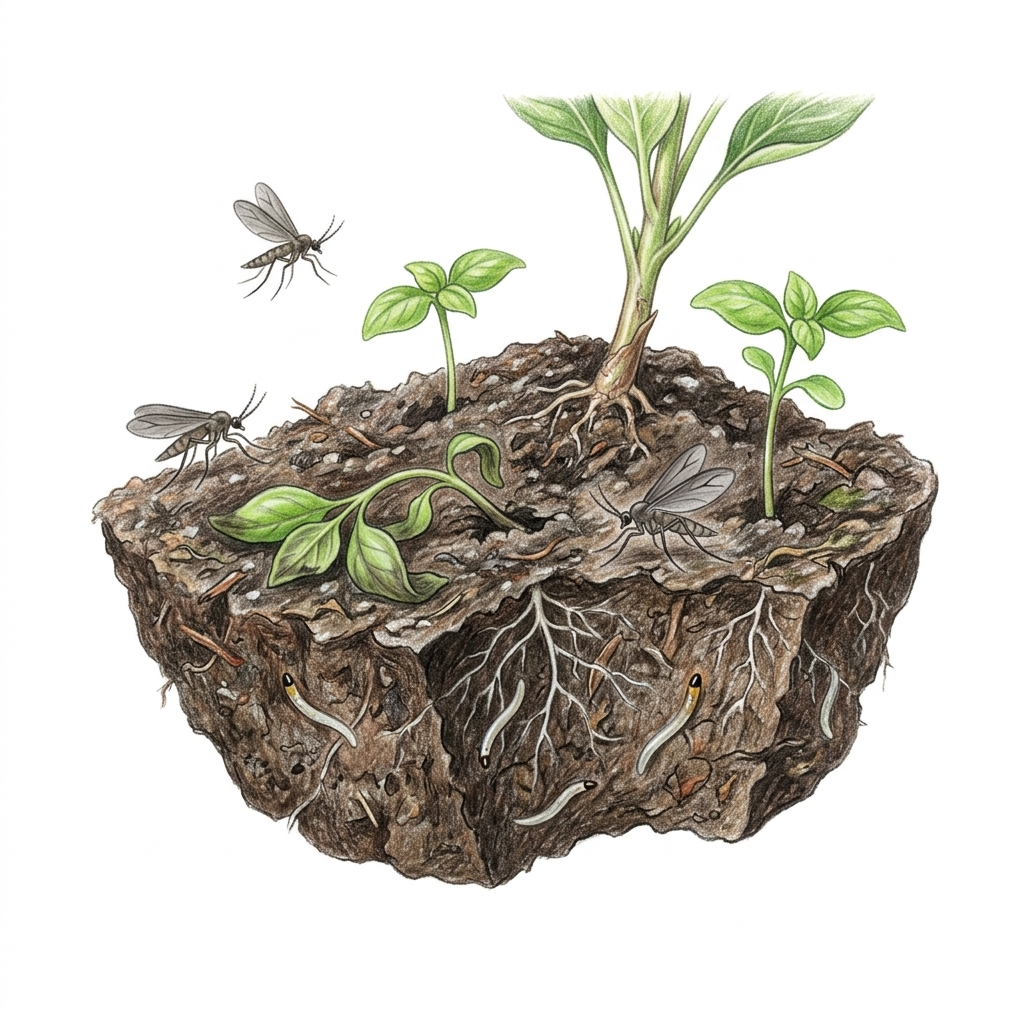
Illustration
Tiny dark flies that run over damp potting mix and drift around houseplants. The adults are harmless; their black-headed larvae live in wet mix and can damage seedlings and cuttings. Letting the top of the mix dry out is the key fix.
How to spot it
- Tiny, delicate, dark grey-brown flies about 3 mm long, like small mosquitoes, with long legs and antennae.
- Flies running over the surface of pots and seed trays, or flying slowly around plants, lamps and windows.
- Slender, see-through whitish maggots up to 6 mm long with shiny black heads in the top of the mix.
- Seedlings and soft cuttings that collapse; established plants are rarely harmed.
Easily confused with
Shore flies
Stouter, strong-flying flies with short antennae and five pale spots on their dark wings.
Fruit flies (vinegar flies)
Fungus gnats have a Y-shaped fork of veins near the wing tip, and ignore the vinegar traps that catch fruit flies.
Whitefly
Look like tiny white moths and leave sticky honeydew on leaves; fungus gnats are dark grey-black.
Where it's a problem
- Worldwide: Common wherever plants grow in damp potting mix, especially houseplants, seedlings and greenhouses. Indoors they breed all year round.
- United Kingdom: More than 250 kinds live in Britain. Most feed on rotting plant matter and are harmless; only a few breed in large numbers in damp compost.
What to do
- Check for larvae by pressing slices of raw potato into the mix and looking underneath after a few days.
- Let the top 2 to 5 cm of mix dry out between waterings, or water from below, and make sure pots drain well.
- Cover the surface with a 1 to 2.5 cm layer of coarse sand or fine gravel.
- Hang yellow sticky traps near the plants to catch adults (they catch other insects too).
- Repot badly affected plants into fresh potting mix, and don't use compost that isn't fully rotted.
- Biological controls, such as nematodes or predatory mites added to the mix, are available for the larvae.
If you use an insecticide, choose one labelled for fungus gnats and follow the label and local rules. Sources say the most important step is letting the potting mix dry between waterings.
Free account, no card needed. You sign up or sign in first, then the scanner opens.
Sources
- RHS: Fungus gnats (sciarid flies)
- University of California IPM: Fungus gnats
- Colorado State University Extension: Fungus gnats as houseplant and indoor pests
- University of Wisconsin: Fungus gnats on houseplants
- University of Wisconsin: Fungus gnats and shore flies in greenhouses
- University of Maryland Extension: Fungus gnats
- University of Maryland Extension: Indoor plant insects
Facts checked Sunday 27 September 2026. General guidance only: follow your local council, agency and product label.