Home › Garden pests › Pea and bean weevil
Garden pests
Pea and bean weevil
Sitona lineatus · Insect
Also called pea leaf weevil (USA and Canada).
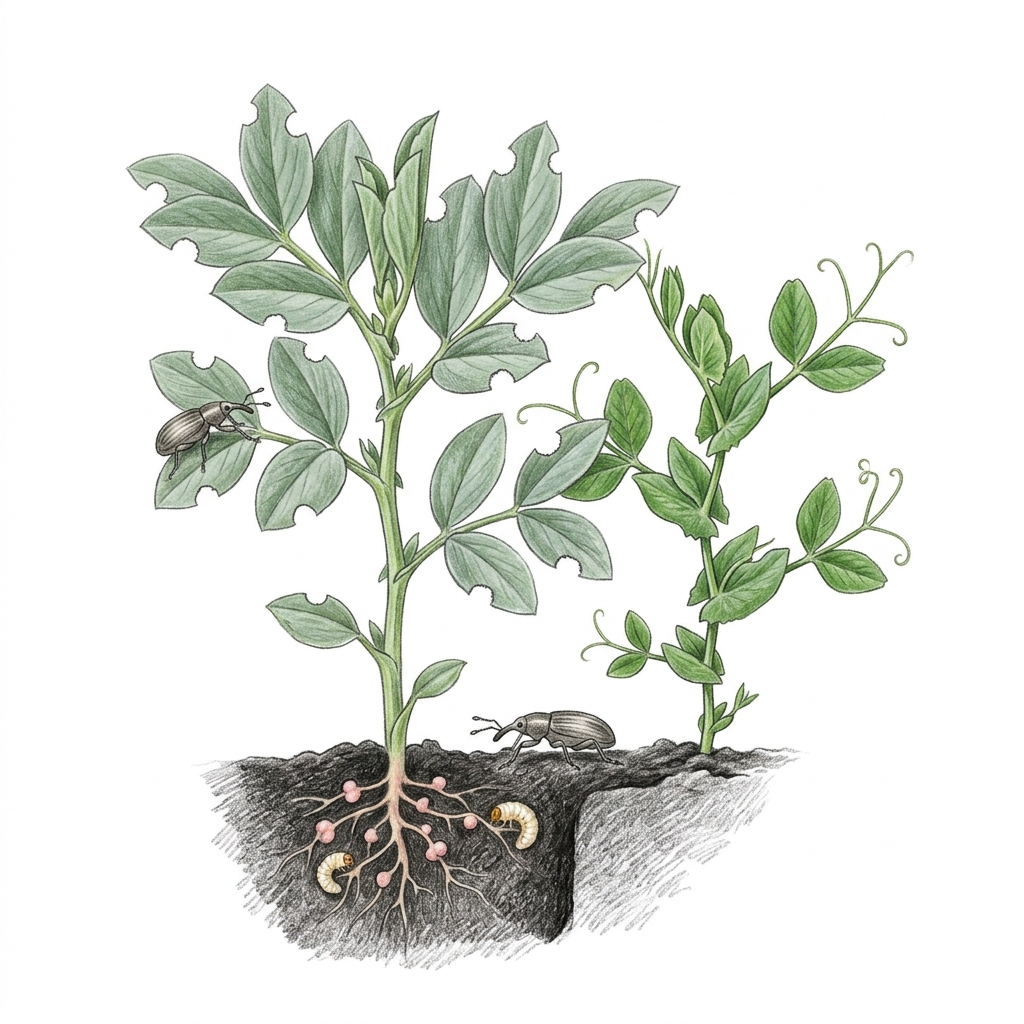
Illustration
A small grey-brown weevil that eats neat U-shaped notches around the leaf edges of broad beans and peas, while its grubs feed unseen on the root nodules. Established plants shrug it off, so control is usually not needed: keep seedlings watered and growing fast, under fleece if needed, so they outgrow the damage.
How to spot it
- Neat U-shaped notches, like little bites, all around the edges of broad bean and pea leaves.
- Most notching on seedlings and young plants in spring and early summer (April to July in the UK).
- Slender, greyish-brown weevils 4–5 mm (about 3/16 in) long, with a short snout and three faint pale stripes down the front part of the body.
- Weevils that drop to the ground when disturbed, so the notches are easier to find than the weevils.
- Grubs in the soil: creamy-white, legless and C-shaped, with a pale brown head, feeding on the root nodules.
Easily confused with
Sitona weevil (Sitona discoideus)
A close relative in Australia and New Zealand that notches leaf edges the same way, mainly on lucerne, clover and medic pastures.
Vine weevil
Bigger, about 9 mm (⅜ in), dull black with faint yellow flecks, and notches the leaves of strawberries, rhododendrons and pot plants rather than peas and beans.
Slugs and snails
Ragged holes anywhere on the leaf, not just neat notches at the edge, with silvery slime trails.
Where it's a problem
- United Kingdom: Common on broad beans and peas. Adults feed from April to July, lay eggs in the soil in late spring, and the new adults appear in late summer. There is one generation a year.
- North America: Called pea leaf weevil. A pest of peas and faba (broad) beans in the Pacific Northwest and on the Canadian Prairies, where it is monitored each year. Adults start feeding from mid-March on the coast and mid-April to early May inland.
- Australia: Our sources record it in Europe and North America, not in Australia. Its relative the sitona weevil notches lucerne, clover and medic pastures in the same way, and is a major pest in South Australia.
What to do
- Usually leave it: leaf loss is small even when the leaves look heavily nibbled, and established plants crop normally.
- Keep seedlings well watered and growing strongly, so they get through the vulnerable stage quickly. Cold, dry spells in spring hold back growth more than the weevils do.
- Cover early sowings with fleece or cloches to help them outgrow the damage.
- Grow peas and beans away from other legumes such as clover and lucerne, and in a different bed each year.
If you use an insecticide, choose one labelled for pea and bean weevil and follow the label and local rules. Sources say control is usually unnecessary, because plants tolerate the damage.
Vegetables it affects
Free account, no card needed. You sign up or sign in first, then the scanner opens.
Sources (5, from RHS, PNW Insect Management Handbook, Prairie Pest Monitoring Network and others)
- RHS: Pea and bean weevil · Vine weevil
- PNW Insect Management Handbook: Pea, green and dry, pea leaf weevil
- Prairie Pest Monitoring Network: Pea leaf weevil
- Cesar Australia: Sitona weevil
Facts checked Wednesday 28 October 2026. General guidance only: follow your local council, agency and product label.