Home › Garden pests › Mexican bean beetle
Garden pests
Mexican bean beetle
Epilachna varivestis · Insect
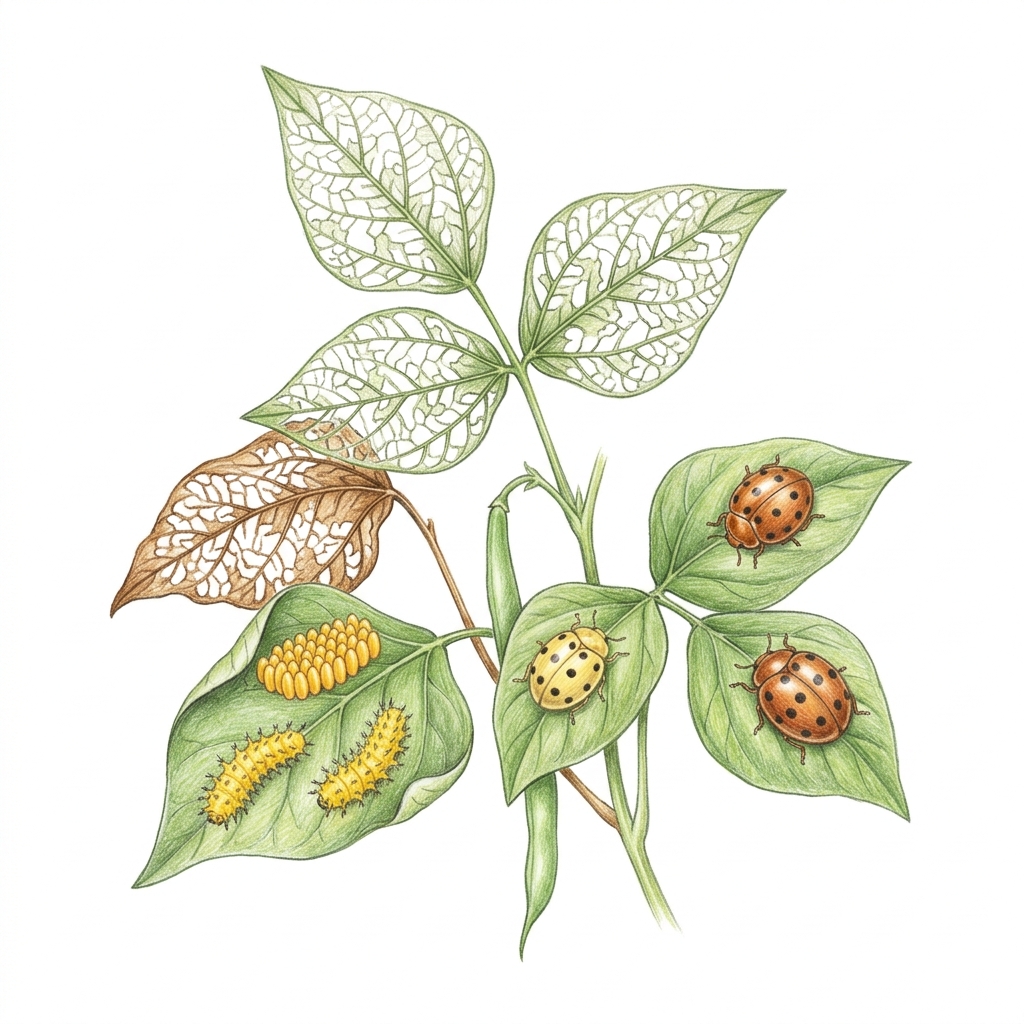
Illustration
A copper-coloured relative of the ladybird, with 16 black spots, whose adults and spiny yellow larvae eat bean leaves from underneath until only a lacy skeleton is left. Check under the leaves and squash eggs, larvae and beetles, cover young beans with row cover, and grow early beans that crop before numbers peak.
How to spot it
- Domed beetles about 6–8 mm (¼–⅓ in) long, yellow when young and coppery brown later, with 16 black spots in three rows (eight on each wing cover).
- Bright yellow larvae up to about 8 mm (⅓ in) long, covered in branched spines with black tips, feeding under the leaves.
- Clusters of 40 to 60 yellow-orange eggs on the undersides of leaves.
- Leaves eaten from underneath to a lace-like skeleton, which dries and turns brown.
- In heavy attacks, pods, stems and flowers are eaten too, and plants can be stripped bare.
Easily confused with
Ladybirds (lady beetles)
Helpful predators of a similar size and shape. In the Mexican bean beetle the head and the plate behind it are the same yellowish colour as the wing covers, and it sits feeding on beans.
Squash beetle
A close relative of similar colour in North America that feeds on squash, pumpkins and other cucurbits rather than beans.
Cucumber beetles
Slimmer, with a black head and long antennae; the spotted one is yellow-green with 12 black spots and chews holes rather than lacy windows.
Spider mites
Leaves fade to a pale speckle and may carry fine webbing, but there are no holes and no beetles or spiny larvae.
Where it's a problem
- North America: Native to Mexico. It reached Alabama in 1918 and spread up the east coast; it is most common in the eastern states, sparse in the Rockies and Great Plains, and uncommon on the Pacific coast. In Canada it is found in parts of Ontario, Québec and New Brunswick. There are one to three generations a year, usually two in the north-east.
- Australia and New Zealand: International pest records list it only in the Americas and a small part of Japan, with no record in Australia or New Zealand. Report an unfamiliar beetle eating beans to the Exotic Plant Pest Hotline on 1800 084 881 (Australia) or MPI on 0800 80 99 66 (New Zealand).
- United Kingdom and Europe: Not recorded. Report an unfamiliar pest to your national plant health authority.
What to do
- From early summer, check under the bean leaves for yellow egg clusters, spiny larvae and beetles.
- Pick off and squash beetles and larvae, and crush the egg clusters: in a small plot this is practical, as they are easy to see.
- Cover young beans with row cover to keep the beetles off.
- Sow early-maturing beans as early as you can, so they crop before the beetles peak in mid to late summer.
- In the United States, a small parasitic wasp sold for the purpose can be released when the larvae first appear. It can't survive cold winters, so it has to be released each year.
- Expect some leaf damage: snap beans can usually lose about a fifth of their leaves before the crop suffers.
In Australia and New Zealand, report a suspected find rather than treating it. Elsewhere, if you use an insecticide, choose one labelled for Mexican bean beetle and follow the label and local rules.
Vegetables it affects
Free account, no card needed. You sign up or sign in first, then the scanner opens.
Sources (6, from Cornell University IPM, Virginia Cooperative Extension, Utah State University Extension and others)
- Cornell University IPM: Mexican bean beetle
- Virginia Cooperative Extension: Mexican bean beetle (ENTO-51NP)
- Utah State University Extension: Mexican bean beetle
- EPPO Global Database: Epilachna varivestis, distribution
- Australian Government DAFF: Report a pest or disease concern
- MPI: Report a pest or disease
Facts checked Wednesday 28 October 2026. General guidance only: follow your local council, agency and product label.