Home › Garden pests › Leek moth
Garden pests
Leek moth
Acrolepiopsis assectella · Insect
Illustration
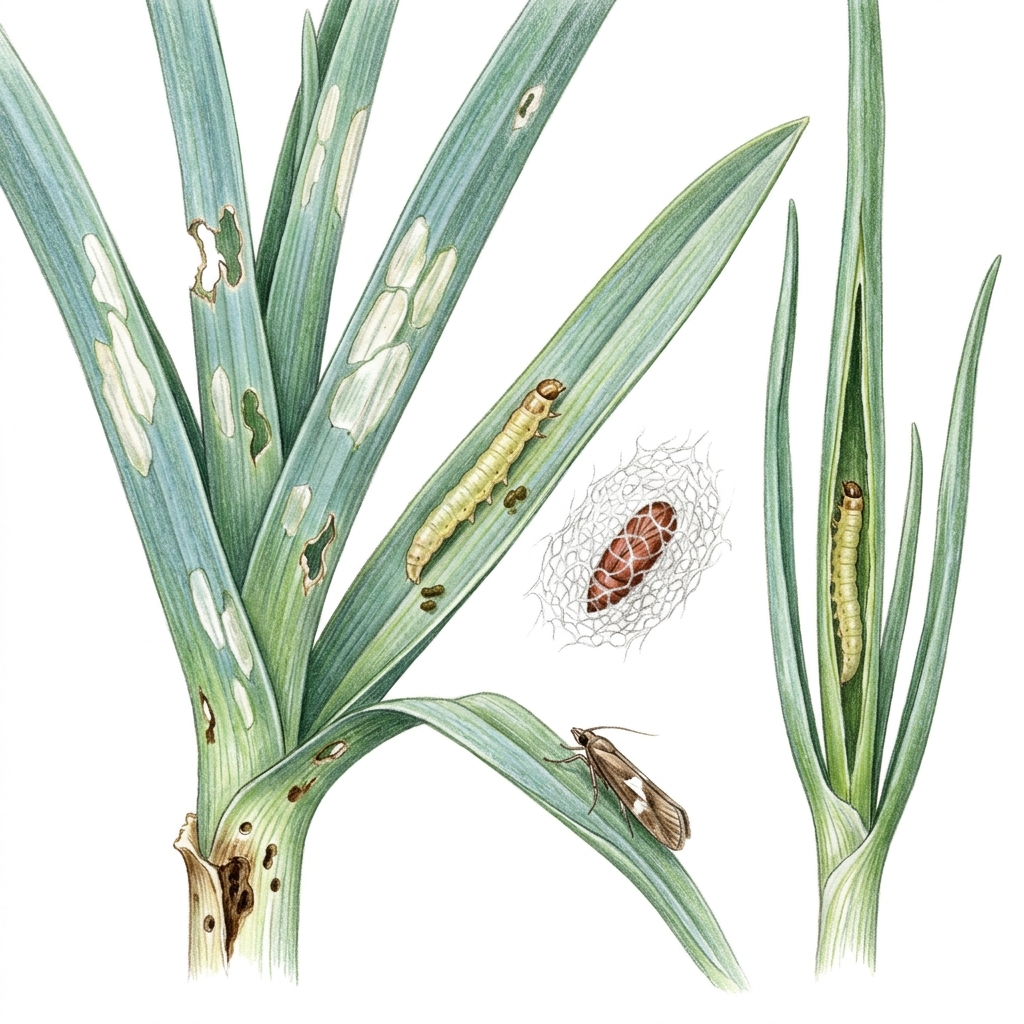
A small brown moth whose caterpillars mine the leaves of leeks, onions and garlic and then bore into the stems and bulbs, leaving white patches, holes and rotting plants. Cover alliums with fine insect mesh all season and rotate beds; it has not been recorded in Australia or New Zealand, where a suspected find should be reported.
How to spot it
- White, see-through 'windowpane' patches on the leaves, where caterpillars have eaten the inside and left the skin.
- Small holes and tunnels in leek stems and in onion, shallot and garlic bulbs; young leeks may die, and damaged plants can rot.
- In hollow onion and chive leaves, caterpillars feeding inside: split a damaged leaf to find them, or their droppings (frass).
- Slender, creamy-yellow to yellowish-green caterpillars with a brown head and small legs, up to 11–14 mm (about ½ in) long.
- White, loose, net-like silk cocoons on the leaves, each holding a reddish-brown pupa.
- The adult: a small brown moth about 15 mm (⅝ in) across the wings, with a white triangle in the middle of its back at rest. It flies at night.
Easily confused with
Allium leaf miner
Starts with a neat line of tiny white dots near the leaf tip, and its maggots have no head and no legs. They pupate inside the stem or bulb as brown cylinders about 3 mm (⅛ in) long, not in net cocoons on the leaves.
Onion fly
Legless white maggots that eat the roots and bore into the bulb from below; outer leaves yellow and wilt, but aren't mined.
Thrips
Silvery flecks dotted with tiny black specks, scattered over the leaf, and no caterpillars inside.
Where it's a problem
- Europe: Found across most of Europe, from Portugal and Spain to Scandinavia and Russia. It has done considerable damage in continental Europe, particularly to leeks.
- United Kingdom: Mainly in southern England, but spreading north, and seen less often than allium leaf miner. There are two generations a year: caterpillars feed in May and June and again from August to October, and the second is the bigger.
- Canada: First found near Ottawa in 1993, and now in Ontario, Quebec, New Brunswick and Prince Edward Island.
- United States: First found in 2009 at Plattsburgh, New York, and now in northern New York and Vermont.
- Australia and New Zealand: Our sources record it in Europe, parts of Asia, North Africa and North America, not in Australia or New Zealand. New Zealand's Ministry for Primary Industries lists it as an unwanted organism. Report a suspected find to the Exotic Plant Pest Hotline on 1800 084 881 in Australia, or to MPI's exotic pest and disease hotline on 0800 80 99 66 in New Zealand.
What to do
- Cover leeks, onions and garlic with fine insect-proof mesh before the moths are about, and keep it on all season, with the edges buried at least 5 cm (2 in). Standard 1.3 mm mesh doesn't reliably keep them out.
- Grow alliums in a different bed each year, so moths can't build up under the mesh.
- Check leaves for white windowpane patches; split damaged leaves and pick out the caterpillars.
- Look for the white, net-like cocoons on the leaves and squash them.
- When you lift garlic and onions, cut off the leafy tops before drying them, so caterpillars stay behind in the garden instead of reaching the bulbs in storage.
- Clear away old allium plants and debris at the end of the season, where adults shelter over winter.
- Encourage ground and rove beetles, which eat some of the pupae.
In Australia and New Zealand, report it rather than treating it. Elsewhere, if you use an insecticide, choose one labelled for leek moth and follow the label and local rules.
Vegetables it affects
Free account, no card needed. You sign up or sign in first, then the scanner opens.
Sources (6, from RHS, Canadian Food Inspection Agency, University of Vermont and Cornell (SARE) and others)
- RHS: Leek moth · Insect-proof mesh
- Canadian Food Inspection Agency: Leek moth fact sheet
- University of Vermont and Cornell (SARE): Leek moth identification and management
- EPPO Global Database: Acrolepiopsis assectella, distribution
- MPI Official New Zealand Pest Register: Leek moth
Facts checked Wednesday 28 October 2026. General guidance only: follow your local council, agency and product label.