Home › Garden pests › Capsid bugs
Garden pests
Capsid bugs
Miridae, including Lygocoris pabulinus, Lygus rugulipennis, Lygus lineolaris and Creontiades dilutus · Insect
Also called common green capsid, tarnished plant bug or bishop bug, apple capsid (UK), plant bugs, lygus bugs, tarnished plant bug (Lygus lineolaris) (USA and Canada), mirids, green mirid (Creontiades dilutus) (Australia).
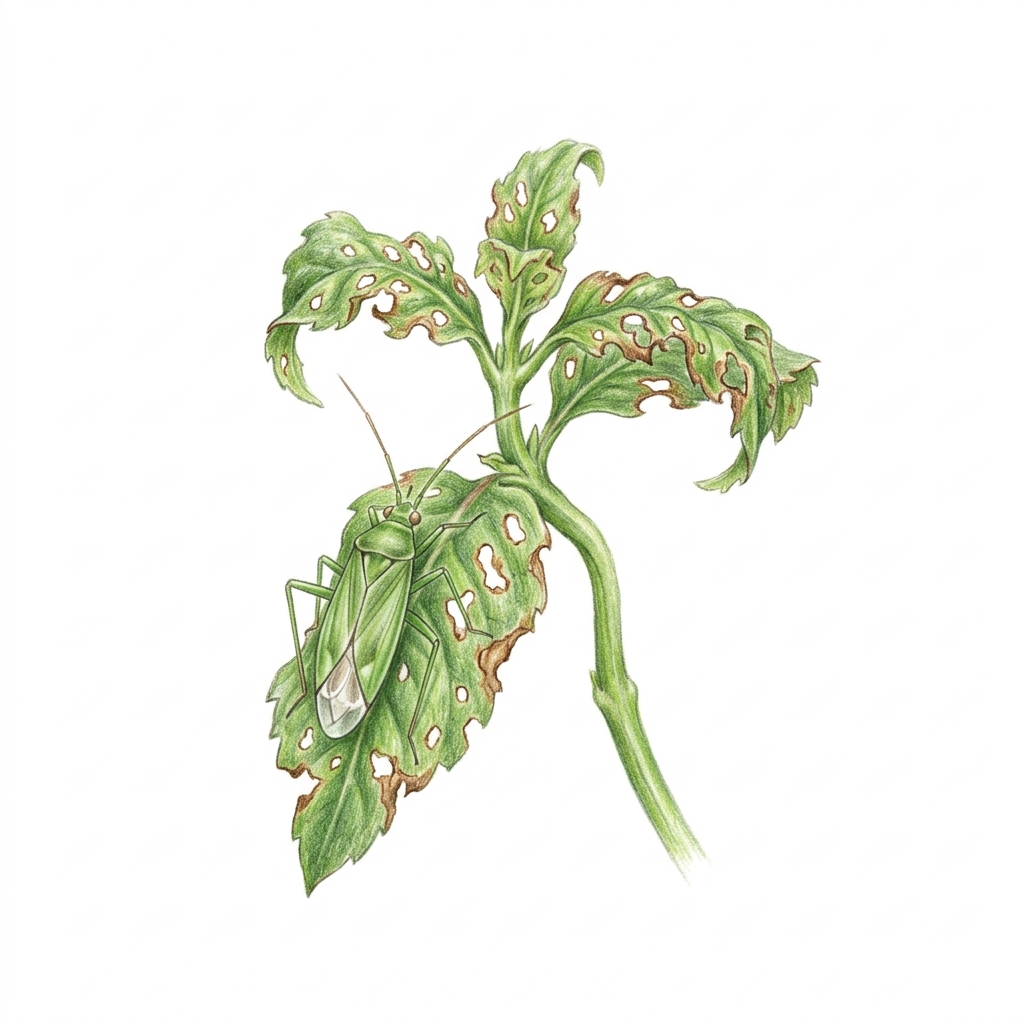
Illustration
Small green or brown sap-sucking bugs whose feeding leaves young leaves tattered and puckered with small brown-edged holes, and stops flower buds opening. Plants usually grow out of it, so tolerate the damage, clear weeds and dead growth where the bugs shelter, and leave birds and predatory insects to keep them down.
How to spot it
- Small holes with brown edges in the young leaves near the shoot tips, which grow on tattered, puckered and misshapen.
- Flower buds that fail to open, notably on fuchsias, and daisy-like flowers such as dahlias and chrysanthemums that open lopsided.
- Raised bumps or corky patches on the skin of apples; these are only skin-deep and the fruit still eats and keeps well.
- Mostly in North America, deformed strawberries (catfacing), which are still edible, and shrivelled or crumbly raspberries.
- The bugs themselves: green or brown, up to about 6 mm (¼ in) long, or 7–9 mm (¼–⅓ in) for Australia's green mirid, with a clear diamond-shaped patch at the rear of the folded wings, and wingless, pale green young.
- Damage seen from late spring to late summer (May to early September in the UK), often after the bugs have gone.
Easily confused with
Slugs and snails
Bigger, ragged holes anywhere on the leaf, with silvery slime trails; capsid holes are small, brown-edged and on the youngest leaves at the shoot tips.
Aphids
Their young look much like capsid young, but aphids hold their antennae back and have two small 'tailpipes' at the rear. Young capsids hold red-tipped antennae forward and move more quickly.
Leafhoppers
A coarse, pale mottling on the leaves of sage, rosemary and other herbs, not holes, and the small wedge-shaped insects jump when disturbed.
Where it's a problem
- Worldwide: A large family of true bugs, also called mirids or plant bugs. Some kinds feed on plants, and some hunt other insects.
- United Kingdom and Europe: The common green capsid and the tarnished plant bug damage fuchsias, dahlias, roses, hydrangeas and chrysanthemums, and the apple capsid marks apples and pears. The RHS says vegetables don't need treating, and on sage capsid bugs seldom cause serious problems, so control isn't needed.
- United States and Canada: Lygus bugs are the main ones: the tarnished plant bug, and in California mostly the western tarnished plant bug. They feed on the buds, shoots and young fruit of many fruit and vegetable plants, deforming strawberries and raspberries and stopping saskatoon fruit from forming, and the adults spend the winter in plant debris and weedy ground. Damage comes and goes from year to year, and is often worse after a wet winter that suits the weeds they breed on.
- Australia: The green mirid is a native bug, pale green and about 7–9 mm (¼–⅓ in) long, found in every state and territory and most common in Queensland and northern New South Wales. It is mainly a pest of cotton and of bean crops such as mungbeans and soybeans, and also feeds on weeds and some fruit and vegetable crops. Large numbers can fly in from inland, mostly in spring and summer.
What to do
- Look closely at shoot tips and flower buds from late spring. The bugs are small and often gone by the time the damage shows.
- Tolerate the damage where you can: plants usually grow out of it, and the marks on apples are only skin-deep.
- Clear weeds in and around the garden over winter and spring, where the bugs breed. As weeds dry off in summer, the bugs move onto watered garden plants.
- In late winter, clear dead stems and plant debris where the adults spend the winter.
- Where they have damaged vegetables or soft fruit before, cover the plants with fine mesh or row cover, held clear of the leaves.
- Leave birds, ground beetles, spiders, damsel bugs, big-eyed bugs and parasitic wasps to help keep numbers down.
- If apple capsid marks your apples every year, choose a less prone variety when you replant; Charles Ross, Allington Pippin and Edward VII can be heavily marked.
If you use an insecticide, choose one labelled for capsid bugs and follow the label and local rules. UC IPM recommends no insecticides for lygus bugs in gardens, and the RHS notes the damage is often seen too late to control.
Vegetables it affects
Free account, no card needed. You sign up or sign in first, then the scanner opens.
Sources (6, from RHS, University of California IPM, University of Saskatchewan Gardening and others)
- RHS: Capsid bugs · How to grow sage
- University of California IPM: Lygus bugs
- University of Saskatchewan Gardening: Tarnished plant bug
- Cesar Australia: Green mirids
- Business Queensland: Mirids
Facts checked Friday 30 October 2026. General guidance only: follow your local council, agency and product label.