Home › Weed guide › Speedwell
Weed guide
Speedwell
Veronica species · Plantain family (Plantaginaceae)
Also called slender or creeping speedwell (Veronica filiformis), Persian or common field speedwell (Veronica persica).
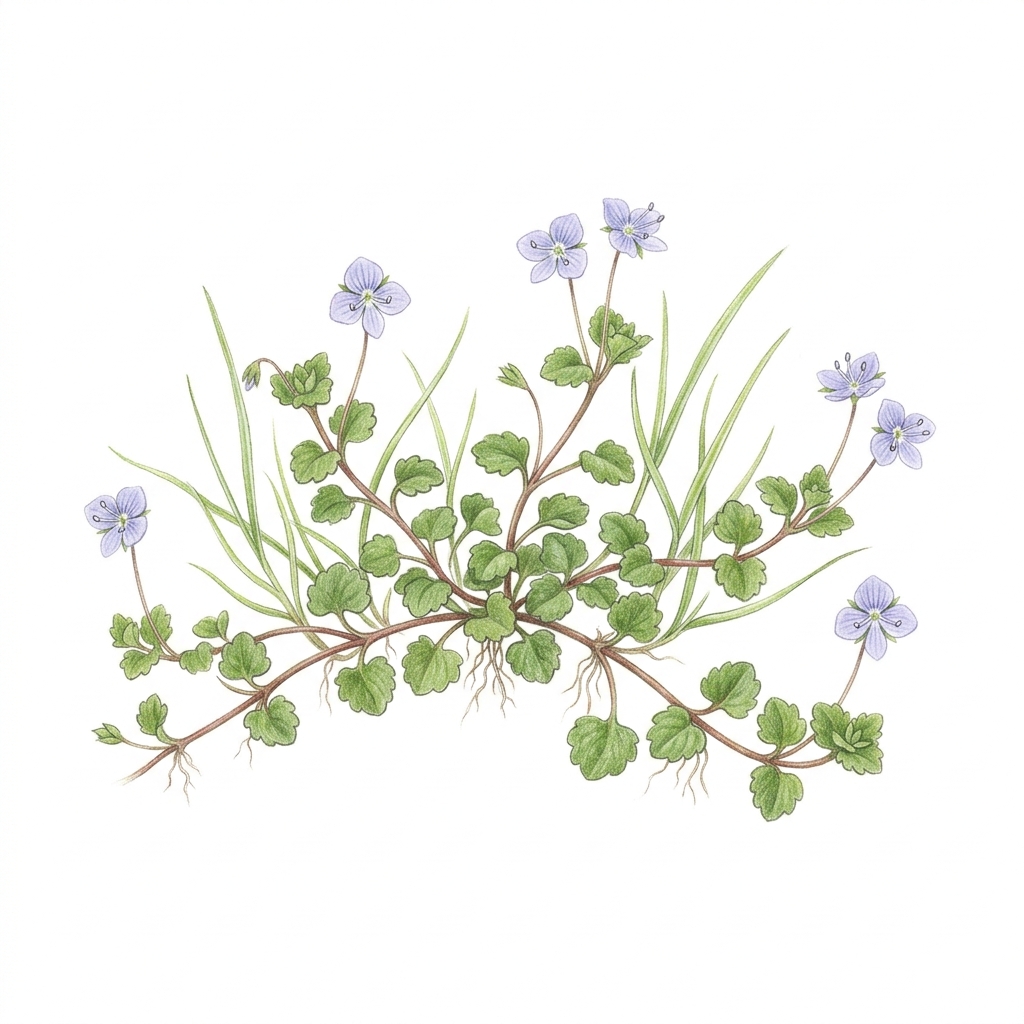
Illustration
Tiny blue flowers dotted through the lawn in spring. Slender speedwell spreads by creeping stems that mowing chops up and scatters, and speedwells shrug off most lawn weedkillers, so a healthier lawn is the best answer.
How to spot it
- Small blue flowers with four petal-like lobes (the lower one smaller) and two stamens.
- Slender speedwell: single pale lilac-blue flowers 8–10 mm across on hair-thin stalks, small kidney-shaped leaves, and reddish creeping stems that root as they go.
- Germander speedwell: bright blue flowers about 10 mm across in spikes, with hairs in two lines down the stem.
- Persian speedwell (a winter annual): flowers 8–12 mm across with a paler lower lobe, on long stalks.
- Flat, heart-shaped seed capsules (slender speedwell rarely sets seed).
Easily confused with
Creeping Charlie
Square stems, bigger violet tubular flowers and a strong smell when crushed.
Chickweed
White flowers with five deeply split petals.
Trailing speedwell (Veronica plebeia, Australia)
A native, with flowers in short spikes of 3–10. Leave it be.
Where it's a problem
- United Kingdom: Germander speedwell is native; slender speedwell arrived from Turkey and the Caucasus in the early 1800s and is now a common lawn weed.
- Australia: Persian and wall speedwell are naturalised and turn up in lawns.
- New Zealand: Persian speedwell is widespread; slender speedwell is local.
- North America: Several speedwells are common lawn weeds.
What to do
- Improve the lawn: feed, water and raise the mowing height, so the grass crowds it out.
- Dig out patches by hand while the soil is moist, and reseed the gap.
- Collect the clippings where slender speedwell grows: mowing scatters pieces of stem that root.
- Pull the annual kinds while they're young, before they seed.
If you use a herbicide, choose one labelled for speedwell and follow the label and local rules. Speedwells are resistant to most lawn weedkillers, according to the RHS, so lawn care usually works better.
Follow your local council's guidance for disposing of weeds. Councils usually advise against putting weeds like this in the green waste / vegetation bin or the compost.
Free account, no card needed. You sign up or sign in first, then the scanner opens.
Sources
- RHS: Speedwell
- Botanical Society of Britain and Ireland: Speedwell identification
- Penn State Extension: Common field speedwell
- NC State Extension: Persian speedwell
- Washington State University Hortsense: Speedwells
- NZ Plant Conservation Network: Veronica filiformis
Facts checked Sunday 27 September 2026. General guidance only: follow your local council, agency and product label.