Home › Weed guide › Chickweed
Weed guide
Chickweed
Stellaria media · Pink family (Caryophyllaceae)
Also called common chickweed (UK and USA), starweed or winterweed (Australia and USA).
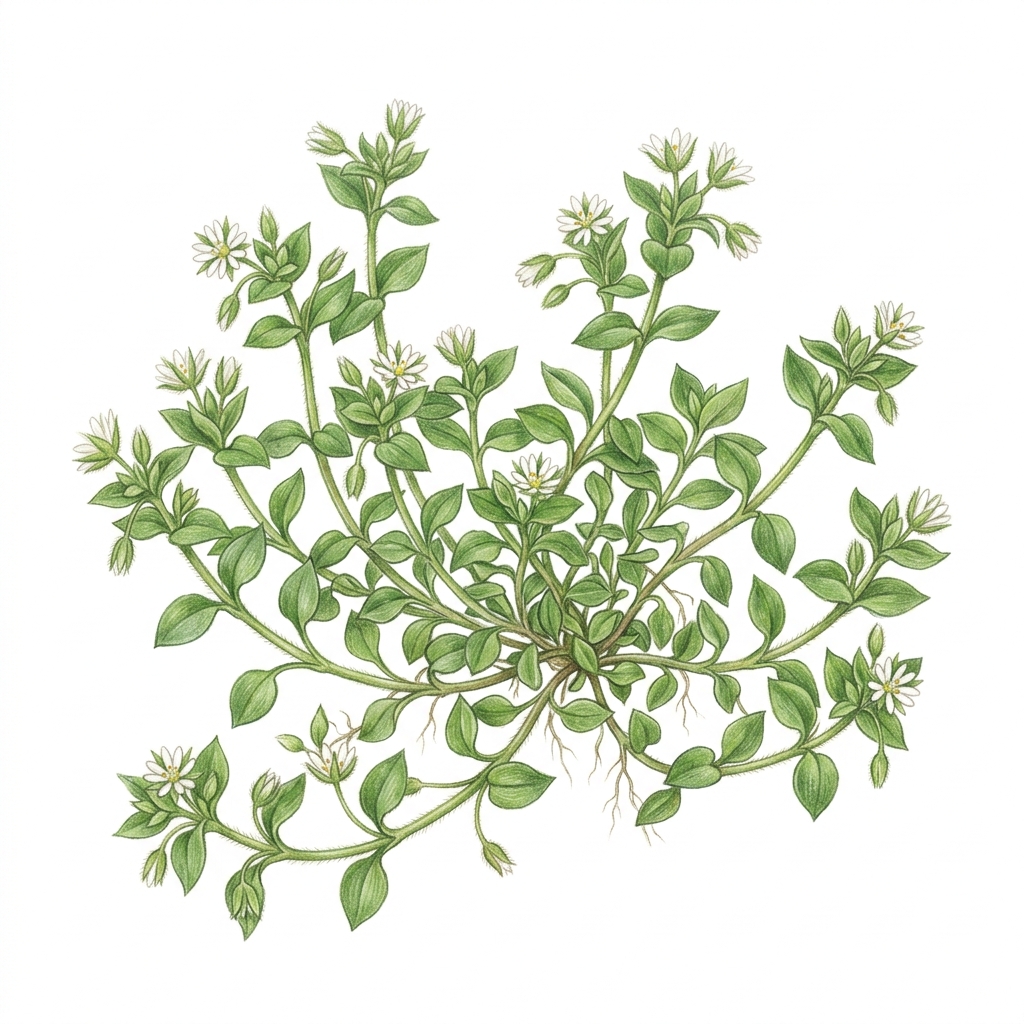
Illustration
A soft, sprawling weed with tiny white star flowers that carpets bare soil in cool, damp weather. It's shallow-rooted and easy to pull; the trick is to get it before it flowers and seeds.
How to spot it
- A single line of fine hairs running down the stem, switching sides at each pair of leaves; the rest of the plant is mostly smooth.
- Small, egg-shaped, pointed leaves in opposite pairs, 5–40 mm long; the lower ones on stalks, the upper ones without.
- Tiny white flowers with five petals split so deeply they look like ten, with green sepals as long as the petals or longer.
- Weak, sprawling stems up to about 60 cm long that can root where they touch the ground.
- Most active in cool, wet weather through autumn, winter and spring.
Easily confused with
Mouse-ear chickweed
Hairy all over, not just a single line of hairs down the stem.
Scarlet pimpernel
Square stems, salmon-orange flowers and purple dots under the leaves. It is toxic, so don't confuse the two.
Lesser chickweed
Often has no petals at all.
Where it's a problem
- UK and Europe: Native, and a very common garden weed.
- Australia: Widely naturalised, and listed as an environmental weed in several states.
- New Zealand: Very common in gardens, especially in winter and spring.
- North America: Introduced, and common in gardens and lawns.
What to do
- Pull or fork it out regularly, before it flowers. The roots are shallow, so it comes away easily.
- Hoe on dry, sunny days, so the pieces shrivel instead of rooting again.
- Mulch beds about 8 cm deep in early spring, and fill gaps with plants or ground cover.
- Don't move soil or compost from a patch where it has seeded.
- In lawns, keep the grass thick; hand-pulling is hard work in turf.
If you use a herbicide, choose one labelled for chickweed and follow the label and local rules. The RHS says there's no need to use a weedkiller on it, and in lawns it shrugs off several common lawn weedkillers.
Follow your local council's guidance for disposing of weeds. Councils usually advise against putting weeds like this in the green waste / vegetation bin or the compost.
Free account, no card needed. You sign up or sign in first, then the scanner opens.
Sources
- RHS: Chickweed
- University of California IPM: Common chickweed
- University of California IPM: Scarlet pimpernel
- University of Maryland Extension: Common chickweed
- PlantNET, Royal Botanic Garden Sydney
- Weeds of Australia (Queensland Government)
- Massey University: Chickweed
- Ontario Government: Chickweed
Facts checked Sunday 27 September 2026. General guidance only: follow your local council, agency and product label.