Home › Weed guide › Creeping Charlie
Weed guide
Creeping Charlie
Glechoma hederacea · Mint family (Lamiaceae)
Also called ground ivy (UK, Australia and New Zealand), alehoof (UK).
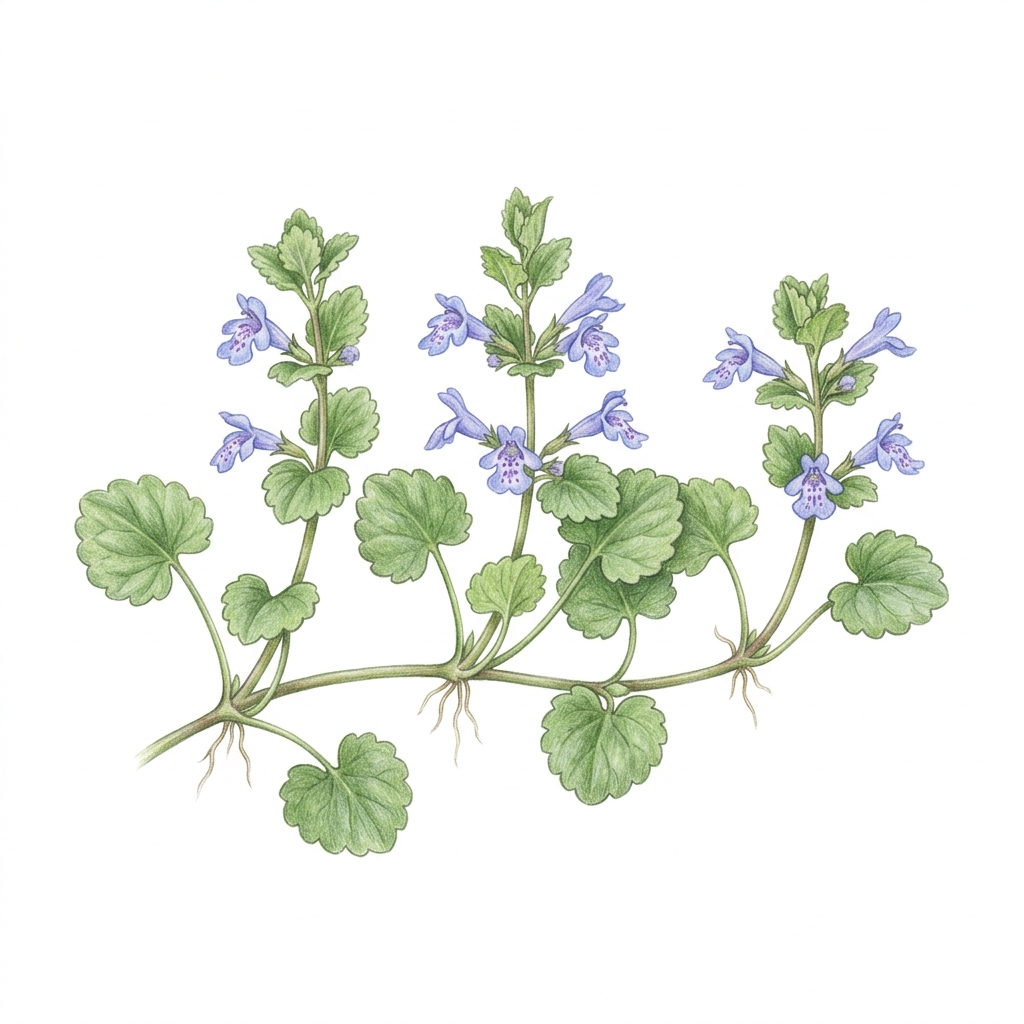
Illustration
A low, creeping mint relative with round scalloped leaves and small blue-violet flowers, worst in damp, shady lawns. Every rooted joint can become a new plant, so pull out all of it and let in more light and air.
How to spot it
- Square stems that creep along the ground and root at the joints.
- Round to kidney-shaped leaves 1–4.5 cm across, in opposite pairs on stalks, with rounded, scalloped edges.
- Small blue-violet tubular flowers 1–1.5 cm long, with a spotted lower lip, in small clusters where the leaves join the stem; it flowers in spring.
- A strong smell when crushed or mown.
- A low mat, with short upright flowering shoots up to about 10 cm tall.
Easily confused with
Henbit
Its upper leaves have no stalk, its stems don't root at the joints, and it's an annual.
Purple deadnettle
Reddish-purple leaves at the top of the stem, and stems that don't root.
Kidney weed (Dichondra repens)
An Australian native with tiny pale greenish-yellow flowers, no blue ones, and leaf stalks much longer than the leaves.
Pennyworts (Hydrocotyle)
Leaves grow singly along the stem rather than in pairs, and the tiny pale green or white flowers sit in small round clusters.
Where it's a problem
- North America: Introduced; a major weed of shady lawns.
- UK and Europe: Native, and even sold as a variegated garden plant.
- Australia: Uncommon; naturalised only in parts of NSW.
- New Zealand: Naturalised since the 1870s.
What to do
- Hand-pull or rake it out, removing every piece of stem: each rooted joint can become a new plant. Take the pieces away so they can't root again.
- For big patches, a dethatching rake or scarifier combs it out of the lawn.
- Fix the conditions it loves: improve drainage, water less often, and prune trees to let in more light.
- Thicken the lawn: mow at about 5–9 cm, feed it, and oversow in autumn. In deep shade, a shade-loving groundcover may do better than grass.
- Skip the old borax remedy: it works poorly, damages the lawn and can leave bare ground.
If you use a herbicide, choose one labelled for creeping charlie and follow the label and local rules. Autumn treatments work better than spring ones, and repeat treatments over several years are often needed. The RHS says no weedkiller is needed; clippings from a treated lawn shouldn't go into compost or mulch.
Follow your local council's guidance for disposing of weeds. Councils usually advise against putting weeds like this in the green waste / vegetation bin or the compost.
Take care: It is listed as toxic to horses if they eat large amounts.
Free account, no card needed. You sign up or sign in first, then the scanner opens.
Sources
- University of Wisconsin–Madison Extension: Controlling creeping Charlie
- Penn State Extension: Ground ivy
- Penn State Extension: Dead nettle, henbit and ground ivy
- Iowa State University Extension: Ground ivy or henbit?
- Washington State University Hortsense: Ground ivy
- RHS: Glechoma hederacea
- PlantNET, Royal Botanic Garden Sydney
- Flora of New Zealand: Glechoma hederacea
- NC State Extension: Glechoma hederacea
Facts checked Sunday 27 September 2026. General guidance only: follow your local council, agency and product label.