Soil
Salty soil
Also called saline soil (soil scientists and farmers), salt-affected soil (farm advice), white alkali (USA, for saline soil), black alkali or slick spots (USA, for sodic soil).
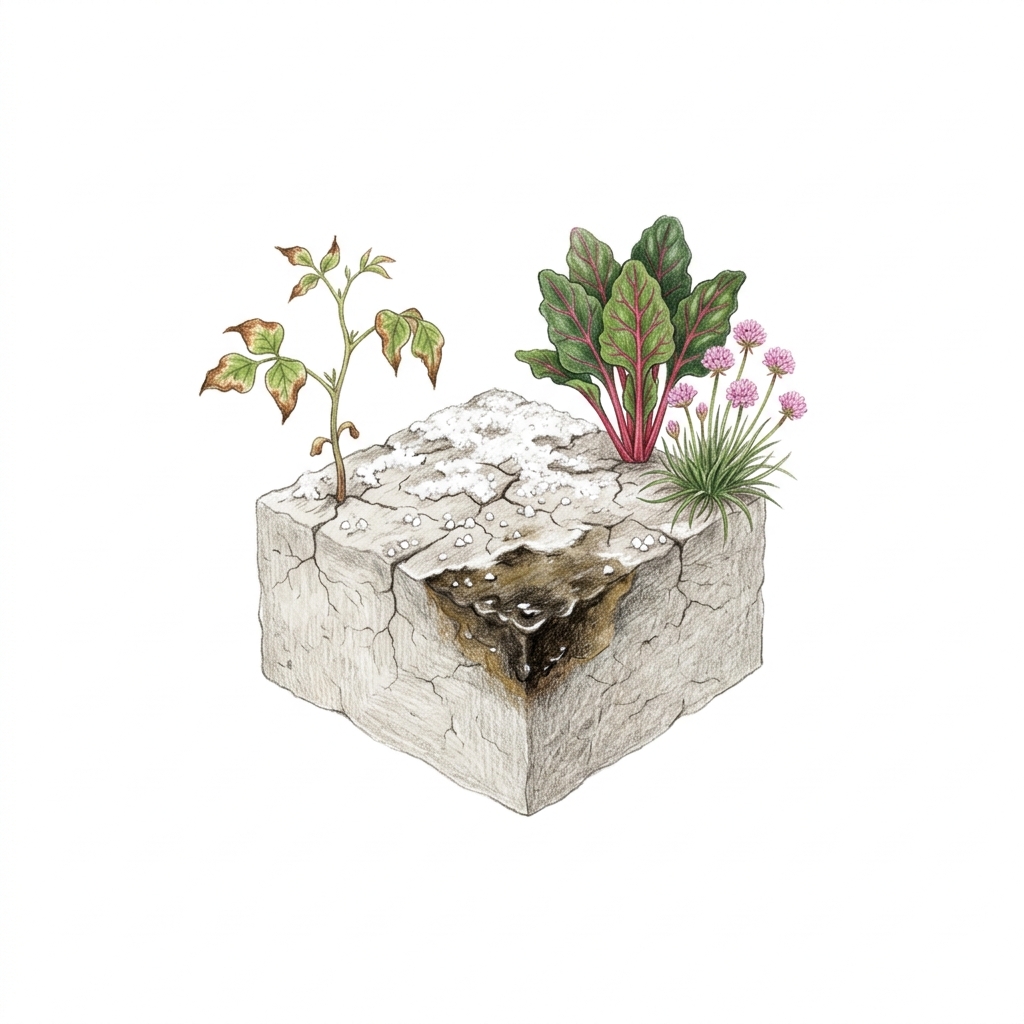
Illustration
Salty soil holds so much salt that roots struggle to take up water, so plants wilt, burn at the leaf edges and grow patchily. Flushing the salt below the roots with clean water, where the soil drains, is the main fix. Gypsum helps sodic soil, not salt.
How to tell
- A white crust on bare patches as the soil dries.
- Leaf edges brown and burn, plants stay small, flowering is poor and seeds fail to come up.
- Patchy growth and bare spots, with salt-tolerant plants taking over and low-lying ground that stays damp.
- A dark, greasy-looking crust and water that won't soak in point to sodic soil, a close relative with too much sodium.
- If beans grow well, salt isn't a problem. For a real answer, get a lab test for salt and sodium; home soil probes aren't accurate.
Easily confused with
Waterlogged soil
Soggy soil with rotting roots but no white crust. The two often go together, as a rising water table brings salt up.
Alkaline and chalky soil
Leaves yellow between green veins rather than burning at the edges, and the soil may fizz with vinegar.
Drought stress
Salt cuts the water roots can take up, so salt-stressed plants can look thirsty even after watering.
Where it's common
- Australia: Dryland salinity affects about 16% of the cropping area, and about three-quarters of it is in Western Australia. It follows clearing, when deep-rooted native plants give way to shallow-rooted ones and the water table rises. Irrigation with salty water or poor drainage adds more.
- Australian towns: Urban salinity comes from leaking pipes, pools, septic tanks and over-watered gardens raising the water table.
- Coastal gardens: Salt spray carried on the wind scorches plants that aren't salt-tolerant.
- North America: Salts build up naturally in drier parts of the West, and beside streets and paths where de-icing salt is used.
How to improve it
- Get a lab soil test for salt and sodium first. Salty soil and sodic soil need different fixes.
- Flush salt below the roots with plenty of good-quality, low-salt water, applied slowly so it soaks in. This is the only practical way to remove salt.
- Fix drainage first: salt can't be flushed out where clay, compaction or a hard layer stops water draining.
- Use gypsum only if a test shows the soil is sodic. On salty soil it adds more salt and makes things worse.
- Go easy on manure, manure-based compost and fertiliser, which can be salty, and keep de-icing salt off garden beds.
- Grow salt-tolerant plants. In towns, fix leaking pipes and don't over-water; on the coast, a permeable windbreak such as a hedge filters salty wind.
Plants that do well
- Asparagus and Swiss chard
- Beetroot and spinach
- Broccoli, squash and tomatoes (moderately tolerant)
- Junipers and arborvitae
- Thrift and sea holly, for salt spray
- Rosemary, sage and thyme by the sea
Free account, no card needed. You sign up or sign in first, then the scanner opens.
Sources
- Soil Science Australia: Save our soils, salinisation and sodification
- Queensland Government: Types of salinity
- Queensland Government: Identifying salinity
- Colorado State University Extension: Saline soils
- Oregon State University Extension: Managing salt-affected soils for crop production
- Utah State University Extension: Managing saline and sodic soils and irrigation water
- RHS: Coastal gardens, planting and design ideas
Facts checked Sunday 27 September 2026. General guidance only: follow your local council, agency and product label.