Home › Plant diseases › Purple blotch
Plant diseases
Purple blotch
Alternaria porri · Fungus
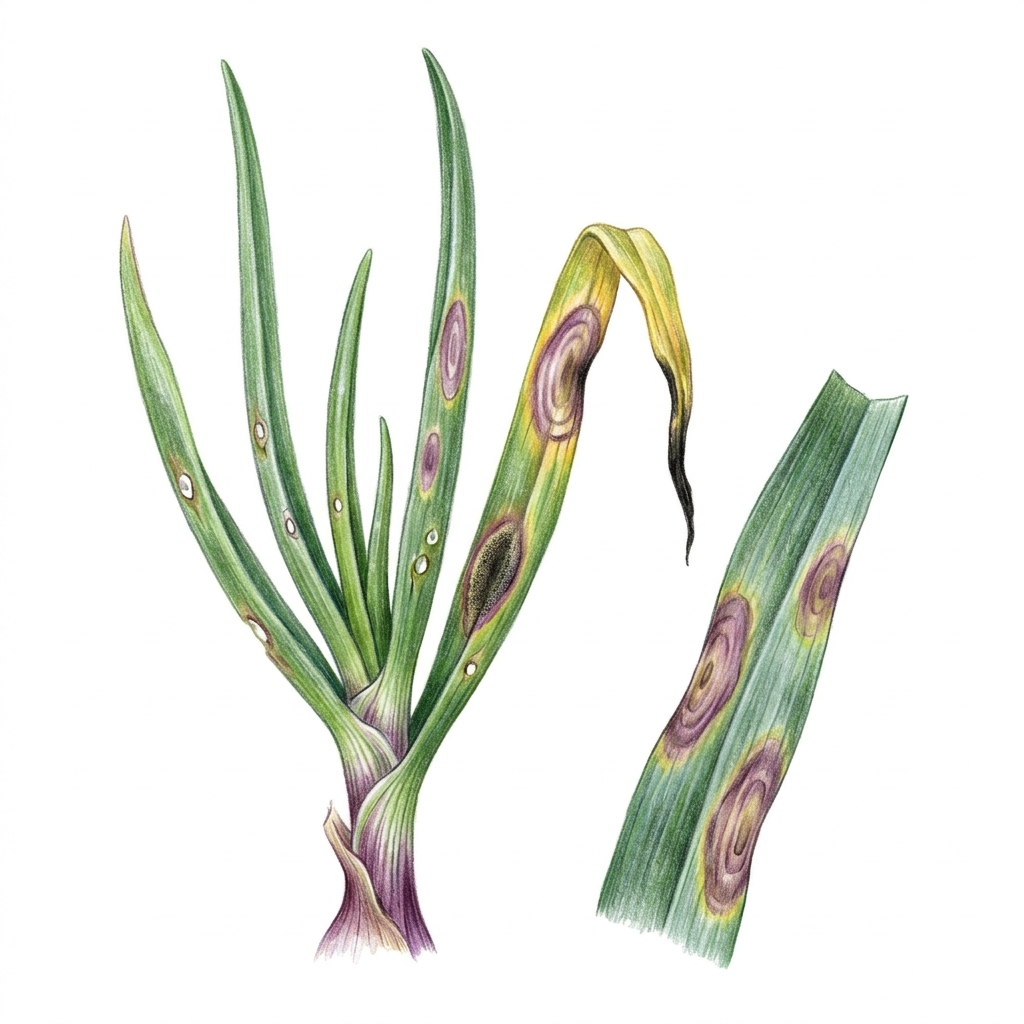
Illustration
A fungus that starts as small white-centred spots on onion, garlic and leek leaves and grows into oval purple-brown blotches with rings, until the leaves collapse above them. Leaves that dry quickly, few thrips, careful harvesting and curing, clearing old leaves and a three-year break from the onion family keep it in check.
How to spot it
- Small, sunken, water-soaked spots with white or pale centres, on the older leaves first.
- The spots grow fast into oval, purple to brown blotches several centimetres (an inch or more) long, with light and dark rings and often a yellow edge.
- In damp weather the blotches turn dark and sooty with spores.
- Where a blotch rings the leaf, or blotches join, the leaf above it yellows, wilts and dies. Leaf tips often blacken and hang down.
- Bulbs can be infected at the neck around harvest, with a watery, yellow to red rot that later turns dark purple to brown-black in store.
- Worst in warm, humid weather, around 25–29°C (77–85°F), when heavy dew, rain or sprinklers keep the leaves wet for many hours.
Easily confused with
Stemphylium leaf blight
Very similar brown spots, often on the same plants at the same time. Only a microscope tells them apart, and they're managed the same way.
Downy mildew
Pale, oval patches with grey-purple fuzz on damp mornings, rather than sunken, ringed purple blotches.
Thrips
Silvery-white streaks and specks where tiny insects have fed, with no sunken spots. Their damage often lets purple blotch in.
Rust
Small, bright orange pustules that burst into orange dust, mostly on leeks, garlic and chives, rather than large, sunken purple blotches.
Where it's a problem
- Worldwide: Found on every continent where onions are grown, and most damaging in warm, humid regions.
- Australia and New Zealand: Recorded in both countries.
- North America: An occasional to serious problem, worst in warm, humid seasons.
What to do
- Start with clean seed and healthy sets or seedlings, and discard any seedlings with spots.
- Space plants and keep them weeded so air moves through. Water the soil, not the leaves, in the morning, so the leaves dry quickly.
- Don't overfeed with nitrogen.
- Keep onion thrips down: plants weakened or wounded by thrips catch it more easily.
- Harvest in dry weather, don't bruise the necks, and let the bulbs cure fully before trimming the tops.
- Clear away or dig in old leaves after harvest, and pull out self-sown onions: the fungus survives on old leaves for at least a year.
- Keep onions, garlic, leeks and shallots out of that bed for at least three years.
If you use a fungicide, choose one labelled for purple blotch and follow the label and local rules. Official guides start sprays as soon as it's confirmed, to stop it spreading. The same sprays also hold back Stemphylium leaf blight.
Follow your local council's guidance for disposing of diseased plant material.
Vegetables it affects
Free account, no card needed. You sign up or sign in first, then the scanner opens.
Sources (4, from UMass Extension, Pacific Pests, Pathogens and Weeds, Utah State University Extension and others)
- UMass Extension: Alliums, purple blotch
- Pacific Pests, Pathogens and Weeds: Onion purple blotch
- Utah State University Extension: Purple blotch
- Texas A&M Plant Disease Handbook: Onion
Facts checked Wednesday 28 October 2026. General guidance only: follow your local council, agency and product label.