Home › Plant diseases › Lemongrass leaf blight
Plant diseases
Lemongrass leaf blight
Curvularia andropogonis and related Curvularia fungi · Fungus
Also called Curvularia leaf blight (farm and research guides).
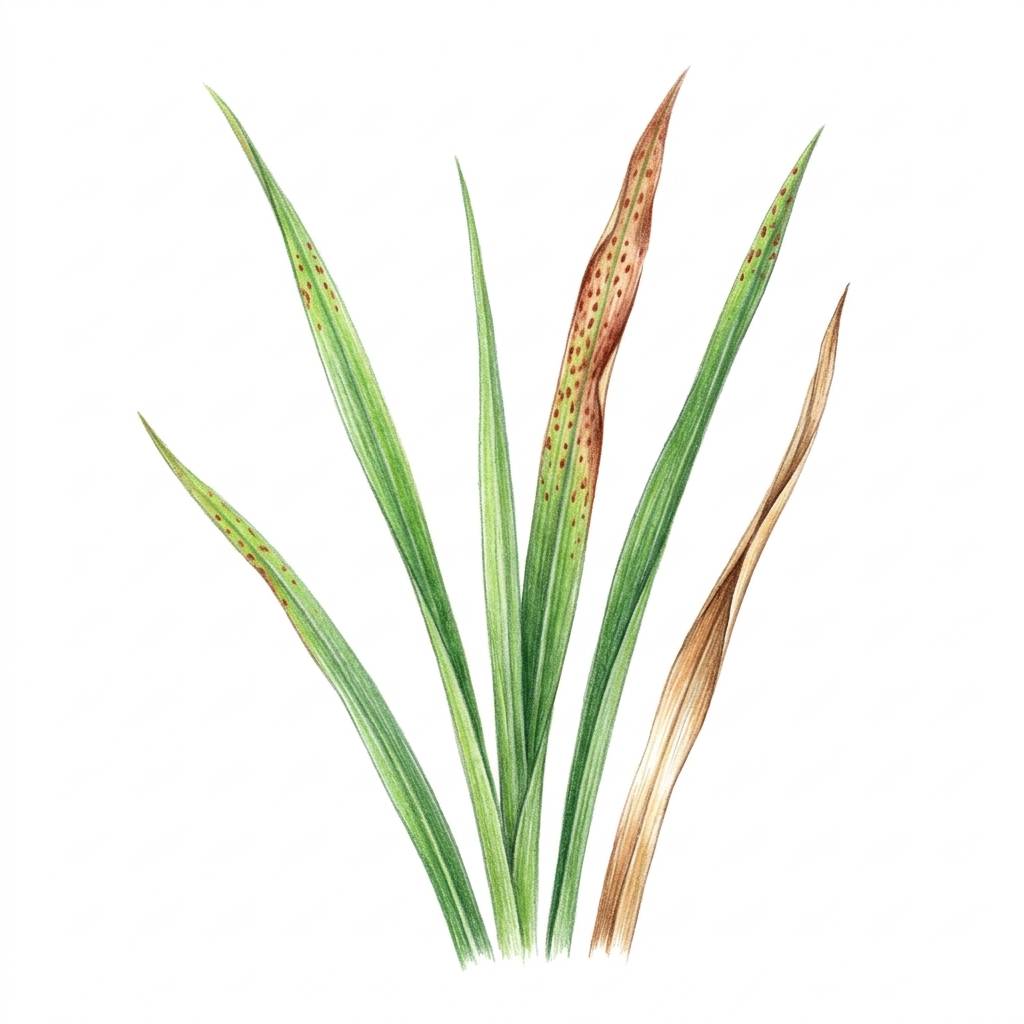
Illustration
A fungal disease that browns lemongrass leaves from the tips and edges: small reddish-brown spots join up until the leaves dry out and die early. Cutting off blighted leaves, clearing the dead ones away, watering at the base and giving the clump room for air help keep it in check.
How to spot it
- Small reddish-brown spots, mostly at the tips and along the edges of the leaves.
- The spots join into long reddish-brown patches along the tips and edges.
- Blighted leaves dry out early; in bad cases whole leaves dry up.
- Older leaves are more likely to be hit than young ones.
- Worst in warm, humid, wet weather.
Easily confused with
Rust
Starts as tiny yellow spots that become brown streaks along the leaf veins, anywhere on the leaf. Under the leaf they burst into cinnamon-brown powder that rubs off on a white tissue. Blight spots start at the tips and edges and leave no powder.
Cold and frost damage
Leaves brown back across the whole clump at once after cold nights or through winter, with no spots first. If the clump survives, new leaves grow from the base once it warms up.
Dry tip-burn
Tips and edges dry and brown after a dry spell or hot, drying winds, with no reddish-brown spots first. New leaves stay green once it's watered well.
Where it's a problem
- Worldwide: Recorded on lemongrass and citronella grass in India and South-East Asia, where both are grown as crops in warm, humid weather. US garden guides also list it among lemongrass diseases.
What to do
- Cut off blighted leaves as soon as you see them. Wear gloves: the leaf edges are sharp.
- Clear dead and fallen leaves from in and around the clump, and don't use them as mulch.
- Water at the base, by hand or with a soaker hose, rather than with a sprinkler, so the leaves stay dry.
- Give it air: space clumps about 90 cm (3 ft) apart, keep weeds down around them, and divide crowded clumps.
- If much of the clump is blighted, cut it back hard while it's growing strongly, not in cold weather, so clean new leaves can come through.
- Keep it growing well, in soil that drains freely, with compost and mulch.
Official guides put removing blighted leaves first, and Utah State University suggests a fungicide only once the blight is positively identified. If you use one, choose one whose label names lemongrass and leaf blight, and follow the label and local rules.
Follow your local council's guidance for disposing of diseased plant material. Official guides usually advise against putting it in a home compost heap.
Vegetables it affects
Free account, no card needed. You sign up or sign in first, then the scanner opens.
Sources (6, from Utah State University Extension, National Horticulture Board, India, ICAR Research Complex for NEH Region and others)
- Utah State University Extension: Lemongrass in the garden
- National Horticulture Board, India: Lemongrass diseases
- ICAR Research Complex for NEH Region: Major diseases of lemongrass (The Morung Express)
- University of Hawai'i CTAHR: Rust of lemongrass
- JARQ (JIRCAS): Leaf blight of citronella grass caused by Curvularia andropogonis
- University of Kentucky Extension: Leaf scorch and winter drying
Facts checked Friday 30 October 2026. General guidance only: follow your local council, agency and product label.