Home › Garden pests › Leaf-footed bugs
Garden pests
Leaf-footed bugs
Leptoglossus species, including L. phyllopus, L. zonatus and L. australis · Insect
Also called leaffooted bugs (USA), passionvine bug (Leptoglossus australis) (Australia), squash leaf-footed bug (Pacific Islands).
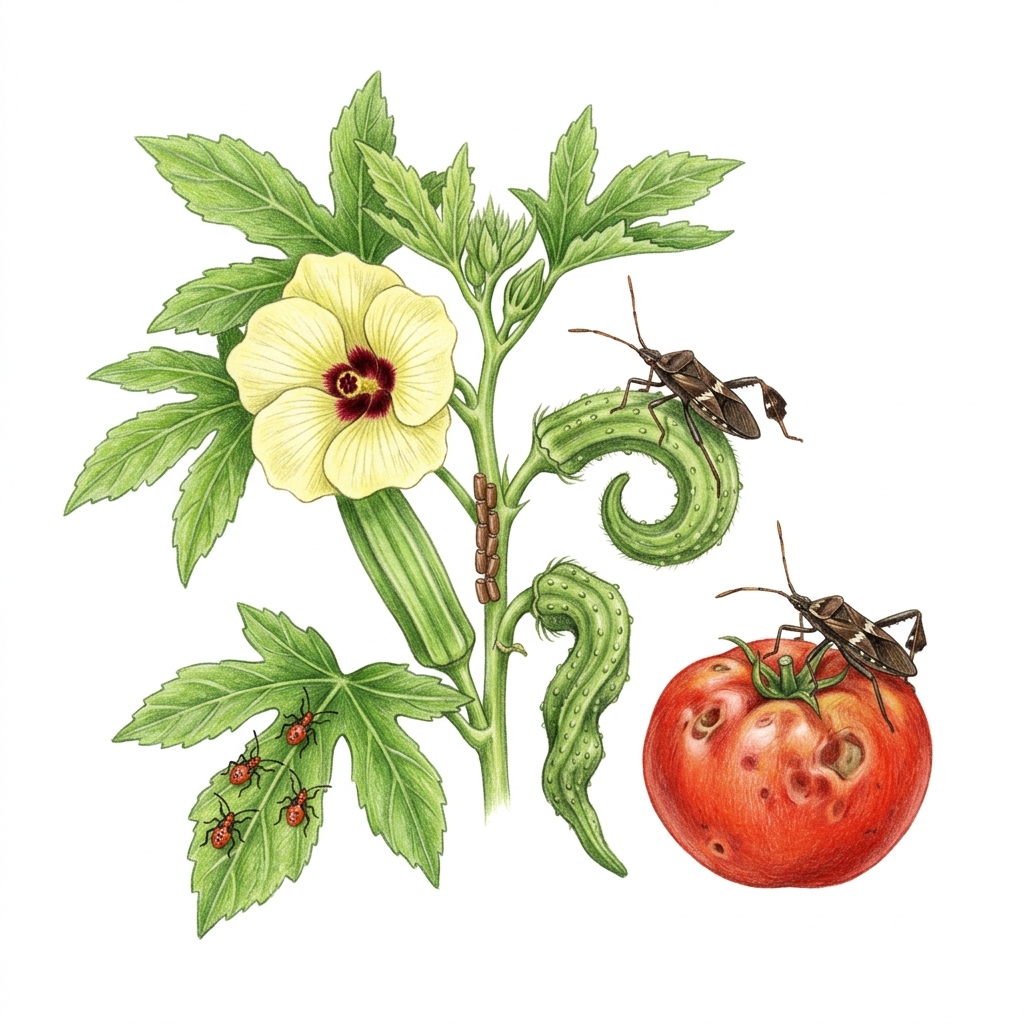
Illustration
Long, brown to black bugs with flat, leaf-like flaps on their hind legs that suck sap from okra pods, tomatoes and other fruit, leaving curled pods, wart-like bumps and sunken spots. Hand-pick the bugs and crush their egg chains early in the morning, and clear the weeds and shelter nearby where they spend the winter.
How to spot it
- Narrow brown or black bugs about 18–25 mm (¾–1 in) long, with a flattened, leaf-like flap on each hind leg; some have a pale zigzag band across the back, or a red or orange band behind the head.
- Young nymphs, bright red or orange-red with dark legs, often in clusters; the leg flaps appear as they grow.
- Brown, cylindrical eggs laid end to end in a chain along a stem, tendril or leaf rib.
- Okra pods that are curled or covered in wart-like bumps, with flattened, shrivelled seeds inside.
- Soft, sunken or dimpled spots on tomatoes and other fruit; young fruit may shrivel and drop.
- A strong, unpleasant smell when handled, and a loud buzz when the adults fly.
Easily confused with
Stink bugs
Broad and shield-shaped, with no leaf-like flaps on the legs; their nymphs are black when small, then green with orange-and-black markings, not bright red.
Squash bugs
Flat, grey-brown bugs about 16 mm (⅝ in) long with plain hind legs, found mostly on squash and pumpkins.
Assassin bugs
Helpful predators with young that look like small leaf-footed nymphs, but with pale legs and antennae; their barrel-shaped eggs have a white cap.
Where it's a problem
- North America: In the south-east, the leaffooted bug Leptoglossus phyllopus attacks okra, tomatoes, peppers, eggplant, peas and beans. In California, L. zonatus is most often found on tomatoes and pomegranates in gardens, and big outbreaks often follow mild winters.
- Australia: The passionvine bug, a leaf-footed bug of Queensland and far northern New South Wales, feeds on passionfruit, citrus, pomegranate and cucurbits such as cucumbers and melons. Damage is usually minor.
- Pacific Islands: A leaf-footed bug feeds on squash, melons, cucumbers and other cucurbits, but only occasionally in numbers that do real harm.
- United Kingdom and Europe: The western conifer seed bug, a North American leaf-footed bug, has spread here since the late 1990s (Britain from 2007). It feeds on pine cones, doesn't harm garden plants and needs no control, though it may come indoors in winter.
What to do
- Check okra and other crops a few times a week, looking closely early in the season, when the nymphs are still in clusters.
- Hand-pick the bugs, or brush them into a bucket of soapy water, early in the morning when they are slow. Wear gloves because of the smell.
- Crush the chains of eggs on stems, tendrils and the undersides of leaves.
- Clear weeds around the garden, and remove or check woodpiles and other places where adults spend the winter.
- Row cover keeps the bugs off if it goes on before they arrive, but it keeps pollinators out too.
- Leave birds, spiders, assassin bugs and parasitic wasps and flies to help, and avoid broad-spectrum sprays that kill them.
If you use an insecticide, choose one labelled for leaf-footed bugs and follow the label and local rules. Sources say insecticides are rarely needed in gardens, and work best on small nymphs.
Vegetables it affects
Free account, no card needed. You sign up or sign in first, then the scanner opens.
Sources (6, from University of California IPM, NC State Extension, Mississippi State University Extension and others)
- University of California IPM: Leaffooted bug
- NC State Extension: Pests of okra
- Mississippi State University Extension: Leaffooted bugs
- Business Queensland: Passionvine bug
- Pacific Pests, Pathogens and Weeds: Leaf-footed bug, squash bug
- RHS: Western conifer seed bug
Facts checked Wednesday 28 October 2026. General guidance only: follow your local council, agency and product label.