Home › Garden pests › Brush turkeys
Garden pests
Brush turkeys
Australian brush-turkey (Alectura lathami) · Bird
Also called scrub turkey, bush turkey (Australia).
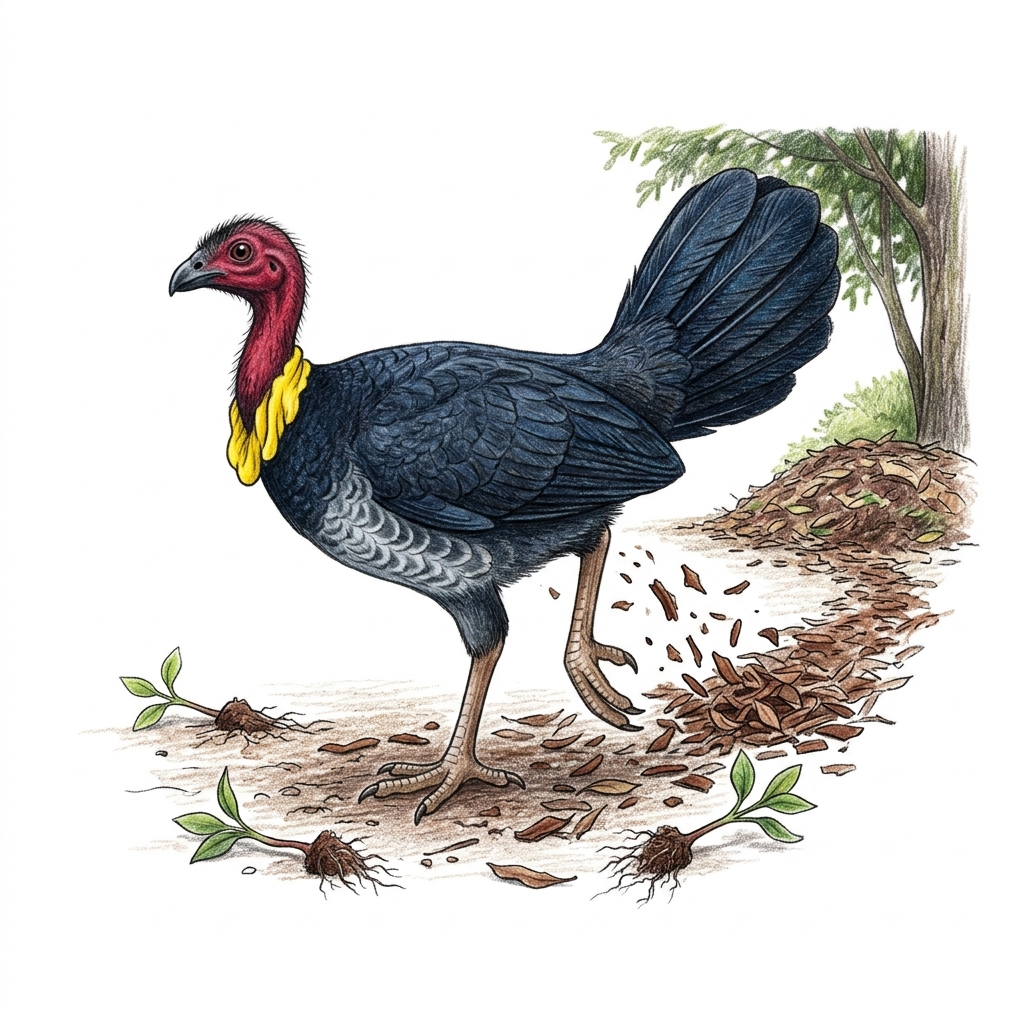
Illustration
A male brush turkey rakes leaf litter, mulch and soil into a huge nesting mound, and can strip a garden bed of mulch and small plants in less than a day. They are protected native birds, and once a mound is under way it is very hard to stop, so the answer is to make your beds hard to rake: wire mesh or rocks over the mulch, guards on young plants, and no food left out.
How to spot it
- A large, black, turkey-like bird, 60 to 75 cm (24 to 30 in) long, with a bare, deep red head and neck and an upright, fan-shaped tail that is flattened side to side.
- Males have a big, bright yellow wattle at the neck, largest in the breeding season; a female's is smaller and duller. On Cape York, in far north Queensland, the wattle is pale blue.
- A mound of leaf litter, mulch and soil, usually 2 to 4 m (7 to 13 ft) across and about 1 m (3 ft) high, most often in shade under trees.
- Beds raked bare, mulch stripped and dragged off in long trails, and seedlings and small plants scratched out. A male may gather mulch from several backyards around his mound.
- Most mound building is from August to December, running into February in New South Wales; scratching for food goes on all year.
Easily confused with
Bandicoots
Dig small, finger-deep, cone-shaped holes in lawns and beds, at night; they don't rake mulch away or pile it up.
Common blackbird
A much smaller bird, 25 to 28 cm (10 to 11 in), that flicks leaf litter and soil about as it feeds but builds no mound; found in south-eastern Australia.
Possums
Feed at night on leaves, shoots and fruit, often high in the plant, rather than raking the ground bare.
Where it's a problem
- Queensland: Brush turkeys and their mounds are protected under the Nature Conservation Act 1992, so don't chase, kill or injure the birds, or harm their mounds or eggs. Destroying a mound or chasing the bird off doesn't work anyway: a male's urge to build is very strong. Only a licensed relocator may catch and move a male, and only where the mound threatens people's health and wellbeing or causes financial loss; it usually costs a fee, and any eggs in the mound must be considered. Even then it often fails, as another male soon takes over the empty territory. Plant new gardens in late summer, after the main mound-building months of August to December.
- New South Wales: Brush turkeys are protected under the Biodiversity Conservation Act 2016, and harassing them is not allowed. Harming or trapping one without a licence is illegal, and that includes damaging eggs in a mound or stopping chicks leaving it; councils say neither they nor residents may forcibly relocate the birds. A mound may be destroyed only if it holds no eggs, so act in the first week or two: rake a brand-new mound apart each day, or cover it with a heavy tarpaulin or chicken wire weighed down with rocks or logs. Once a mound has been worked for several weeks, wait 60 days for the eggs to hatch and the chicks to leave before spreading it. Eggs are laid from August to February.
- Outside Australia: Brush turkeys live only in eastern Australia, from Cape York Peninsula in Queensland south to the Illawarra in New South Wales, so similar raking anywhere else is the work of another animal.
How to protect your garden
- Start early. Mound building begins from about August, and once a male has been working a mound for a few weeks he is very hard to move on, so protect your beds before spring.
- Lay chicken wire over mulched beds and hold it down with stakes and rocks. In spots he keeps raking, peg galvanised chicken mesh about 20 mm (3/4 in) below the surface of the mulch.
- Use heavy cover instead of ordinary mulch: rocks, large gravel or river gravel, especially around the base of new plants. Large branched sticks or logs help too, as do dense, low ground covers planted among rocks.
- Put tree guards around new, small or valuable plants. Plant in late summer or autumn, after the main mound-building months, and build a new garden in stages, protecting each stage as you go.
- Cover vegetable beds with bird netting over bamboo or wooden stakes, pulled taut and pegged down so no bird can get tangled. Raised beds, or a fence more than 70 cm (28 in) high around the garden, also help, though a bold bird may hop in.
- Take away what draws them in: cover compost heaps and spare piles of mulch, keep food scraps and pet and chicken food out of reach, remove water they don't need to drink from, and never feed brush turkeys. Feeding makes them bolder and keeps them close to the house.
- Where your state's rules allow (see below), cover a brand-new mound before any eggs are laid, and prune overhanging branches: more sun makes the spot harder for him to keep at the right heat, and takes away a night roost.
- When a male first starts building, a short burst of water from a hose or sprinkler, aimed at his chest early in the morning, may move him on. Don't repeat it over and over or chase him, as that counts as harassment, and never do it once eggs are laid.
- On a bigger block, offer him somewhere else: an open compost or mulch pile in heavy shade beside a large tree, well away from the beds you care about.
- If a mound is already established, many people simply leave it: once the chicks have gone, from about March to July, it makes rich compost. A chick on its own isn't lost, as chicks look after themselves from hatching, so leave it be, keep cats inside, and call a wildlife rescue group only if it is clearly injured.
Never poison, trap or harm a brush turkey, or damage its mound or eggs: it is a protected native bird in Queensland and New South Wales, and doing so is an offence. Protect the garden with covers instead, and ask your council or state wildlife agency if you need more help.
Free account, no card needed. You sign up or sign in first, then the scanner opens.
Sources (13, from Queensland Government, NSW Environment, Australian Museum and others)
- Queensland Government: Brush turkeys · About bandicoots
- NSW Environment: Australian brush turkey
- Australian Museum: Australian Brush-turkey · Common Blackbird
- Brisbane City Council: Brush turkey
- Redland City Council: Brush-turkey in urban areas
- Tablelands Regional Council: Australian Brush-Turkeys
- Sunshine Coast Council: Australian brush turkey
- City of Ryde: Australian Brush-turkeys in Sydney (Dr Ann Goeth)
- Ku-ring-gai Council: Brush turkey
- Hunter's Hill Council: Brush turkeys
- Northern Beaches Council: Australian brush turkey
Facts checked Friday 13 November 2026. General guidance only: follow your local council, agency and product label.