Home › Weed guide › Wild onion and wild garlic
Weed guide
Wild onion and wild garlic
Allium canadense and Allium vineale · Onion family (Amaryllidaceae)
Also called field garlic (USA), crow garlic (UK and Australia).
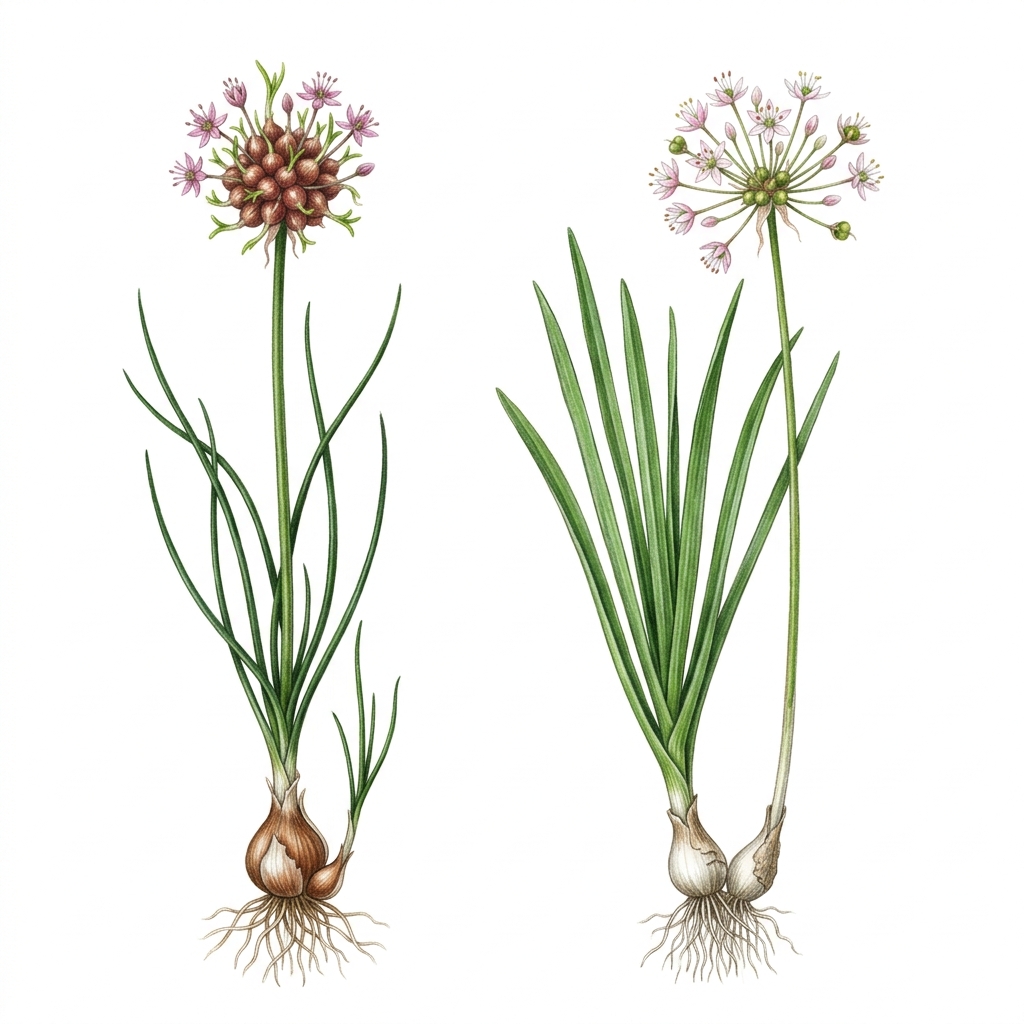
Illustration
Clumps of tall, grassy leaves that shoot up in lawns over winter and spring and smell of onion or garlic when mown. Waxy leaves and hard little bulbs make them stubborn, so digging and patience win.
How to spot it
- Grassy clumps that grow taller than the lawn and smell of onion or garlic when crushed or mown.
- Wild garlic: round, hollow leaves that grow part-way up the stem.
- Wild onion: flat, solid leaves clustered at the base.
- Heads of small bulbils (wild garlic) or pink, white or lavender star flowers (wild onion), on stalks up to about 1 m.
- They appear in late autumn, grow through winter and spring, and die back in early summer.
Easily confused with
Star-of-Bethlehem
No onion or garlic smell, and a white stripe down the middle of each leaf. It is poisonous.
Death camas
No smell at all. It is highly poisonous and has been mistaken for wild onion.
Three-cornered garlic
A flower stem that's triangular in cross-section.
Where it's a problem
- USA: Common in lawns across the eastern and southern states; wild garlic is on California's noxious weed list.
- United Kingdom: Crow garlic is native and common in grassland in southern England. (In the UK, 'wild garlic' usually means ramsons, a different plant.)
- Australia: Crow garlic is declared in some states.
What to do
- Don't just pull: the leaves snap and the bulb stays behind. Dig out the whole clump with its bulbs while the soil is moist.
- For a stubborn patch, lift the whole spadeful and replace it with clean soil.
- Mow before the bulbils form, so new ones can't drop; mowing alone won't kill it.
- Keep the lawn thick, and avoid mowing very short.
- Expect a few years of regrowth: its hard bulbs can lie dormant for years.
If you use a herbicide, choose one labelled for wild onion and wild garlic and follow the label and local rules. A thin waxy coating on the leaves stops weedkillers sticking; mowing just before treating helps. Expect to repeat over more than one season.
Follow your local council's guidance for disposing of weeds. Councils usually advise against putting weeds like this in the green waste / vegetation bin or the compost.
Take care: Two poisonous look-alikes, star-of-Bethlehem and death camas, have no onion or garlic smell.
Free account, no card needed. You sign up or sign in first, then the scanner opens.
Sources
- Clemson University HGIC: Wild garlic and wild onion
- Penn State Extension: Wild onion and wild garlic
- University of Maryland Extension: Wild garlic or wild onions
- Cornell University: Wild garlic
- University of California IPM: Wild garlic
- Purdue University Turf Science: Wild garlic
- Montana State University Extension: Death camas
- RHS: Wild garlic and crow garlic
Facts checked Sunday 27 September 2026. General guidance only: follow your local council, agency and product label.