Home › Weed guide › Onion weed
Weed guide
Onion weed
Nothoscordum borbonicum and Allium triquetrum · Onion family (Amaryllidaceae)
Also called false onion weed (Australia), three-cornered garlic or leek (Allium triquetrum; Australia, New Zealand and UK).
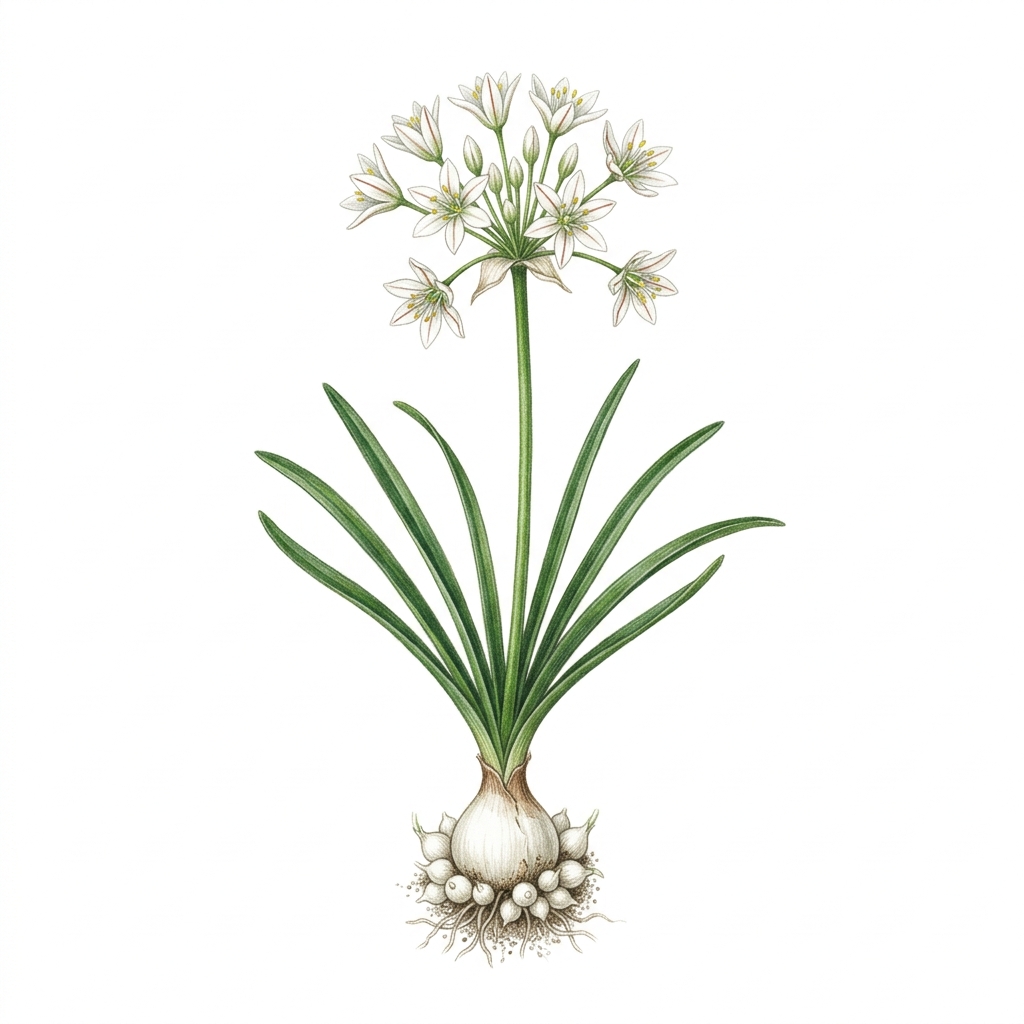
Illustration
Grassy clumps with white flowers that grow from bulbs ringed with dozens of tiny bulblets. Pull it and the bulblets stay behind, so the answer is to dig out the whole clump, bulbs and all.
How to spot it
- Two bulb weeds share the name. False onion weed (Nothoscordum) has flat, strap-like leaves and upright, scented, star-shaped white flowers with a reddish-brown stripe down each petal.
- Its flower stalk is round and 20–100 cm tall, and the plant smells only faintly of onion, or not at all.
- Three-cornered garlic (Allium triquetrum) has a flower stalk that's triangular in cross-section, nodding white bell flowers with a green stripe, and a strong garlic smell.
- Both grow from small white bulbs, 1–2.5 cm across, often ringed with many tiny bulblets.
Easily confused with
Onion weed of farmland (Asphodelus fistulosus)
Hollow, round leaves, no bulb, and yellow fibrous roots. It is a declared farm weed in several Australian states.
Crow garlic
Dense heads of little bulbils instead of full flowers.
Native leek (Bulbine semibarbata)
An Australian native with golden-yellow flowers: leave it be.
Where it's a problem
- Australia: False onion weed is a common and very hard-to-clear garden weed in the south and east, but not declared. Three-cornered garlic is declared or restricted in some states.
- New Zealand: Three-cornered garlic is New Zealand's 'onion weed' and is listed as an environmental weed; false onion weed can be troublesome in older gardens.
- United Kingdom: Three-cornered leek is listed under the Wildlife and Countryside Act: it's an offence to plant it or cause it to grow in the wild.
What to do
- Dig, don't pull: pulling snaps the leaves off and leaves the bulb and its bulblets in the soil.
- Lift the whole clump with a spade or fork, soil and all, and pick out every tiny bulblet; most sit in the top 20 cm.
- Bag the bulbs, and keep them out of home compost.
- For a big patch, smother it under cardboard and about 20 cm of mulch, and leave it for a few years.
- Check the spot regularly and dig out any regrowth: clearing it can take several years.
If you use a herbicide, choose one labelled for onion weed and follow the label and local rules. Repeat treatments over more than one season are usually needed; spot-spraying three-cornered garlic works best before it flowers.
Follow your local council's guidance for disposing of weeds. Councils usually advise against putting weeds like this in the green waste / vegetation bin or the compost.
Free account, no card needed. You sign up or sign in first, then the scanner opens.
Sources
- VicFlora: Nothoscordum borbonicum
- VicFlora: Allium triquetrum
- Weeds of Australia (Queensland Government): Nothoscordum
- Weeds Australia: Three-cornered garlic
- NSW DPI WeedWise: Onion weed (Asphodelus)
- Weedbusters NZ: Onion weed
- RHS: Wild garlic and crow garlic
- NSW Government: Weed control techniques
Facts checked Sunday 27 September 2026. General guidance only: follow your local council, agency and product label.