Home › Weed guide › White clover
Weed guide
White clover
Trifolium repens · Pea family (Fabaceae)
Also called Dutch clover (USA).
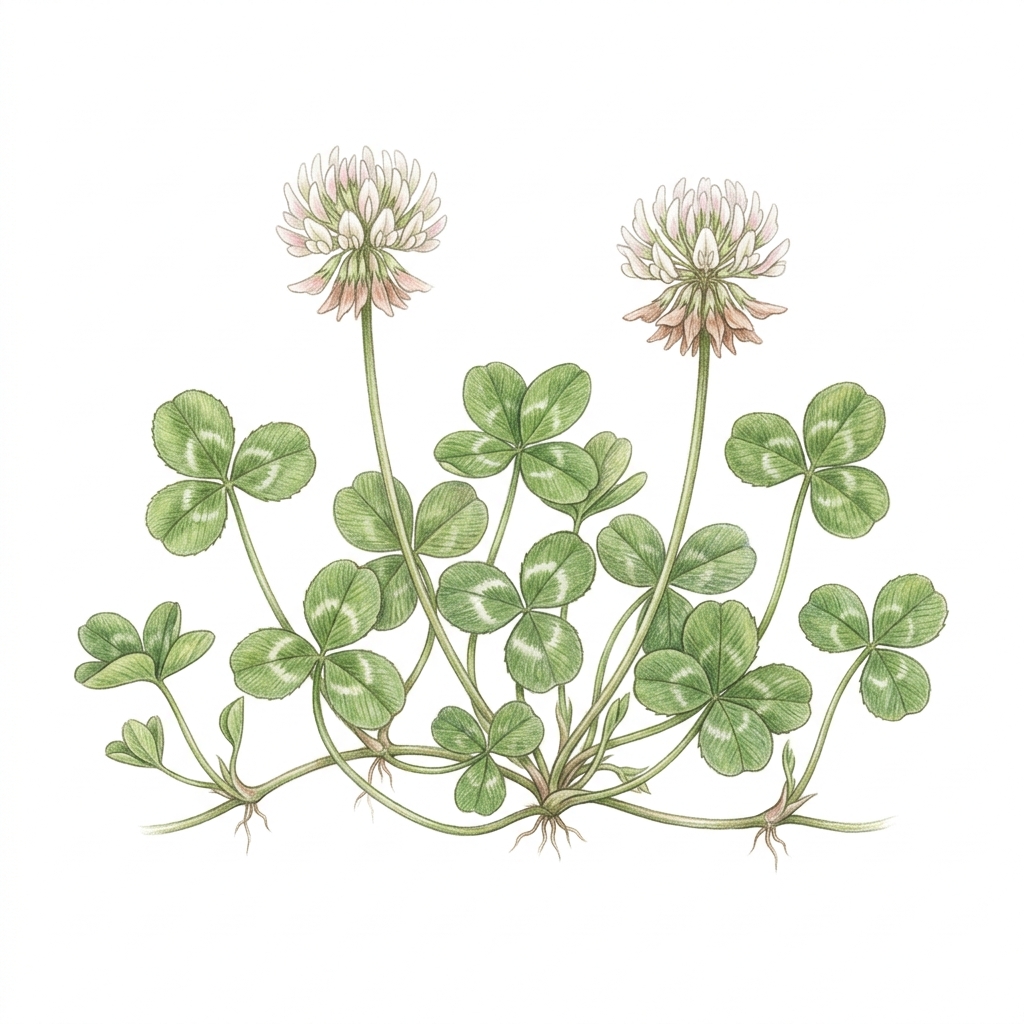
Illustration
The three-leaved lawn plant with white pom-pom flowers. Plenty of gardeners now keep it on purpose, because it feeds the soil and the bees; if you want pure grass, a thick, well-fed lawn is the best cure.
How to spot it
- Three rounded leaflets (occasionally four) that all join at one point; usually 0.6–1.2 cm long in a mown lawn.
- A pale crescent or V-shaped mark on many leaflets, which have finely toothed edges.
- Hairless stems that creep along the ground and root where they touch it.
- Round white flower heads, often tinged pink, 1.5–3.5 cm across, on stalks standing above the leaves; older florets bend downwards.
Easily confused with
Black medic
Small yellow flower heads, and the middle leaflet sits on its own short stalk.
Creeping oxalis
Heart-shaped leaflets with a deep notch, and yellow flowers with five separate petals.
Strawberry clover
No pale crescent on the leaflets, and its seed heads swell up like little bladders.
Where it's a problem
- Australia: Not a declared weed in any state, but a common lawn weed and an environmental weed in the south-east.
- New Zealand: Introduced, and unwanted in fine turf.
- UK and Europe: Native. Many gardeners now leave it in lawns for the bees.
- North America: Naturalised throughout the USA and Canada.
What to do
- Decide first whether it's a problem: clover feeds the soil and the bees, and many gardeners now leave it in the lawn.
- Feed the lawn. Well-fed grass crowds clover out.
- Pull it by hand when the soil is moist: gather the stems together and pull, or fork out rooted sections, then reseed any bare patches.
- Rake before mowing and collect the clippings, because pieces can root again and drop seed.
- Mow at the right height for your grass and water properly, so the lawn stays thick.
If you use a herbicide, choose one labelled for white clover and follow the label and local rules. Clover shrugs off many lawn weedkillers, and the RHS says there is no need to use one. If you do, spot-treat rather than spraying the whole lawn, and avoid hot weather.
Follow your local council's guidance for disposing of weeds. Councils usually advise against putting weeds like this in the green waste / vegetation bin or the compost.
Take care: Bees love the flowers, so watch for stings when walking barefoot on a flowering lawn.
Free account, no card needed. You sign up or sign in first, then the scanner opens.
Sources
- RHS: Clover in lawns
- University of California IPM: Clovers pest notes
- Penn State Extension: White clover
- Clemson University HGIC: White clover
- Australian Government OGTR: The biology of white clover
- PlantNET, Royal Botanic Garden Sydney
- USDA Forest Service: Fire Effects Information System
Facts checked Sunday 27 September 2026. General guidance only: follow your local council, agency and product label.