Home › Weed guide › Creeping oxalis
Weed guide
Creeping oxalis
Oxalis corniculata · Wood sorrel family (Oxalidaceae)
Also called creeping wood sorrel (USA and Australia), yellow sorrel (UK).
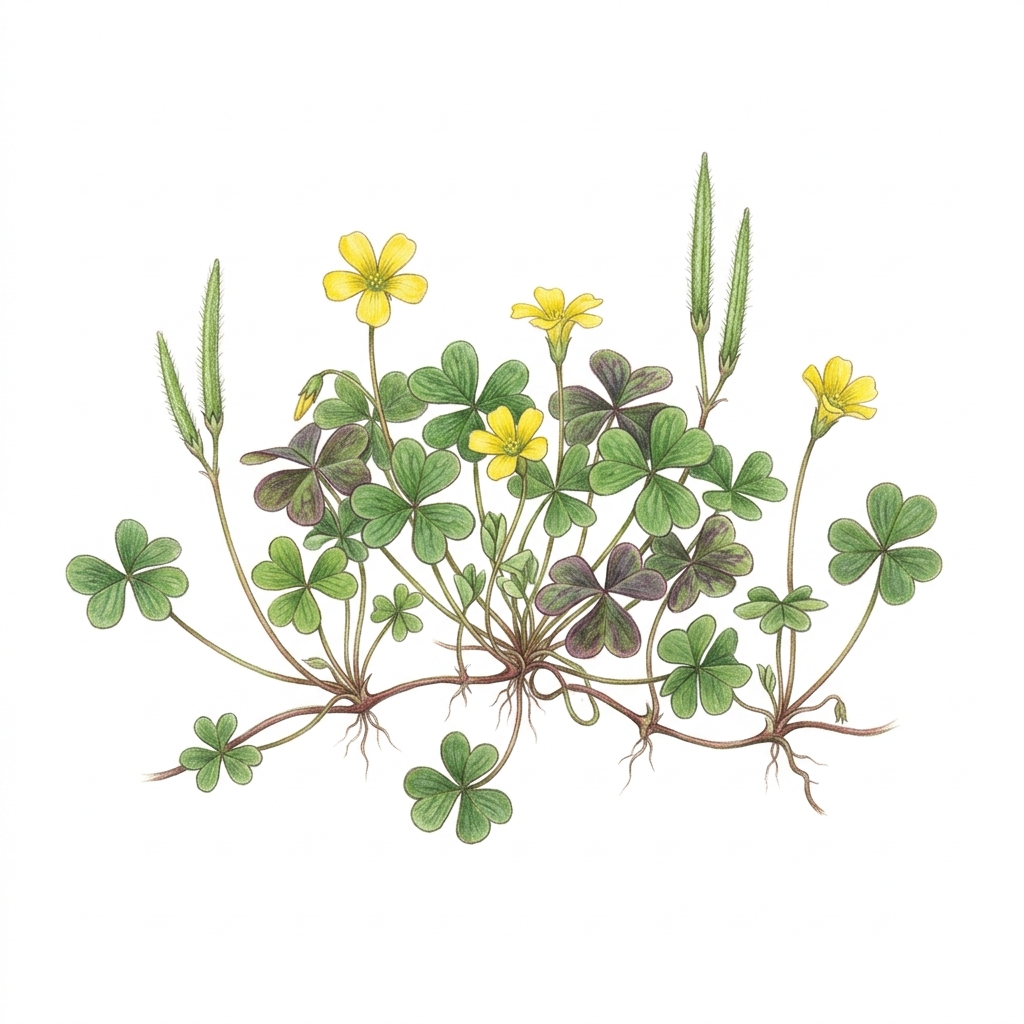
Illustration
A small clover-like weed with yellow flowers and seed pods that fire their seeds up to 3 m. It hides in lawns, pots and paving cracks, and pieces left behind grow back, so expect to weed it more than once.
How to spot it
- Three heart-shaped leaflets, 4–13 mm long, green to deep purple, that fold down at night and in strong sun.
- Creeping stems up to 30 cm long that root at the joints.
- Small yellow five-petalled flowers (petals about 6–7 mm), one to five per stalk, at or below leaf height.
- Upright, slender, hairy seed pods 1–2 cm long, like miniature okra, that burst when touched.
- Older plants have a taproot.
Easily confused with
White clover
Rounded leaflets with a pale V mark, and round white flower heads.
Black medic
Oval leaflets ending in a tiny point, the middle one on its own stalk, and tight round yellow flower heads.
Soursob (Oxalis pes-caprae)
Grows from a bulb with its leaves crowded at ground level, and has much bigger yellow flowers (petals 15–25 mm) on a leafless stalk.
Native oxalis (Oxalis exilis)
A small native of Australia and New Zealand, often the only oxalis in New Zealand lawns. Its seed pods are short and broad (5–11 mm), and a magnifying glass helps tell them apart.
Where it's a problem
- Australia: Naturalised in every state, often in gardens and parks.
- New Zealand: Naturalised, in gardens with deeper soil and more shade.
- United Kingdom: A common garden and lawn weed.
- North America: A weed of yards, lawns and plant nurseries.
- Southern Africa: A troublesome weed of gardens and pots.
What to do
- Pick off flowers and pods before they ripen, so the seeds can't fire.
- Fork out plants with their taproot, or hoe on a warm, dry day. Pieces of root and stem left behind regrow, so go back over the area.
- Mulch beds 5–7.5 cm deep: its seeds need light to sprout.
- Check the pots of new plants before you buy, and use clean potting mix; it often arrives in nursery pots.
- In lawns, rake before mowing to lift the creeping stems. A stronger lawn doesn't crowd it out, so hand removal matters more.
If you use a herbicide, choose one labelled for creeping oxalis and follow the label and local rules. The RHS says home-garden weedkillers aren't very effective on it, and established plants often need a repeat treatment a few weeks later.
Follow your local council's guidance for disposing of weeds. Councils usually advise against putting weeds like this in the green waste / vegetation bin or the compost.
Take care: It contains oxalates, and animals that eat a lot of it, horses especially, can become ill.
Free account, no card needed. You sign up or sign in first, then the scanner opens.
Sources
- University of California IPM: Creeping woodsorrel pest notes
- RHS: Oxalis
- NC State Extension: Oxalis corniculata
- PlantNET, Royal Botanic Garden Sydney
- VicFlora, Royal Botanic Gardens Victoria
- NZ Plant Conservation Network: Oxalis exilis
- SANBI PlantZAfrica: Oxalis
- Penn State Extension: Three weeds with three leaflets
Facts checked Sunday 27 September 2026. General guidance only: follow your local council, agency and product label.