Home › Weed guide › Paspalum
Weed guide
Paspalum
Paspalum dilatatum · Grass family (Poaceae)
Also called dallisgrass (USA), sticky heads (USA).
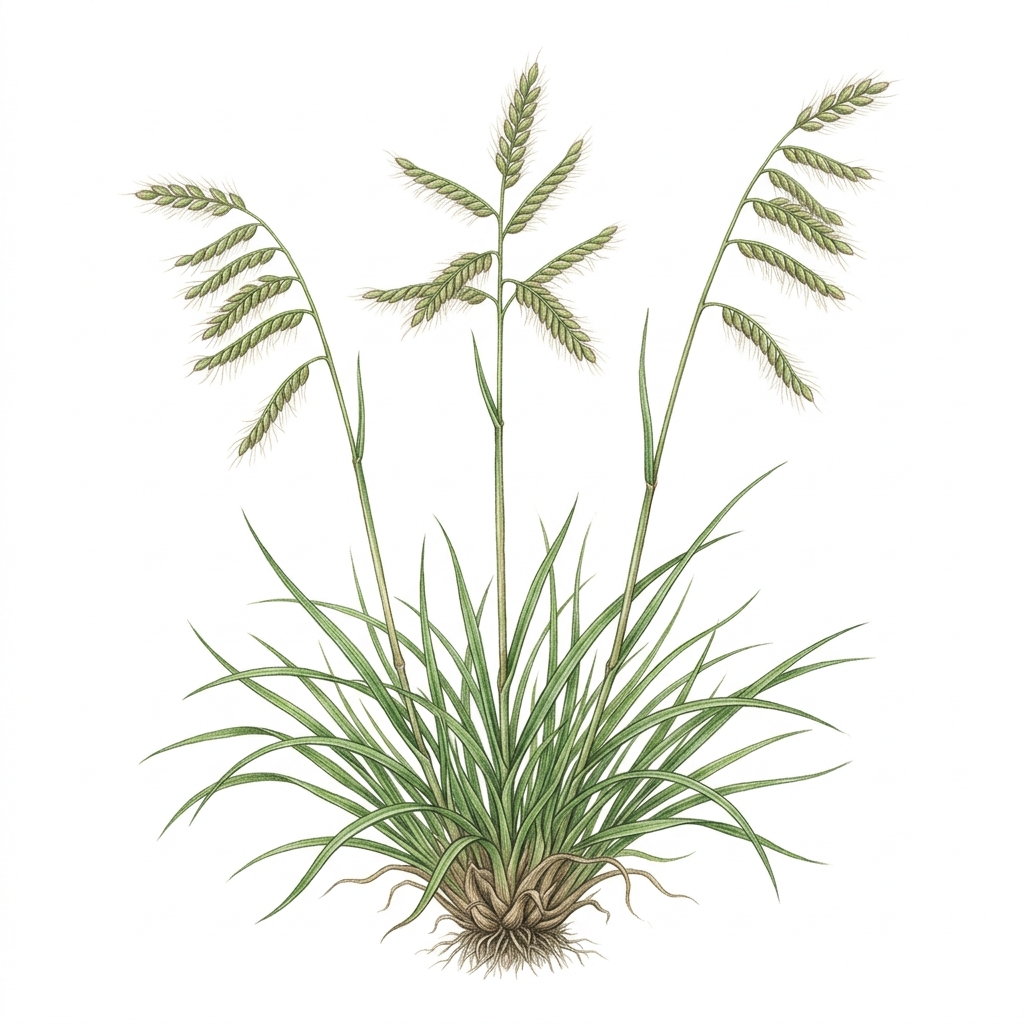
Illustration
A coarse, clumping grass whose tall seed heads shoot up above the mower and stick to shoes and clothes. It grows from a tough, knotted crown, so dig out the whole crown and keep the lawn thick.
How to spot it
- Coarse clumps with flat leaves 3–15 mm wide, lying flat in mown lawns but sending seed stalks up above mower height.
- A tall papery flap (2–8 mm) where each leaf meets the stem.
- Seed heads of usually three to seven drooping branches spaced along the top of the stalk.
- Flat, oval seeds in four rows, fringed with silky hairs and often sticky.
- A tough, knotted crown at the base.
Easily confused with
Bahia grass (Paspalum notatum)
Smooth, shiny, hairless seeds.
Crabgrass
Seed-head branches that start close together near the top of the stem, like fingers.
Tussock paspalum
A tall bluish tussock up to 2 m, with 15–25 branches per seed head.
Where it's a problem
- Australia: An environmental weed in most states and a common lawn weed, but not declared.
- New Zealand: Naturalised since the 1890s.
- USA: Known as dallisgrass; one of the harder weeds to control in turf.
- Southern Africa: Not a listed invasive (only tussock paspalum is).
What to do
- Dig out young plants before they spread or seed. For older clumps, use a mattock to remove the whole crown, as pieces left behind can regrow.
- Cut off seed heads before they ripen, and wash shoes and tools so the sticky seeds don't travel.
- Keep the lawn thick and oversow any bare patches.
- Check again after a few weeks: follow-up is essential.
If you use a herbicide, choose one labelled for paspalum and follow the label and local rules. Even with weedkillers it is very difficult to control.
Follow your local council's guidance for disposing of weeds. Councils usually advise against putting weeds like this in the green waste / vegetation bin or the compost.
Take care: A fungus that grows on the sticky seed heads is toxic to livestock, and the sticky secretion may irritate skin.
Free account, no card needed. You sign up or sign in first, then the scanner opens.
Sources
- Brisbane City Council: Paspalum
- NRE Tasmania: Paspalum
- VicFlora, Royal Botanic Gardens Victoria
- PlantNET, Royal Botanic Garden Sydney
- NZ Plant Conservation Network: Paspalum dilatatum
- University of California IPM: Dallisgrass
- NC State TurfFiles: Dallisgrass
Facts checked Sunday 27 September 2026. General guidance only: follow your local council, agency and product label.