Home › Weed guide › Crabgrass
Weed guide
Crabgrass
Digitaria sanguinalis · Grass family (Poaceae)
Also called summer grass (Australia and New Zealand), hairy finger-grass (UK), large crabgrass (USA).
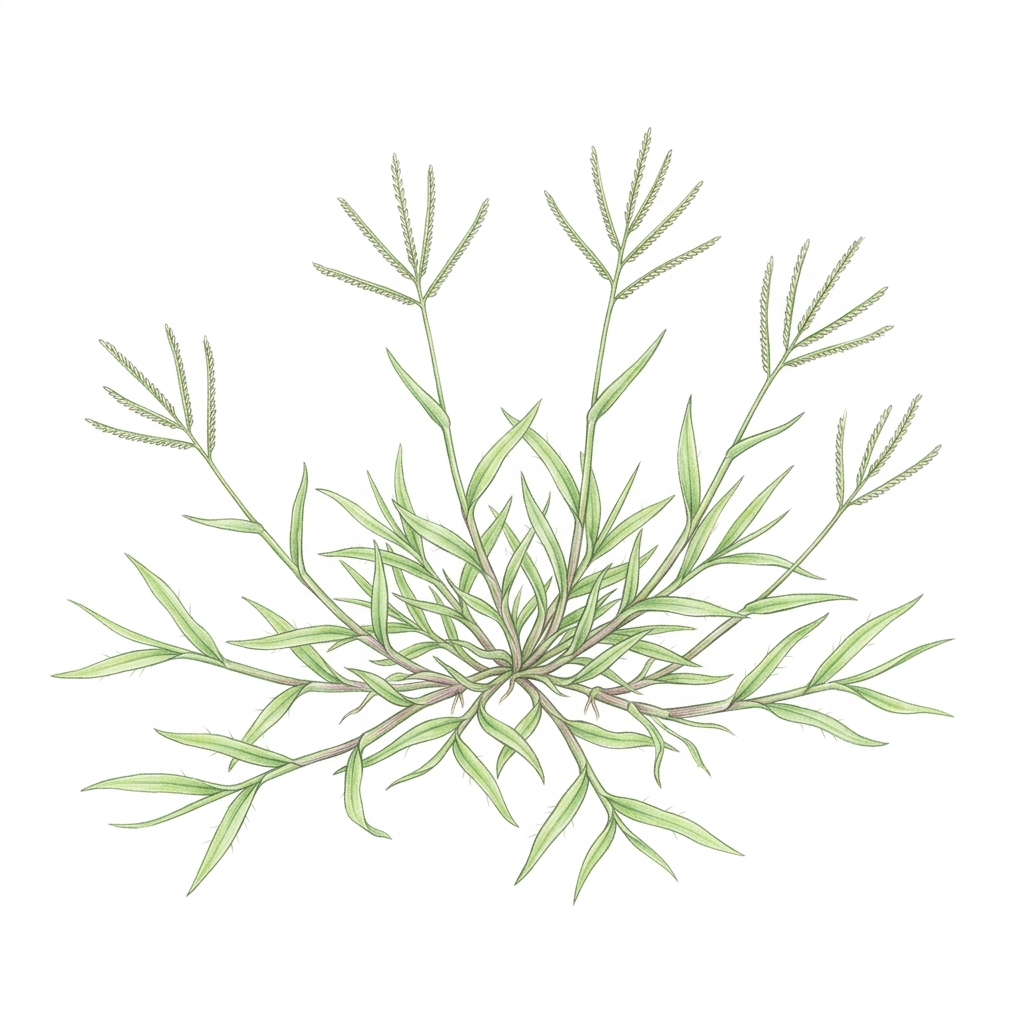
Illustration
A coarse, sprawling summer grass that sprouts as the soil warms in spring and dies with the first frost, after dropping thousands of seeds. Stop it seeding and keep the lawn thick, and it fades away.
How to spot it
- Soft, flat leaves about 4–9 mm wide with a clear midvein, wider than most fine lawn grasses.
- Long scattered hairs on the leaves and leaf sheaths, which are often purple-veined.
- Stems that sprawl out flat from the centre, lie low under the mower and root where they touch the ground.
- Seed heads of 3–11 slender 'fingers', 3–15 cm long, spaced a little way up the stem rather than all from one point.
- Sprouts in spring once the soil stays around 13 °C for several days, and dies at the first frost.
Easily confused with
Summer grass (Digitaria ciliaris)
A very close relative with fewer hairs. It is treated exactly the same way, and in Australia both are called summer grass.
Crowsfoot grass (goosegrass)
A silvery-white centre, folded leaves, and seed-head fingers that all start from the same point.
Couch / Bermuda grass
Where the leaf meets the stem there is a ring of white hairs, and it spreads by runners instead of dying off each winter.
Where it's a problem
- Australia and New Zealand: Introduced; a widespread weed of gardens and irrigated lawns.
- United Kingdom: Non-native, turning up in borders and pavement cracks, often from bird-seed mixes.
- North America: One of the most common lawn weeds.
What to do
- Pull or hoe young plants before they set seed, lifting the roots with a trowel.
- Mow at the top of the recommended height for your lawn (about 7.5 cm for cool-season grasses): taller grass shades out the seedlings.
- Water deeply (soaking the top 15–20 cm) and less often. Light daily watering weakens the lawn and suits the weed.
- Oversow or patch thin spots, so there's no bare soil for seed to land in.
- In garden beds, mulch 5–15 cm deep; the coarser the mulch, the deeper it needs to be.
If you use a herbicide, choose one labelled for crabgrass and follow the label and local rules. Pre-emergent weedkillers, used before it sprouts in spring, are the usual approach. They also stop lawn seed sprouting, so hold off reseeding, and resistance has been recorded.
Follow your local council's guidance for disposing of weeds. Councils usually advise against putting weeds like this in the green waste / vegetation bin or the compost.
Free account, no card needed. You sign up or sign in first, then the scanner opens.
Sources
- University of California IPM: Crabgrass pest notes
- Penn State Extension: Smooth and large crabgrass
- NC State TurfFiles: Large crabgrass
- PlantNET, Royal Botanic Garden Sydney
- VicFlora, Royal Botanic Gardens Victoria
- Flora of New Zealand: Digitaria sanguinalis
- Botanical Society of Britain and Ireland
Facts checked Sunday 27 September 2026. General guidance only: follow your local council, agency and product label.