Home › Weed guide › Couch grass
Weed guide
Couch grass
Cynodon dactylon · Grass family (Poaceae)
Also called Bermuda grass (USA), green couch (Australia), kweek (South Africa).
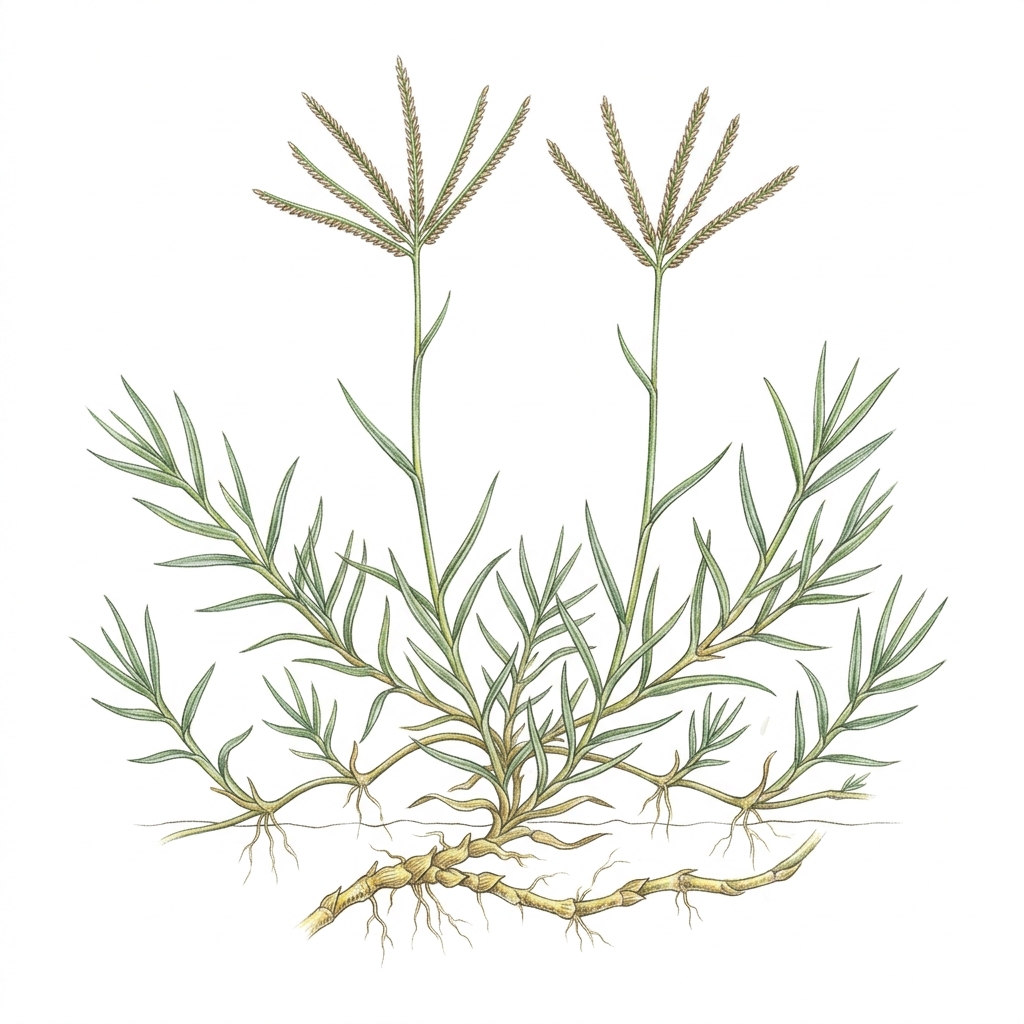
Illustration
A tough, fine-leaved grass that makes a popular lawn in warm climates and a nightmare when its runners creep into garden beds. Every piece of runner can regrow, so it takes thorough removal and a barrier to keep it out.
How to spot it
- Seed heads of 3–7 slender 'fingers', 1.5–6 cm long, all spreading from one point at the top of the stem.
- Short, flat, pointed grey-green leaves, 1.6–9 cm long and only 1–3 mm wide.
- A ring of white hairs where each leaf meets the stem.
- Wiry runners across the surface that root at every joint, plus scaly underground stems.
- It turns brown and goes dormant in cold weather.
Easily confused with
Crabgrass
Its seed-head fingers start a little apart up the stem, not all from one point, and it dies off each winter.
Kikuyu
Never shows a fingered seed head: its tiny flowers hide in the leaf sheaths.
'Couch grass' in the UK (Elymus repens)
The same name for a different grass: taller (to about 1 m), with one unbranched, wheat-like seed spike and no surface runners.
Where it's a problem
- Australia: Sown as a lawn grass, but a significant environmental weed in several states; its runners invade garden beds.
- New Zealand: Listed as an environmental weed.
- USA: Widely used for lawns in the south, and a weed of gardens and landscapes.
- Southern Africa: Native, and valued as a lawn grass.
What to do
- Dig out small patches, removing every piece of runner and underground stem: pieces left in moist soil regrow.
- Don't rotary-hoe live plants: it spreads from the chopped pieces.
- Put a solid edging barrier between lawn and garden beds to stop the runners creeping in.
- Smother bare areas in summer under black plastic with no holes for at least 6–8 weeks. Wood chips alone won't stop it, so lay overlapping landscape fabric under the mulch.
- Check beds regularly and pull any runner the moment it appears.
If you use a herbicide, choose one labelled for couch grass and follow the label and local rules. Grass-only weedkillers spare most flowers and shrubs but will also harm lawns and ornamental grasses, and more than one treatment is usually needed.
Follow your local council's guidance for disposing of weeds. Councils usually advise against putting weeds like this in the green waste / vegetation bin or the compost.
Take care: Its pollen is a common hay fever trigger.
Free account, no card needed. You sign up or sign in first, then the scanner opens.
Sources
- University of California IPM: Bermudagrass pest notes
- University of Maryland Extension: Bermudagrass
- Weeds of Australia (Queensland Government): Couch
- VicFlora, Royal Botanic Gardens Victoria
- Flora of New Zealand: Cynodon dactylon
- ASCIA: Bermuda/couch grass pollen
- RHS: Couch grass
Facts checked Sunday 27 September 2026. General guidance only: follow your local council, agency and product label.