Home › Weed guide › Capeweed
Weed guide
Capeweed
Arctotheca calendula · Daisy family (Asteraceae)
Also called cape dandelion (Australia), tonteldoek (South Africa).
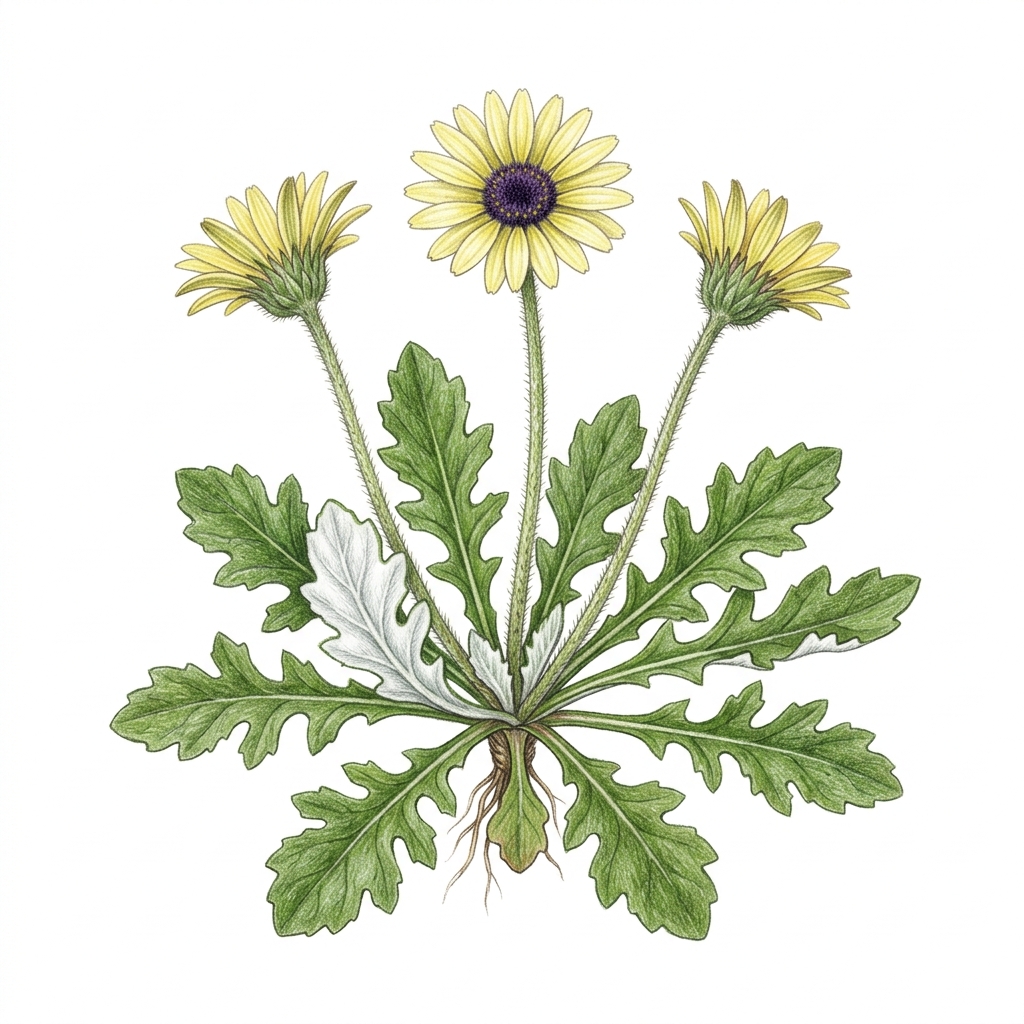
Illustration
A flat rosette with lobed, white-backed leaves and pale yellow daisies with dark centres, sprouting after autumn rain and dying off by summer. Lift it with a fork before it seeds, and keep lawns thick so it can't find bare ground.
How to spot it
- A flat rosette of deeply lobed, toothed leaves 5–25 cm long, green on top and white and felty underneath.
- Single flower heads on hairy, leafless stalks about 15–20 cm tall.
- Pale yellow petals around a dark purple-black centre; flowers about 2–6 cm across.
- Small seeds wrapped in pinkish-brown wool.
- Sprouts after autumn rain, flowers from late winter into spring, and dies off in summer.
Easily confused with
Dandelion
Leaves that aren't white and felty underneath, flowers yellow all over, and a fluffy seed clock.
Prostrate capeweed (Arctotheca prostrata)
A creeping garden groundcover that spreads by runners.
Beach daisy
A yellow centre, and leaves that are white on both sides.
Where it's a problem
- Australia: Naturalised in every state and a common lawn and pasture weed; not declared in Tasmania.
- New Zealand: A naturalised turf weed that is still spreading.
- USA: A Federal Noxious Weed; California rates the seeding form as a top priority.
- Southern Africa: Native.
What to do
- Loosen the soil with a fork and lift out as much of the root as you can, ideally before it seeds.
- Keep lawns and pasture thick: it moves into bare patches left by drought or wear.
- Check again after autumn rain, when new seedlings appear.
If you use a herbicide, choose one labelled for capeweed and follow the label and local rules. Tasmania's weed agency notes that herbicide control is only a short-term solution.
Follow your local council's guidance for disposing of weeds. Councils usually advise against putting weeds like this in the green waste / vegetation bin or the compost.
Take care: On rich soil it can build up nitrate that poisons livestock, and it can cause skin irritation and hay fever in sensitive people.
Free account, no card needed. You sign up or sign in first, then the scanner opens.
Sources
- VicFlora, Royal Botanic Gardens Victoria
- NRE Tasmania: Capeweed
- Brisbane City Council: Capeweed
- WeedScan: Capeweed
- Massey University: Capeweed
- USDA APHIS: Capeweed risk assessment
Facts checked Sunday 27 September 2026. General guidance only: follow your local council, agency and product label.