Home › Weed guide › Dandelion
Weed guide
Dandelion
Taraxacum officinale agg. · Daisy family (Asteraceae)
Also called lion's tooth (North America).
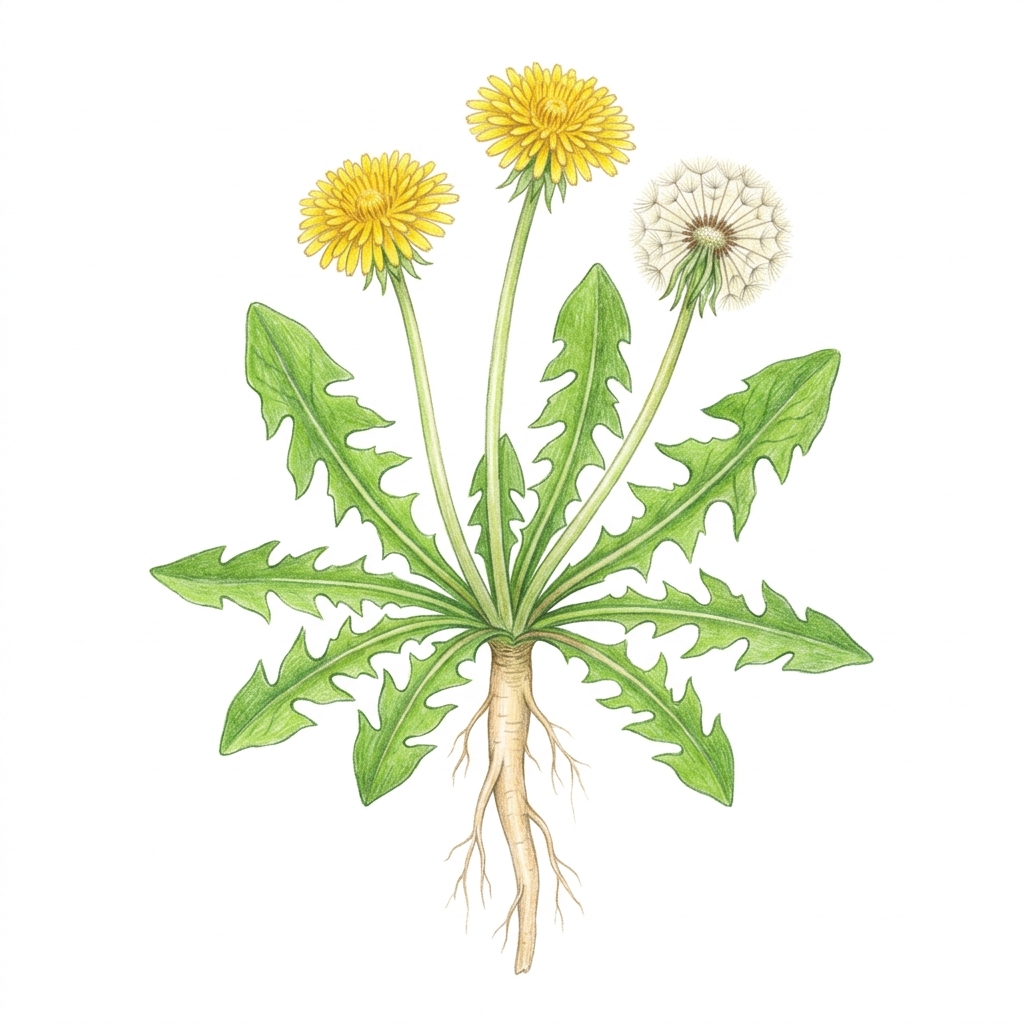
Illustration
The yellow-flowered lawn weed with the fluffy seed clock. Its thick taproot regrows if you only take the top, so dig it out whole, ideally before it seeds.
How to spot it
- A flat rosette of leaves with sharp, triangular lobes pointing back towards the centre: the 'lion's teeth' that give it its name.
- Leaves are usually smooth rather than hairy.
- Each flower sits alone on a hollow, leafless stalk that never branches.
- Bright yellow flower heads 2.5–5 cm across, packed with 100–300 tiny strap-shaped florets.
- Milky sap when a leaf or stalk is snapped, and a thick taproot underneath.
- After flowering, a round white seed 'clock' of tiny parachutes.
Easily confused with
Catsear (flatweed)
Hairy leaves and branched, solid flower stems carrying several flowers. A dandelion's stalk is hollow, unbranched and has just one flower.
Hawkbit
Hairy leaves and thin, wiry flower stems.
Hawksbeard
Hairy leaves and branched flower stems with small leaves on them.
Where it's a problem
- United Kingdom: Common in lawns and borders.
- North America: A familiar weed of lawns and turf across the USA. In Manitoba, Canada, it is a Tier 3 noxious weed that owners must control where it is likely to cause harm.
- Australia: A weed of lawns, roadsides and waste places.
- New Zealand: Naturalised since the 1850s; mostly a lawn and orchard nuisance.
What to do
- Dig or fork out young plants, aiming at the centre of the rosette and taking as much of the taproot as you can. A narrow dandelion weeder makes it easier.
- Pieces of root as short as 2.5 cm can regrow, so come back for any that reappear.
- Pick off flowers as they fade, so they can't set seed.
- Mowing alone won't control it, because the rosette sits below the blades. A thick, well-fed lawn mown at the right height leaves it less room.
- In beds, about 7.5 cm of mulch smothers seedlings. For a bad patch, lay cardboard under a deeper layer of mulch.
If you use a herbicide, choose one labelled for dandelion and follow the label and local rules. Late summer to early autumn is usually the most effective time. Some weedkillers kill the leaves but not the root, and lawn weedkillers also harm clover.
Follow your local council's guidance for disposing of weeds. Councils usually advise against putting weeds like this in the green waste / vegetation bin or the compost.
Take care: The milky sap can irritate sensitive skin, and people with a latex allergy are advised to avoid handling the fresh plant.
Free account, no card needed. You sign up or sign in first, then the scanner opens.
Sources
- RHS: Dandelion
- University of California IPM: Dandelion pest notes
- Cornell University: Dandelion weed profile
- University of Wisconsin–Madison Extension: Dandelion
- Massey University: New Zealand Weeds Database
- Florabase, Western Australian Government
- Manitoba Agriculture: Declaration of noxious weeds
Facts checked Sunday 27 September 2026. General guidance only: follow your local council, agency and product label.