Soil
Topsoil
Also called A horizon (soil scientists), manufactured or blended topsoil (UK, when mixed from subsoil or sand with compost), garden or landscaping soil (Australia).
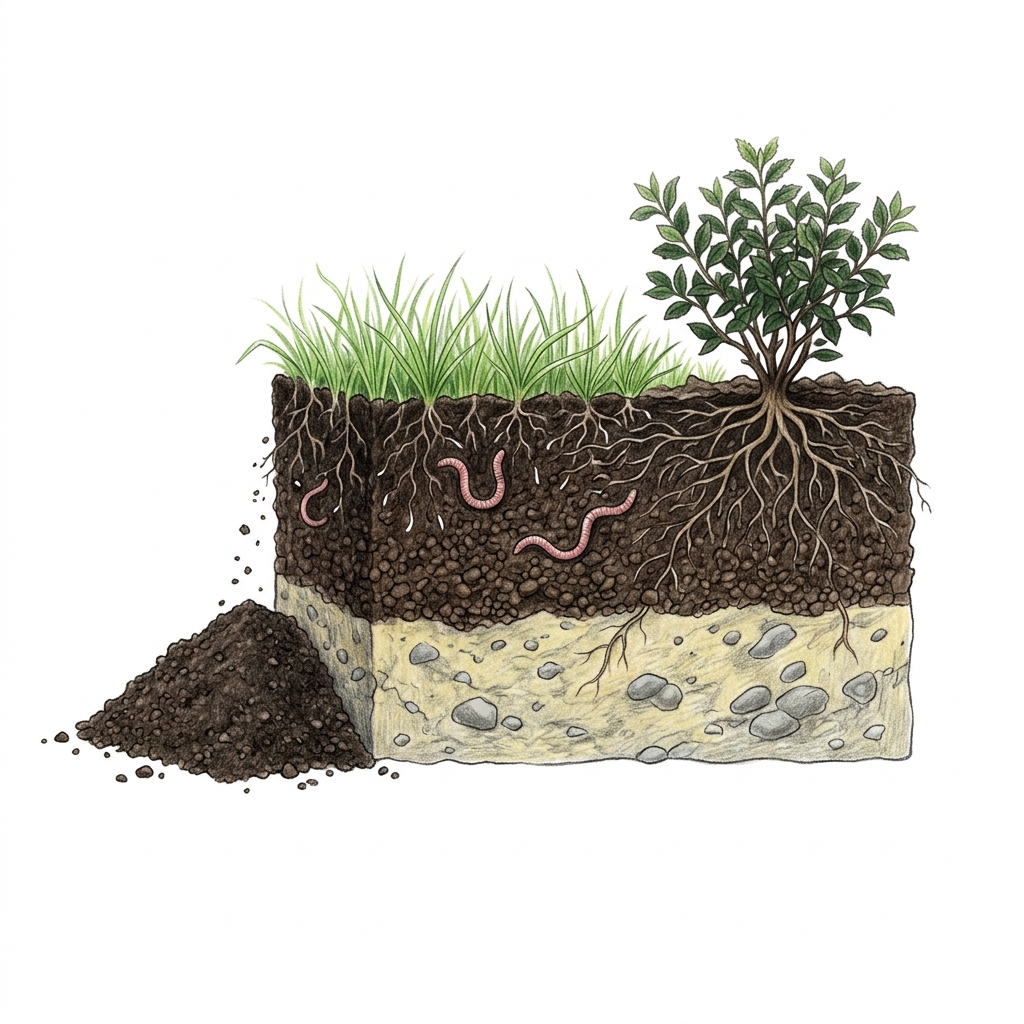
Illustration
Topsoil is the dark top layer of soil, richer in organic matter and life than the subsoil beneath. When buying it, check for stones, weed roots and rubbish, ask where it came from and for test results, and never bury it under subsoil.
How to tell good topsoil
- In a hole, it's the darker top layer. The paler subsoil beneath has more clay, salts and lime.
- Good topsoil has few stones and no thick fibrous roots, weeds, glass, brick or other rubbish. Weed roots are often white and fleshy, sometimes with a brown skin, and can be couch grass or Japanese knotweed.
- Sniff it. Don't buy soil with a chemical or other odd smell.
- Pale soil is usually lower in organic matter than dark brown or black soil, and a white crust on the surface can mean salty soil.
- Sow a few seeds, such as oats and beans, in a sample. If they come up poorly, the soil may carry weedkiller residues, as soil stripped from farmland occasionally does.
Easily confused with
Subsoil
The paler, denser layer below the topsoil. It has more clay, salts and lime, and is a poor substitute.
Soil screened from building waste
Sifted out of site-clearance waste and sometimes sold as 'screened' or 'general purpose' topsoil. It's often very alkaline, salty and infertile, and can hold brick, glass and contaminants. Good topsoil can be screened too, so ask for test results.
Compost
Rotted organic matter, not soil. Bought topsoil is usually low in organic matter, so the two are often mixed.
By region
- United Kingdom: Good topsoil should meet British Standard BS 3882, and it's sold in premium, general-purpose and economy grades. On new estates the original topsoil is usually stripped before building, leaving compacted subsoil and sometimes buried rubble.
- Australia: The voluntary Australian Standard AS 4419 covers soils for landscaping and garden use, and gives the wording for health warnings on bags and with bulk sales. EPA Victoria warns that free soil can hide asbestos, heavy metals and other waste, and whoever accepts untested soil risks being held responsible.
- North America: In Utah, natural topsoil is commonly 5 to 25 cm (2 to 10 in) thick. In Maine, some farm soils spread with sewage sludge decades ago may carry PFAS 'forever chemicals', which is one more reason to ask where soil came from.
How to buy and use it
- Ask the supplier where it comes from and whether it's all from one source, as building-site soil varies. Ask for a copy of any soil analysis, and get their claims in writing.
- See a sample before you buy, and check every load as it arrives. Reject soil with rubbish in it, or that doesn't look or smell right.
- If it hasn't been tested, have a sample tested yourself: a test shows its pH, nutrients, organic matter and any lead. Most bought soil is low in organic matter, so mix in compost or well-rotted manure.
- Loosen compacted ground and clear out rubble first, then spread the topsoil on top. Never bury topsoil under subsoil or rubble, or mix the two.
- Depth: the RHS suggests at least 10 cm for a new lawn and about 20 cm or more for new beds; the UK government's soil code prefers at least 15 cm under lawns. For trees and shrubs, go no deeper than about 40 cm of topsoil, as deeper down it goes airless; use loosened subsoil below that.
- Spread it when the ground is fairly dry. Soil left in a heap goes dense and airless, so dig it over well before planting, turfing or sowing.
Best used for
- Making new beds and borders
- Filling raised beds
- A base for a new lawn, from seed or turf
- Replacing topsoil stripped off in building work
- Trees and shrubs, over loosened subsoil
Take care: Garden soils, including bagged and bulk soil, can carry Legionella bacteria, which cause Legionnaires' disease, a serious lung infection. Keep the soil damp, open bags away from your face, work outside, wear gloves and a P1 or P2 dust mask, and wash your hands afterwards. Imported soil can also hold asbestos, glass or other hazards, so reject loads that contain waste.
Free account, no card needed. You sign up or sign in first, then the scanner opens.
Sources
- RHS: Topsoil: buying guide
- RHS: Transforming a new-build garden
- Defra (UK Government): Construction code of practice for the sustainable use of soils on construction sites
- University of Maine Cooperative Extension: Tips for purchasing soil for gardens and landscape projects
- Utah State University Extension: Topsoil quality guidelines for landscaping
- EPA Victoria: Free soil too good to be true? It just might be
- WA Department of Health: Guideline for the management of public health risks associated with commercial garden soils
Facts checked Sunday 27 September 2026. General guidance only: follow your local council, agency and product label.