Home › Plant diseases › Sooty mould
Plant diseases
Sooty mould
Capnodium and other surface fungi · Fungus
Also called sooty mold (USA).
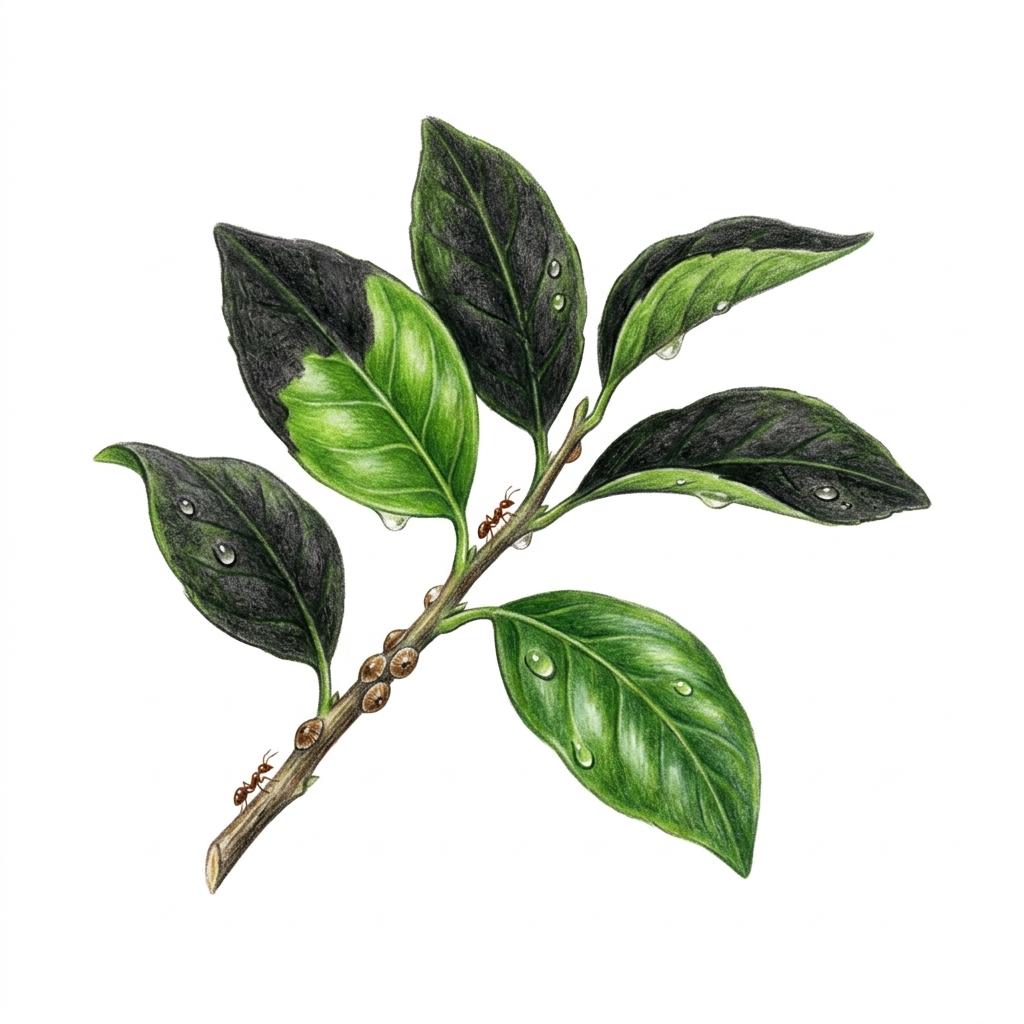
Illustration
A black, sooty coating on leaves that's really a sign of sap-sucking insects. The mould grows on their sticky honeydew, so deal with the insects and it weathers away.
How to spot it
- A black, sooty coating, from a fine powder to a thick sheet, mostly on the upper side of leaves, twigs and fruit.
- Sticky, shiny honeydew underneath it.
- The coating wipes or peels off, leaving a healthy leaf.
- Aphids, scale, mealybugs, whitefly or psyllids nearby, often with ants.
Easily confused with
Rose black spot
Purplish-black patches in the leaf that don't wipe off, with yellowing and leaf drop.
Black mildew
A true disease that won't wash off.
Sooty blotch on apples
Smudges in the fruit's wax, with no honeydew.
Where it's a problem
- Worldwide: Common wherever sap-sucking insects are; the mould itself isn't regulated.
- Australia: One honeydew insect, the Asian citrus psyllid, isn't present and must be reported if found.
What to do
- Find the insect producing the honeydew.
- Hose the insects off, and let natural predators do their work.
- Stop ants protecting them with a sticky band around the trunk, or by trimming branches that touch buildings.
- Wipe leaves with water; once the honeydew stops, the mould weathers away.
The mould itself doesn't need spraying. If you treat the insects, follow the label and local rules, and remember that some insecticides also kill their natural predators.
Free account, no card needed. You sign up or sign in first, then the scanner opens.
Sources
- RHS: Sooty moulds
- University of California IPM: Sooty mold
- University of Maryland Extension: Honeydew and sooty mold
- NC State Extension: Sooty molds
- Business Queensland: Black scale
- NZ Department of Conservation: Beech forest
Facts checked Sunday 27 September 2026. General guidance only: follow your local council, agency and product label.