Home › Plant diseases › Rose black spot
Plant diseases
Rose black spot
Diplocarpon rosae · Fungus
Also called blackspot (USA).
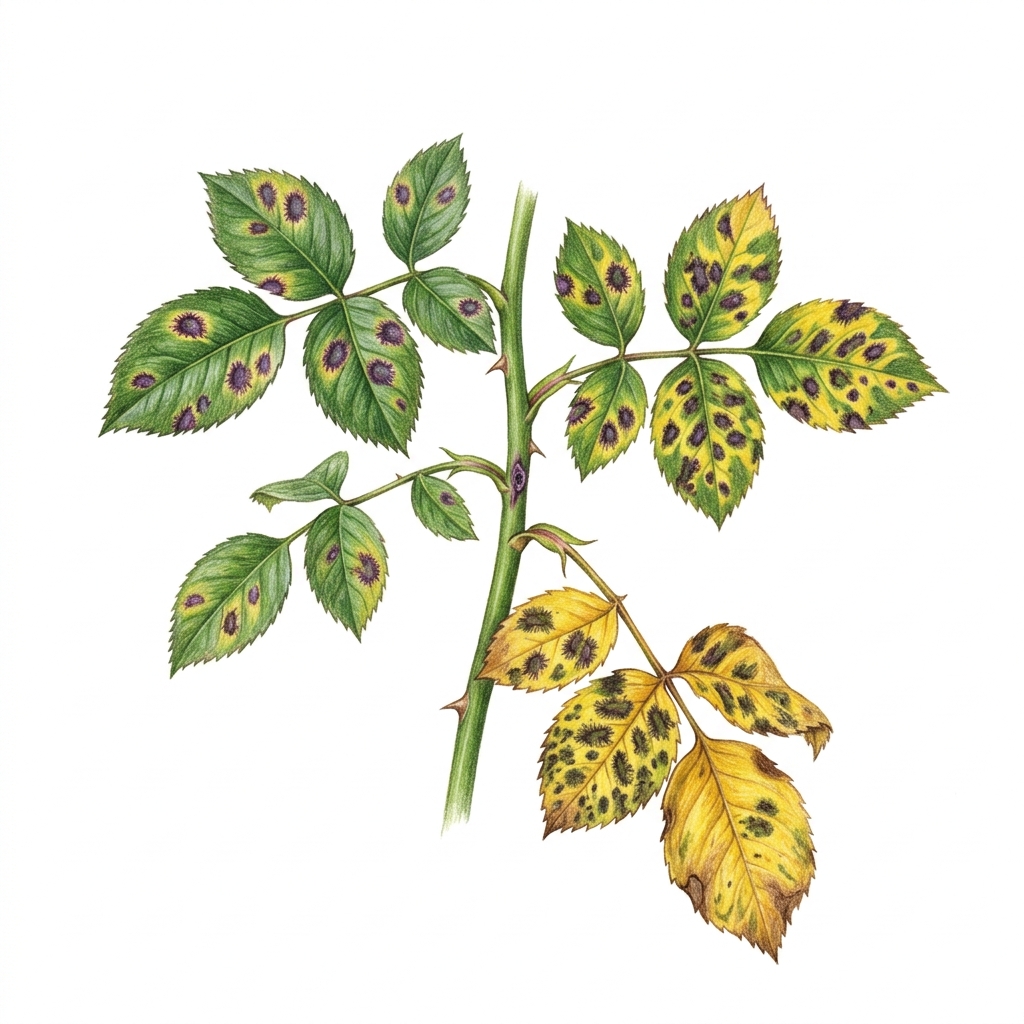
Illustration
Purple-black spots with feathery edges on rose leaves, followed by yellowing and leaf drop. It spreads by splashing water, so clearing fallen leaves and keeping the foliage dry are the keys.
How to spot it
- Purple-black spots, 2–12 mm across, on the upper side of the leaf.
- Feathery, fringed edges to each spot.
- Yellowing around the spots, then leaves falling, from the bottom of the plant up.
- Small black-purple scabby marks on young stems.
Easily confused with
Cercospora leaf spot
Small round spots whose centres turn tan to grey.
Downy mildew
Angular purple-red patches between the veins, with pale fuzz underneath.
Anthracnose
Spots whose centres turn grey or white, with a dark red rim.
Where it's a problem
- Worldwide: Wherever roses grow; worst in warm (20–25 °C), wet weather.
- United Kingdom: Most summers are wet enough for it.
- USA: Rare in inland California, but a problem in humid coastal areas.
What to do
- Collect fallen leaves in autumn, or bury them under mulch.
- Pick off leaves left on over winter, and prune out stem marks in spring before the leaves appear.
- Water the soil, not the leaves, in the morning.
- Grow roses in a sunny, open spot, well spaced and pruned for airflow, and mulch to stop splash.
- Choose resistant varieties, though resistance may last only a few years.
If you use a fungicide, choose one labelled for rose black spot and follow the label and local rules. The RHS recommends against fungicides; where they're used, they only protect and have to be repeated regularly.
Follow your local council's guidance for disposing of diseased plant material. Official guides usually advise against putting it in a home compost heap.
Free account, no card needed. You sign up or sign in first, then the scanner opens.
Sources
- RHS: Rose black spot
- University of California IPM: Rose diseases
- Washington State University Hortsense: Rose black spot
- University of Maine Extension: Black spot of rose
- University of Florida IFAS: Black spot of rose
Facts checked Sunday 27 September 2026. General guidance only: follow your local council, agency and product label.