Home › Garden pests › Sawfly larvae
Garden pests
Sawfly larvae
Caliroa cerasi, Arge, Euura and many related species · Insect
Also called pear and cherry slug (Australia), pear and cherry slugworm (UK), pearslug, roseslug (USA), spitfires (native eucalypt sawflies) (Australia).
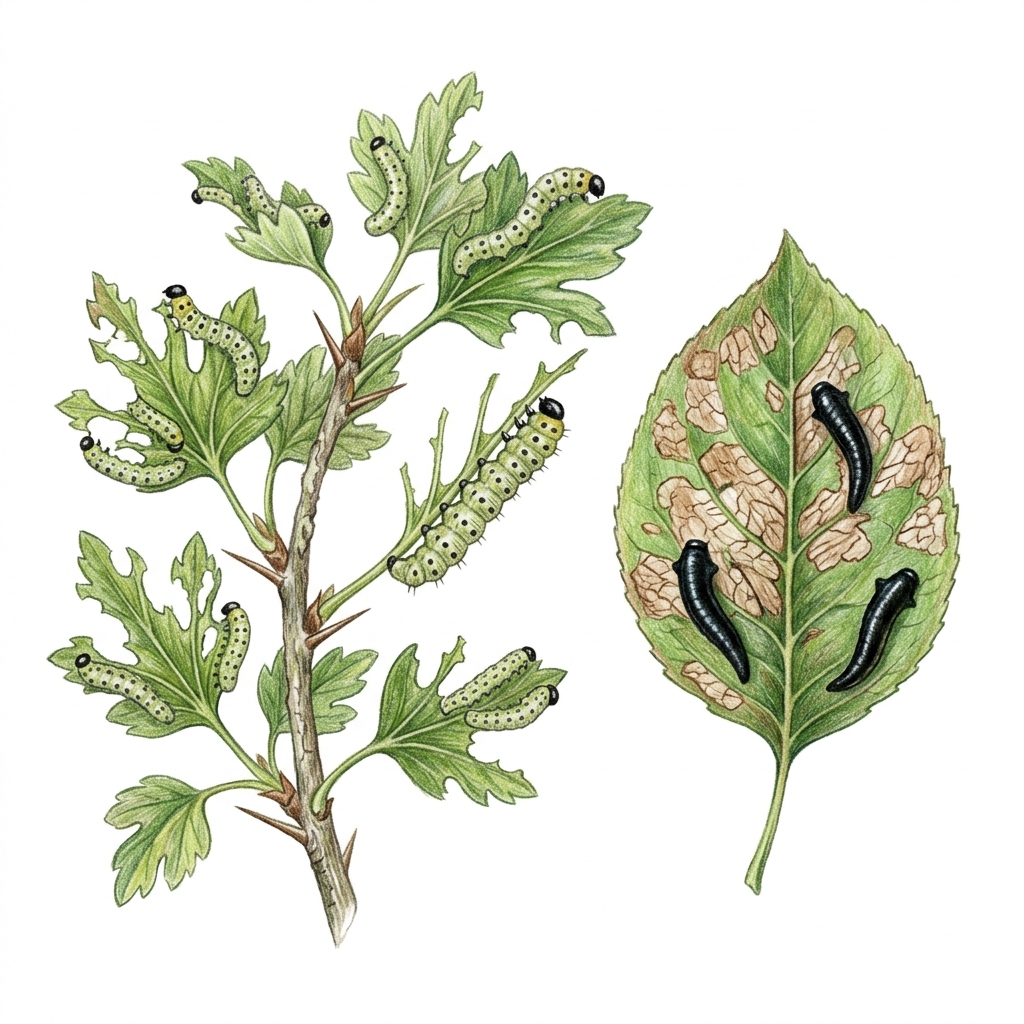
Illustration
Caterpillar-like grubs of small, non-stinging wasps. They strip leaves from gooseberries, currants and roses, or graze pear and cherry leaves until they turn brown. Pick them off by hand; healthy plants usually recover.
How to spot it
- Pale green larvae with many black spots and black heads, up to 20 mm, eating gooseberry and currant bushes bare from low in the centre outwards.
- Pale green larvae with black spots and yellow blotches, up to 25 mm, stripping rose leaves, and long scars on young rose shoots where eggs were laid.
- Small, black, slimy, slug-like larvae (about 10 mm) on pear, cherry and plum leaves, which they graze until the patches dry and turn brown.
- Six or more pairs of stubby legs along the belly: the sure sign of a sawfly larva.
Easily confused with
Moth and butterfly caterpillars
Five or fewer pairs of stubby legs along the belly; sawfly larvae have six or more.
Slugs and snails
Pear and cherry 'slugs' are insect larvae only about 1 cm long that sit on top of the leaf and graze it brown between the veins.
Where it's a problem
- United Kingdom/Europe: Gooseberry sawflies (several generations from late April to September), large rose sawfly (late May to October) and pear and cherry slugworm (June to October) are the common garden kinds.
- North America: Roseslugs on roses, and pearslug and California pear sawfly on fruit trees, are the usual garden species.
- Australia: About 176 native sawfly species live here. Clusters of dark 'spitfire' larvae on eucalypts, melaleucas and bottlebrush raise their tails and give off a yellowish fluid when disturbed, and can strip individual trees.
What to do
- Check plants regularly from mid-spring (from April in the UK), looking low in the centre of gooseberry and currant bushes, where young larvae start.
- Pick larvae off by hand, or knock them off with a strong jet of water.
- On roses, run a fingernail along the egg scars on young shoots to crush the eggs.
- Encourage birds, ground beetles and wasps, which eat them.
- Tolerate light damage: healthy roses recover, and pear and cherry trees and their crop are usually unaffected.
- For serious attacks on gooseberries, a biological control using nematodes is available.
If you use an insecticide, choose one labelled for sawfly larvae and follow the label and local rules. Some caterpillar sprays, the bacterial kind, don't work on sawfly larvae, because they aren't caterpillars.
Take care: Adult sawflies can't sting, but Australian spitfire larvae can release an irritating liquid onto skin or into eyes if disturbed.
Free account, no card needed. You sign up or sign in first, then the scanner opens.
Sources
- RHS: Gooseberry sawfly
- RHS: Large rose sawfly
- RHS: Pear and cherry slugworm
- University of California IPM: Sawflies
- University of California IPM: Pear sawfly
- Business Queensland: Eucalypt sawflies
- Australian Museum: Sawflies
Facts checked Sunday 27 September 2026. General guidance only: follow your local council, agency and product label.