Home › Weed guide › Winter grass
Weed guide
Winter grass
Poa annua · Grass family (Poaceae)
Also called annual bluegrass (USA and Canada), annual meadow grass (UK).
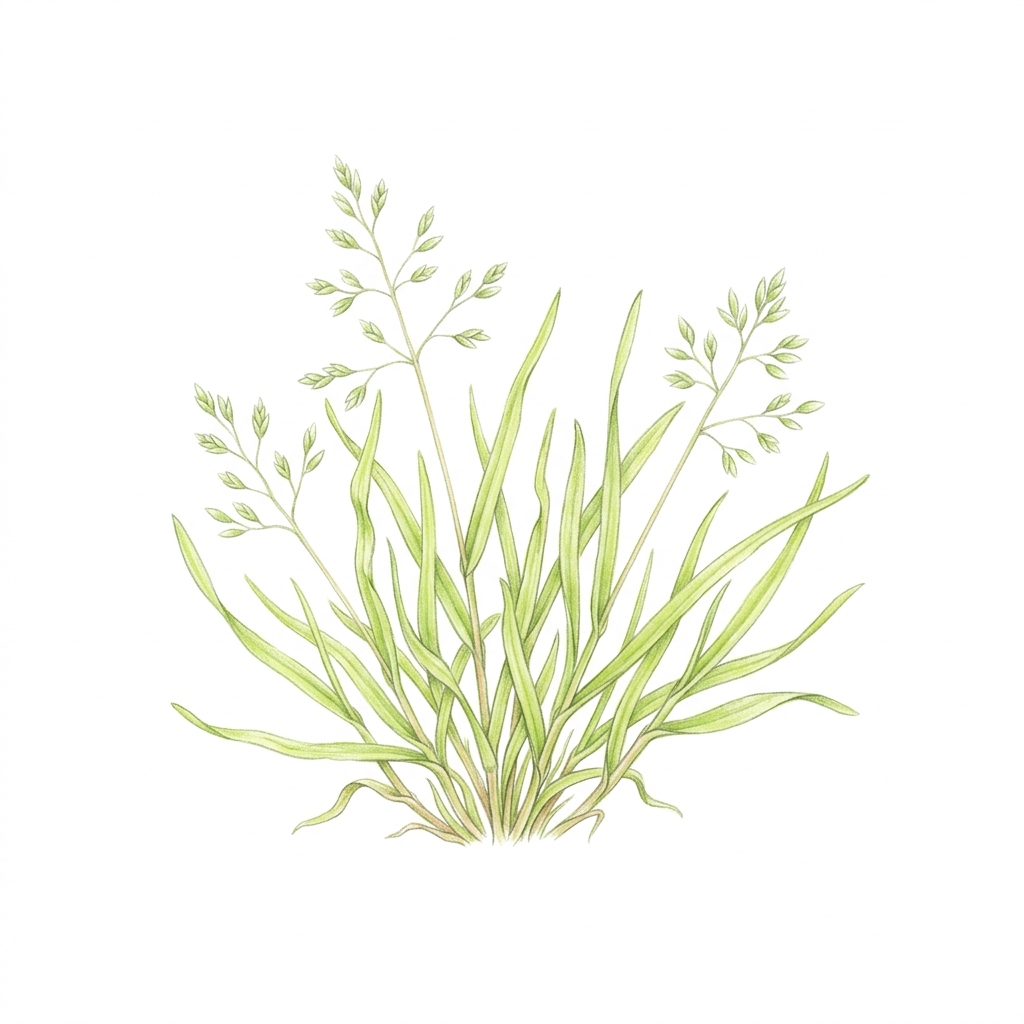
Illustration
The pale, tufty grass that pops up in lawns as the weather cools and flowers even when mown short. It loves compacted, wet or shady spots, so fixing those is the long-term cure.
How to spot it
- Light, lime or yellowish-green tufts that stand out against the rest of the lawn.
- Leaf tips shaped like the bow of a boat.
- Soft blades 1–5 mm wide, often crinkled part way along, with a clear line either side of the midrib.
- Open, pale, triangular seed heads 1–12 cm long, produced even in closely mown lawns.
- Sprouts as the soil cools in late summer and autumn, with more flushes through winter and spring.
Easily confused with
Kentucky bluegrass (smooth meadow-grass)
A lawn grass itself: the small collar where its leaf meets the stem (the ligule) is very short or missing, while winter grass has a clear one.
Rough bluegrass (Poa trivialis)
A glossy underside to the leaf and creeping runners; winter grass has neither.
Where it's a problem
- Australia: A common weed of lawns and disturbed ground.
- New Zealand: Among the most troublesome weeds of turf.
- United Kingdom: Native, and treated as a coarse lawn grass.
- North America: One of the most common weeds of turf and gardens.
What to do
- Pull, hoe or fork plants out before they seed, and repeat through the cooler months as new flushes appear.
- Rake lightly before mowing and collect the clippings, to catch the seed heads.
- Mow higher, above about 6.5 cm. It still flowers below the mower blades, but taller grass competes better.
- Water deeply and less often, and fix compaction, poor drainage and heavy shade where you can.
- Oversow thin patches so the lawn stays dense.
If you use a herbicide, choose one labelled for winter grass and follow the label and local rules. Pre-emergent weedkillers only work if applied before it sprouts in late summer or early autumn; few lawn weedkillers control it once it's up, and resistance is known.
Follow your local council's guidance for disposing of weeds. Councils usually advise against putting weeds like this in the green waste / vegetation bin or the compost.
Free account, no card needed. You sign up or sign in first, then the scanner opens.
Sources
- University of California IPM: Annual bluegrass pest notes
- RHS: Coarse grasses in lawns
- PlantNET, Royal Botanic Garden Sydney
- Flora of New Zealand: Poa annua
- Massey University: Annual poa
- NC State TurfFiles: Annual bluegrass
- Purdue University Turf Science: Annual bluegrass
Facts checked Sunday 27 September 2026. General guidance only: follow your local council, agency and product label.