Home › Weed guide › Stinging nettle
Weed guide
Stinging nettle
Urtica dioica and Urtica urens · Nettle family (Urticaceae)
Also called common nettle (UK), small nettle (Urtica urens; Australia and New Zealand).
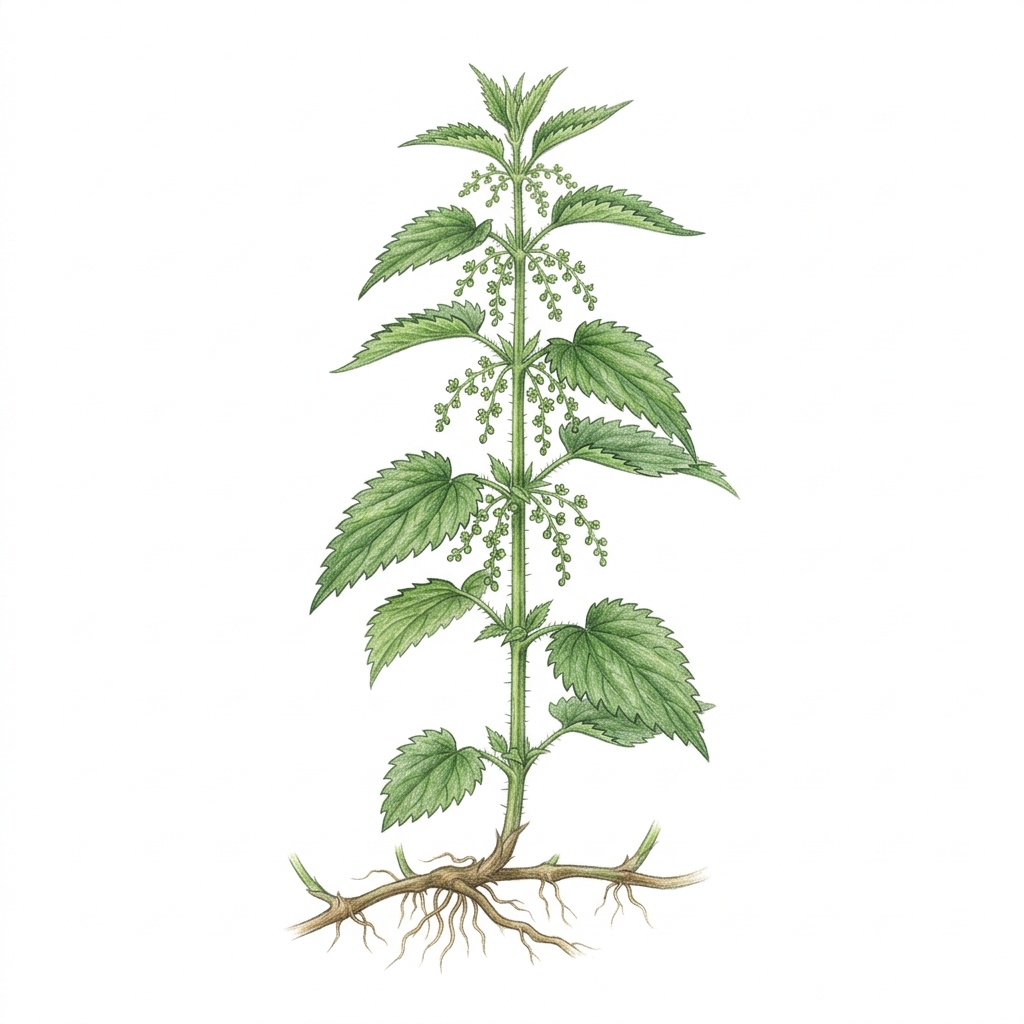
Illustration
The plant that stings: tiny hollow hairs inject irritants when you brush past. Wear gloves, pull small nettles before they seed, and fork out the creeping roots of the tall perennial kind.
How to spot it
- Stinging hairs on the stems and leaves.
- Coarsely toothed, pointed leaves in opposite pairs on square stems.
- Tiny green or cream flowers hanging in strings where the leaves join the stem.
- Common nettle: a perennial up to about 2 m that forms clumps from creeping underground stems.
- Small nettle: an annual under about 60 cm with rounder leaf tips, common in vegetable beds.
Easily confused with
Dead-nettles (Lamium)
No sting, and showy white or pink hooded flowers.
Native scrub nettle (Urtica incisa, Australia)
An Australian native, nearly hairless between its stinging hairs.
Tree nettle, ongaonga (Urtica ferox, New Zealand)
A native shrub whose sting is far more dangerous. Keep well away.
Where it's a problem
- UK and Europe: Native, and a haven for wildlife, but a nuisance in borders.
- North America: Native across much of the continent.
- Australia: Small nettle is a common weed of gardens and vegetable beds; common nettle is naturalised in the east.
- New Zealand: Small nettle is common throughout.
What to do
- Wear gloves, long sleeves and long trousers.
- Hoe or pull small nettle before it seeds: it can set seed about five weeks after sprouting.
- Fork out common nettle with its creeping underground stems: any piece with a joint can grow a new plant.
- Don't dig over or rotavate an established patch, which spreads the roots.
- Cut it regularly, or smother the patch with cardboard and about 20 cm of mulch for a few years.
If you use a herbicide, choose one labelled for stinging nettle and follow the label and local rules. The RHS says there's no need to use a weedkiller.
Follow your local council's guidance for disposing of weeds. Councils usually advise against putting weeds like this in the green waste / vegetation bin or the compost.
Take care: The sting causes redness, itching and burning that usually passes quickly but can last up to 36 hours. Wash with soap and water and don't rub; a cold, damp cloth helps. Get urgent help if lips, mouth or throat swell or breathing becomes hard.
Free account, no card needed. You sign up or sign in first, then the scanner opens.
Sources
- RHS: Nettles as weeds
- University of California IPM: Stinging nettle
- healthdirect Australia: Stinging plants
- Queensland Poisons Information Centre: Stinging nettles
- NZ Plant Conservation Network: Urtica urens
- NZ Plant Conservation Network: Ongaonga
Facts checked Sunday 27 September 2026. General guidance only: follow your local council, agency and product label.