Home › Weed guide › Spurge
Weed guide
Spurge
Euphorbia maculata and Euphorbia peplus · Spurge family (Euphorbiaceae)
Also called spotted spurge (the flat kind in paths and lawns), petty spurge or radium weed (the upright kind in beds).
Illustration
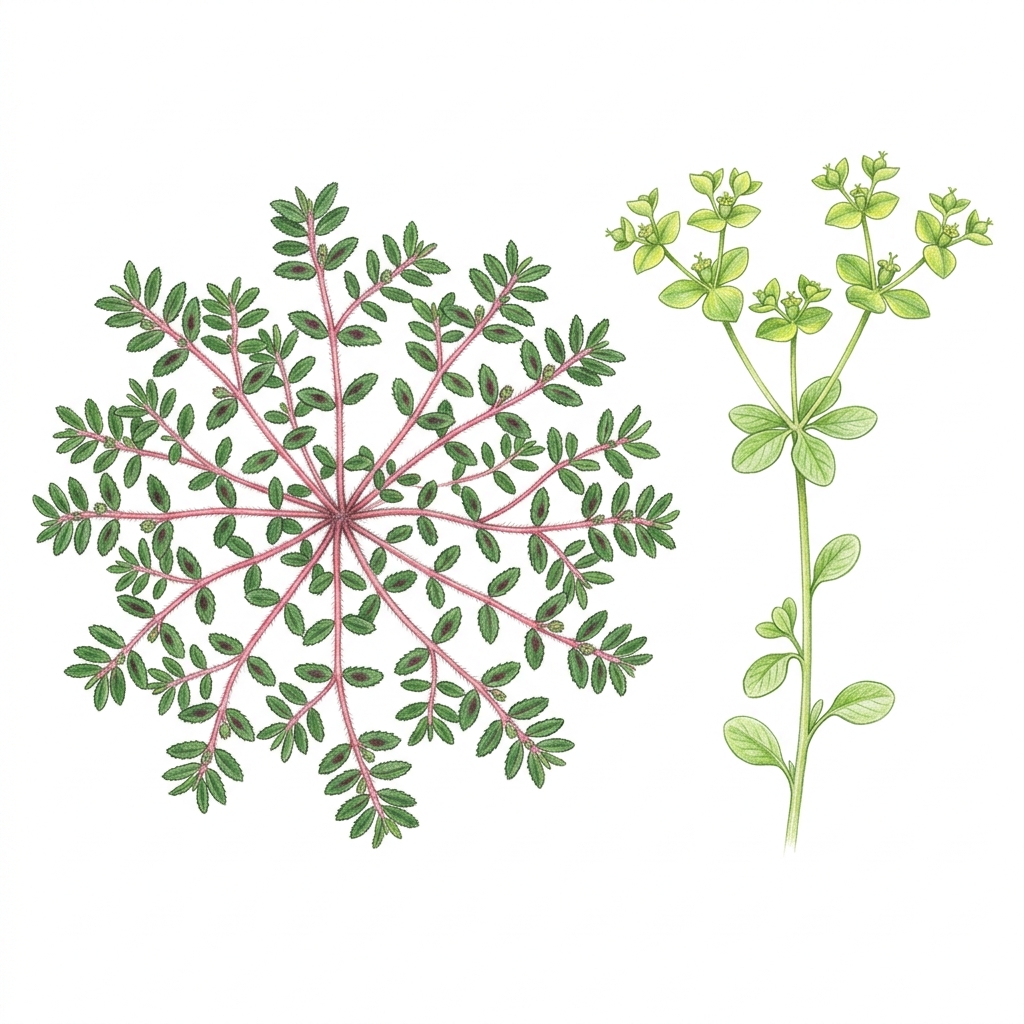
Two common garden spurges: a flat, red-stemmed mat in paths and lawns (spotted spurge), and a small, upright green plant in beds (petty spurge). Both bleed a milky sap that irritates skin and eyes, so always wear gloves.
How to spot it
- Both ooze a white, milky sap when a stem or leaf is broken.
- Spotted spurge: a flat mat of hairy pink-red stems spreading from one root, with small finely toothed leaves (3–8 mm) in pairs, often with a reddish-brown blotch in the middle.
- Petty spurge: upright and hairless, 5–40 cm tall and light green, with rounded smooth-edged leaves and a top that forks into little umbrella-like branches.
- Tiny flowers: spotted spurge's sit where the leaves join the stem; petty spurge's are greenish cups at the tips.
- Seed capsules are hairy on spotted spurge and smooth on petty spurge.
Easily confused with
Purslane
Fleshy, succulent leaves and no milky sap.
Prostrate knotweed
Leaves grow one at a time, with a papery sheath where each joins the stem, and there's no milky sap.
Sun spurge
Like petty spurge, but its leaves are toothed near the tip.
Where it's a problem
- Australia: Petty spurge is an environmental weed in several southern states; spotted spurge is a common weed of paths and cracks.
- New Zealand: Both are introduced and common.
- United Kingdom: Petty spurge is a long-established garden weed; spotted spurge is turning up more and more in pavements in the south and east.
- North America: Spotted spurge is one of the most common weeds of lawns and gardens.
What to do
- Always wear gloves: the sap is a strong irritant.
- Pull or hoe young plants before they seed, getting the root out, because broken stems can regrow from the crown. Spotted spurge can set seed about five weeks after sprouting.
- Mulch at least 5 cm deep: the seeds need light, and few sprout from deeper than about 1 cm.
- In lawns, keep the grass thick and mow at 5 cm or higher.
- Check the pots of new plants before you buy: it often comes along for the ride.
If you use a herbicide, choose one labelled for spurge and follow the label and local rules. In vegetable gardens, only use a product whose label covers food crops.
Follow your local council's guidance for disposing of weeds. Councils usually advise against putting weeds like this in the green waste / vegetation bin or the compost.
Take care: The milky sap can cause intense pain and blistering on skin, and severe pain and swelling if it gets in the eyes. For eyes, rinse with water for 15 minutes and get urgent medical care (Queensland Poisons Information Centre).
Free account, no card needed. You sign up or sign in first, then the scanner opens.
Sources
- University of California IPM: Spurges pest notes
- University of Wisconsin–Madison Extension: Spotted spurge
- Penn State Extension: Spotted spurge
- PlantNET, Royal Botanic Garden Sydney: Euphorbia maculata
- Weeds of Australia (Queensland Government): Petty spurge
- Queensland Poisons Information Centre: Petty spurge
- RHS: Euphorbia peplus
- Flora of New Zealand: Euphorbia peplus
Facts checked Sunday 27 September 2026. General guidance only: follow your local council, agency and product label.