Home › Weed guide › Ribwort plantain
Weed guide
Ribwort plantain
Plantago lanceolata · Plantain family (Plantaginaceae)
Also called buckhorn or English plantain (USA), narrow-leaved plantain (New Zealand and Canada).
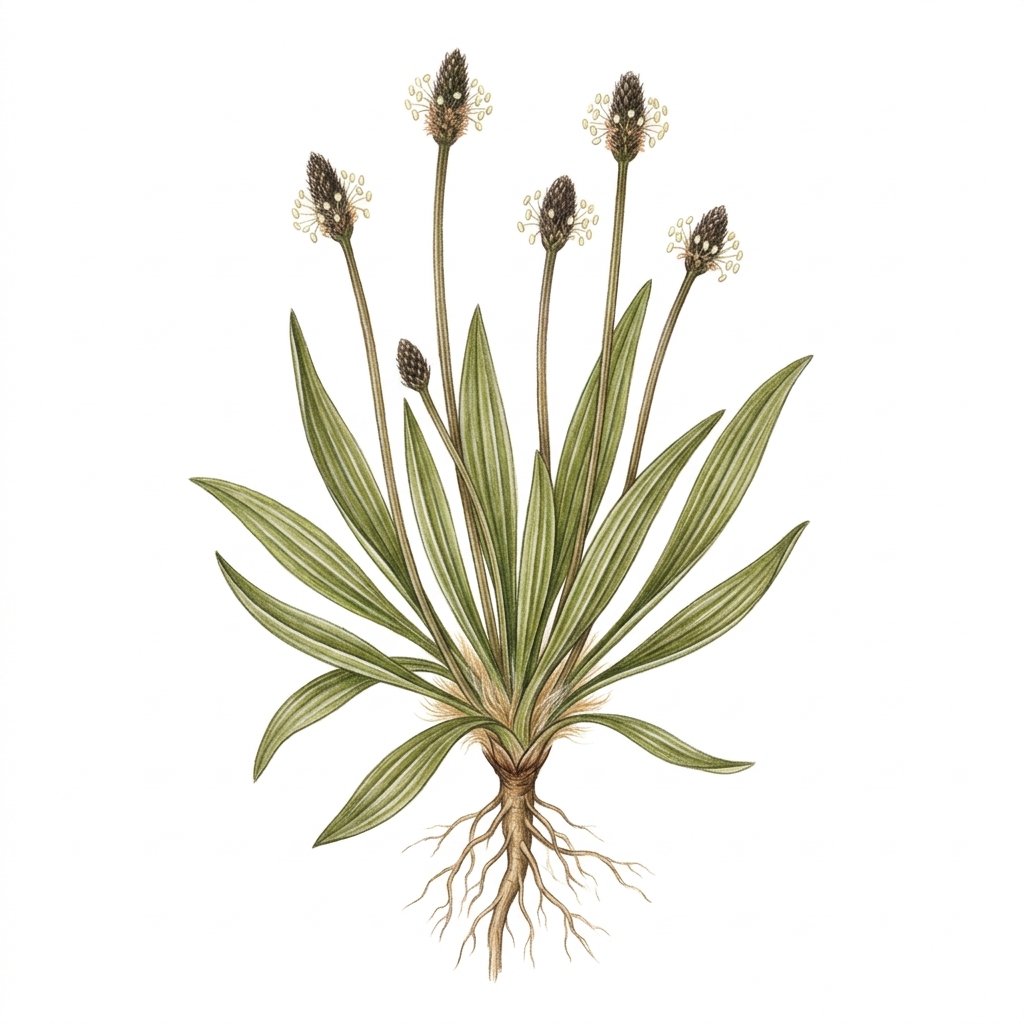
Illustration
A rosette of long, narrow, ribbed leaves with short dark flower heads on tall stalks. It likes dry, hungry lawns, so dig out the taproot and give the lawn a feed.
How to spot it
- A rosette of long, narrow, lance-shaped leaves, 7–20 cm long and 1–4 cm wide.
- Three to five strong, pale ribs running the full length of each leaf.
- Tan woolly hairs at the crown, where the leaves meet.
- Tall, grooved, leafless stalks topped with a short, dense, dark-brown oval head (usually 2–8 cm) ringed with creamy-white stamens.
- A taproot underneath.
Easily confused with
Broadleaf plantain
Broad oval leaves and a long, slender, pencil-like flower spike.
Native variable plantain (Australia)
Obvious triangular teeth along the leaf edges and smooth, unridged flower stalks; ribwort has only a few tiny teeth and ridged stalks.
Buck's-horn plantain
Narrow leaves that are deeply lobed, like antlers.
Where it's a problem
- UK and Europe: Native, and sometimes considered a weed, though it is also valued for wildlife.
- Australia: Regarded as an environmental weed in NSW, Victoria and Western Australia.
- New Zealand: Naturalised since the 1850s.
- North America: Introduced; in Canada its seed is listed as a noxious weed seed.
What to do
- Dig out the whole taproot with a hand fork or a taproot weeder, ideally before it flowers.
- Go deep enough to get the crown: it can regrow if it's cut off at the surface.
- Mowing won't control it, but avoid mowing very short.
- Feed and water the lawn: it thrives on dry, low-fertility soil and struggles in a thick lawn.
- In garden beds, 5–10 cm of mulch stops the seedlings.
If you use a herbicide, choose one labelled for ribwort plantain and follow the label and local rules. Mature plants are hard to kill with weedkillers, and the RHS says non-chemical methods are enough. Clippings from a treated lawn shouldn't go into compost or be used as mulch.
Follow your local council's guidance for disposing of weeds. Councils usually advise against putting weeds like this in the green waste / vegetation bin or the compost.
Take care: Its pollen is a well-known hay fever trigger while it flowers in summer.
Free account, no card needed. You sign up or sign in first, then the scanner opens.
Sources
- University of California IPM: Plantains pest notes
- University of California IPM: Buckhorn plantain
- RHS: Plantago lanceolata
- VicFlora, Royal Botanic Gardens Victoria
- PlantNET, Royal Botanic Garden Sydney
- Weeds of Australia (Queensland Government)
- NZ Plant Conservation Network: Plantago lanceolata
- ASCIA: Plantain pollen
Facts checked Sunday 27 September 2026. General guidance only: follow your local council, agency and product label.