Home › Weed guide › Ragwort
Weed guide
Ragwort
Jacobaea vulgaris · Daisy family (Asteraceae)
Also called common ragwort (UK, Australia and New Zealand), tansy ragwort (USA and Canada).
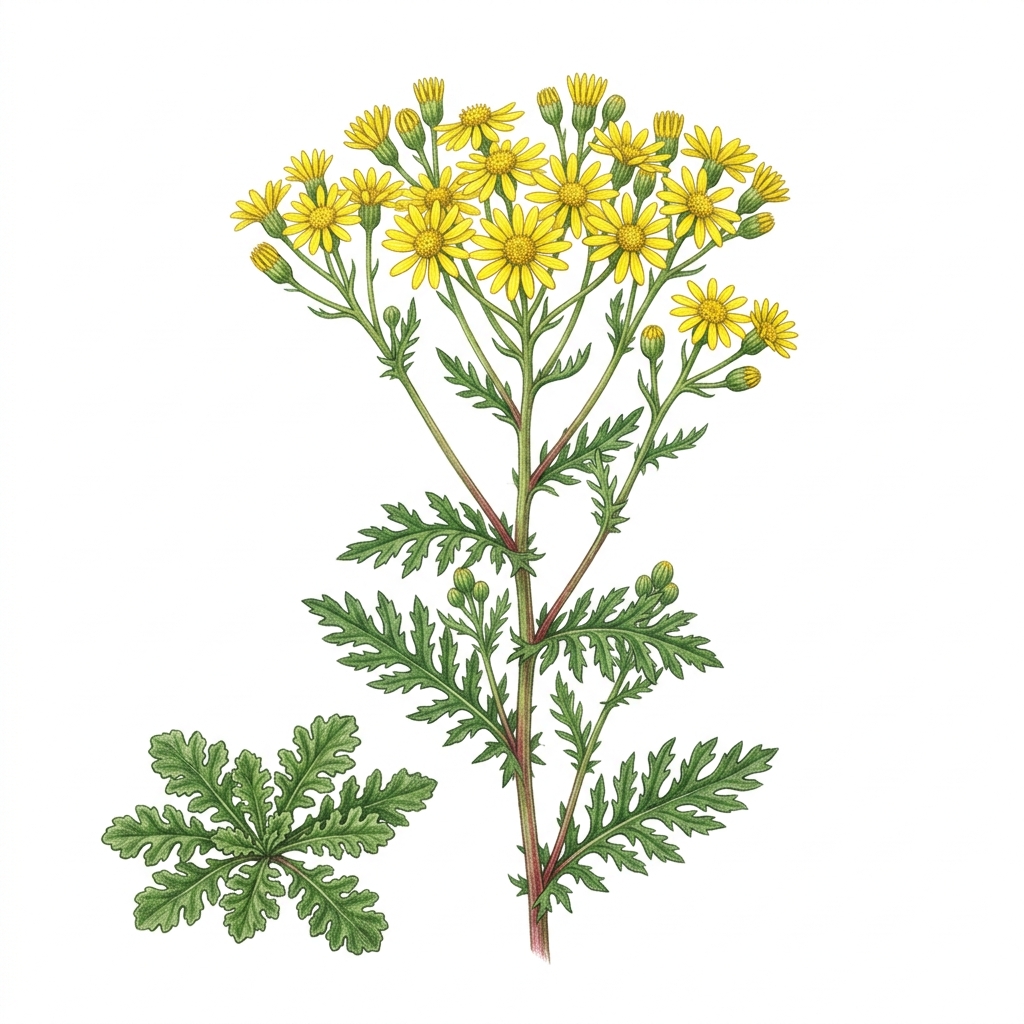
Illustration
A tall yellow daisy that's poisonous to horses and cattle. In gardens it mainly matters if it can spread to grazing land nearby; pull out the whole root with gloves on, and don't just cut it.
How to spot it
- Flat-topped clusters of bright yellow daisy flowers, each about 2 cm across with around 13 petals; centre and petals both yellow.
- Dark green, deeply and raggedly cut leaves.
- An upright stem usually 30–90 cm tall, often red-tinged at the base and branching only near the top.
- In its first year, a flat rosette of ruffled leaves; it flowers in its second year.
- An unpleasant smell when crushed.
Easily confused with
Fireweed (Senecio madagascariensis)
A related Australian Weed of National Significance, usually 10–60 cm tall, with long, narrow leaves no more than about 1 cm wide. It is also toxic to livestock.
Common tansy
Button-like yellow flowers with no petals.
St John's wort
Flowers with five petals, not about thirteen.
Protected ragworts (UK)
Fen ragwort is protected, so be sure of your identification before removing a ragwort-like plant.
Where it's a problem
- United Kingdom: One of five 'injurious weeds' under the Weeds Act 1959. You can have it on your land, but you should stop it spreading to grazing or forage land; the official code of practice treats flowering plants within 50 m of such land as high risk.
- Australia: Declared in several states, including Tasmania, where its import, sale and distribution are prohibited.
- New Zealand: Regional councils require control near boundaries with productive land.
- North America: A listed noxious weed in Washington, Oregon and Ontario.
What to do
- Wear waterproof gloves and cover your arms and legs.
- Pull or dig out the whole plant with its root, ideally in its first year or when the soil is moist; root pieces left behind regrow.
- Don't cut or mow it: it soon flowers again and can become perennial.
- Never leave pulled plants where animals can reach them: wilted ragwort is still poisonous.
- Hoe seedlings in spring and autumn, and keep grass or pasture thick.
If you use a herbicide, choose one labelled for ragwort and follow the label and local rules. Sprayed plants stay poisonous, so remove them from anywhere animals graze.
Follow your local council's guidance for disposing of weeds. Councils usually advise against putting weeds like this in the green waste / vegetation bin or the compost.
Take care: Poisonous to livestock, especially horses and cattle: it causes cumulative liver damage that can be fatal, and it's eaten more readily when dried in hay or silage. Handling it can irritate skin.
Free account, no card needed. You sign up or sign in first, then the scanner opens.
Sources
- GOV.UK: Stop ragwort and other harmful weeds spreading
- Defra: Code of practice on ragwort
- RHS: Ragwort
- NRE Tasmania: Ragwort
- NSW DPI WeedWise: Fireweed
- Weeds Australia: Ragwort
- Waikato Regional Council: Ragwort
- Washington State Noxious Weed Control Board: Tansy ragwort
Facts checked Sunday 27 September 2026. General guidance only: follow your local council, agency and product label.