Home › Weed guide › Poison ivy
Weed guide
Poison ivy
Toxicodendron radicans · Cashew family (Anacardiaceae)
Also called western poison ivy (Toxicodendron rydbergii) (western North America).
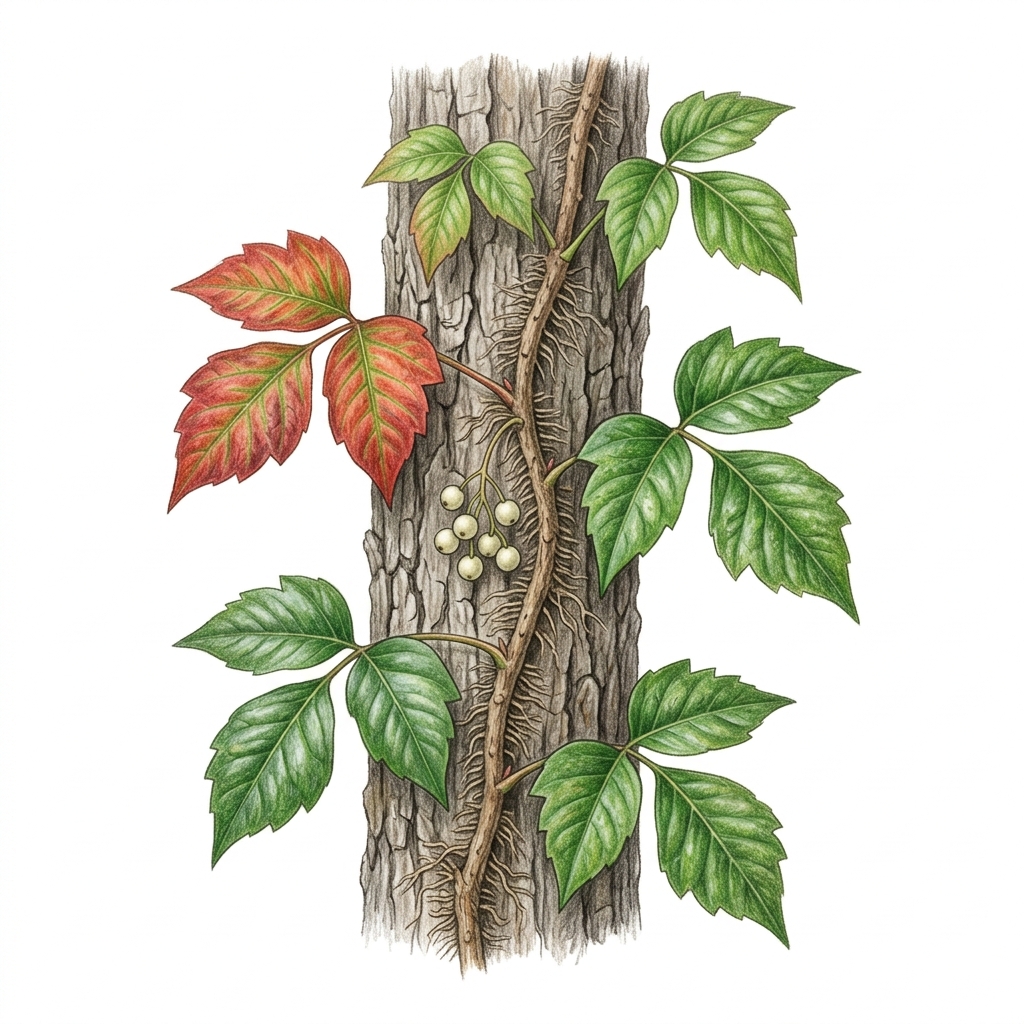
Illustration
The North American vine behind the itchy, blistering rash. Every part of the plant carries an oil, urushiol, that causes it, even when the plant is dead, so remove it with great care and never burn it.
How to spot it
- Leaves made of three leaflets (rarely five), with the middle leaflet on a longer stalk.
- Leaflets 3–12 cm long with pointed tips; the edges can be smooth, toothed or lobed, even on the same plant.
- Climbing stems covered in hairy aerial roots, like a hairy rope up a tree trunk.
- Clusters of small creamy-white berries from late summer into winter.
- Glossy green in summer and red, orange or yellow in autumn; new spring growth is often reddish.
Easily confused with
Virginia creeper
Five leaflets, not three.
Boxelder seedlings
Leaves grow in opposite pairs; poison ivy's alternate along the stem.
Blackberries and raspberries
Thorny stems; poison ivy has none.
Poison oak
Oak-like lobed leaflets. It causes the same rash.
Where it's a problem
- North America: Native across most of the USA and southern Canada.
- Australia: Not established. South Australia requires it to be destroyed and reported, and it is a prohibited pest in Western Australia.
- New Zealand and UK: Not known to grow wild.
What to do
- Cover up before you start: long sleeves, long trousers and gloves (cotton gloves over plastic ones).
- Dig out the whole plant, roots included, when the soil is moist. Winter, when it's leafless, is the safest time.
- Bag it. Never burn it or compost it.
- Don't mow, strim or rotary-hoe through it: that spreads the oil and the roots, and cutting alone makes it resprout.
- Wash tools, gloves and clothes afterwards, separately from other washing. Dead and dried plants can still cause a rash for years.
If you use a herbicide, choose one labelled for poison ivy and follow the label and local rules. Treated and dead plants still carry the oil, so handle them with the same care.
Follow your local council's guidance for disposing of weeds. Councils usually advise against putting weeds like this in the green waste / vegetation bin or the compost.
Take care: Its oil causes an itchy, blistering rash, usually 12–48 hours after contact. Wash skin with soap and cool water as soon as possible. Never burn it: the smoke can harm the lungs. Get emergency help for a severe reaction, such as swelling or difficulty breathing (US CDC and FDA).
Free account, no card needed. You sign up or sign in first, then the scanner opens.
Sources
- University of California IPM: Poison oak and poison ivy
- Clemson University HGIC: Poison ivy
- University of Wisconsin–Madison Extension: Poison ivy
- US CDC NIOSH: Poisonous plants
- US FDA: Outsmarting poison ivy
- Weeds Australia: Poison ivy
- PIRSA (South Australia): Poison ivy
Facts checked Sunday 27 September 2026. General guidance only: follow your local council, agency and product label.