Home › Weed guide › Nutgrass
Weed guide
Nutgrass
Cyperus rotundus · Sedge family (Cyperaceae)
Also called purple nutsedge (USA), coco grass (UK).
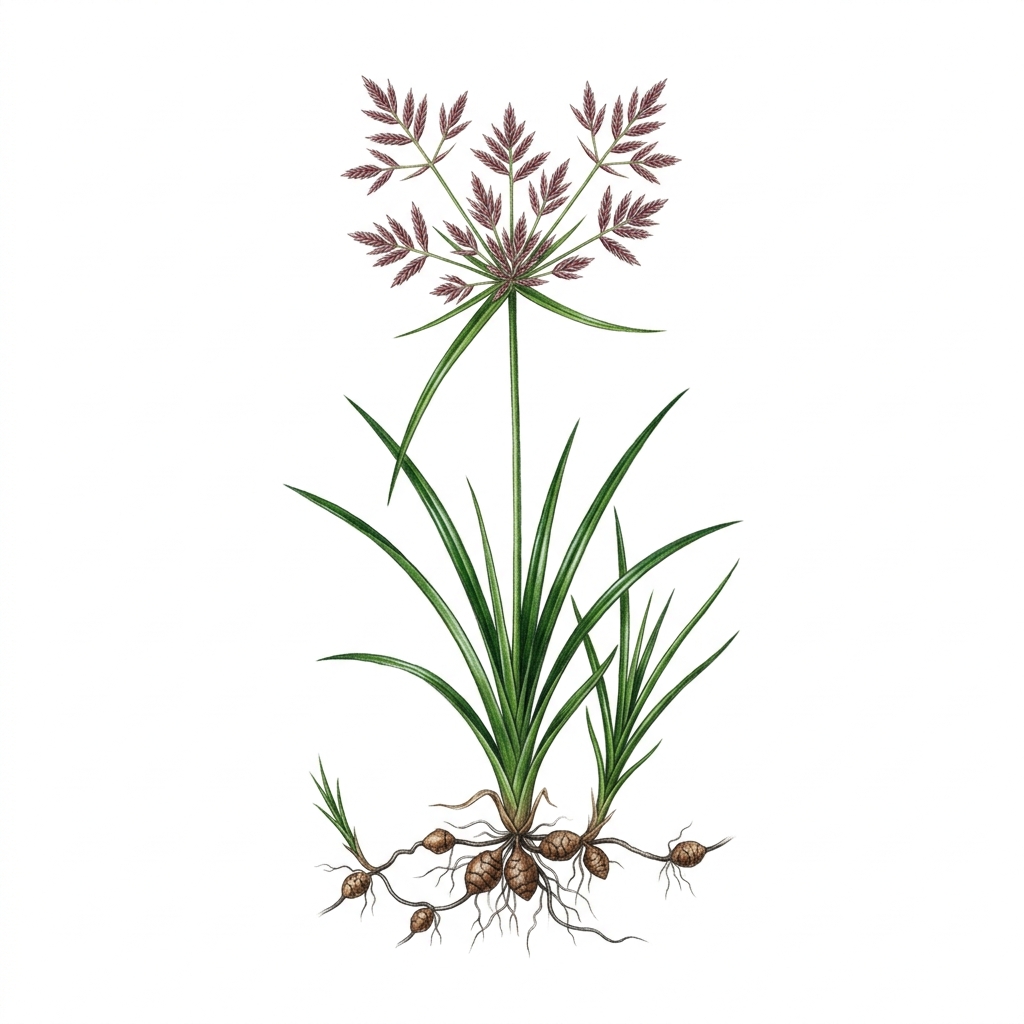
Illustration
Not a grass at all but a sedge, and one of the hardest garden weeds to beat: pull the top and it regrows from chains of little nuts underground. The answer is to keep removing it while it's young until the nuts run out.
How to spot it
- Roll a stem between your fingers: it's triangular and solid. Grass stems are round and hollow.
- Leaves come in threes from the base (grasses come in twos): dark green, narrow (2–6 mm), folded into a V, with a blunt tip.
- Reddish-purple to brown flower heads of flattened spikelets on spreading branches, with long leaf-like bracts underneath.
- Usually 15–30 cm tall.
- Dig one up and you'll find hard, scaly brown 'nuts' about 1 cm across, joined in chains along underground stems.
Easily confused with
Yellow nutsedge (Cyperus esculentus)
Straw to golden-brown flower heads, lighter green leaves with sharp tips, and a single nut at the end of each runner instead of chains. It is a declared weed in some Australian states.
Lawn grasses
Round, hollow stems and leaves in twos.
Green kyllinga
A round green flower head and no nuts underground.
Where it's a problem
- Worldwide: Rated among the most troublesome weeds of farms and gardens from temperate to tropical climates.
- Australia: Naturalised in most mainland states and common around homes and gardens.
- New Zealand: Naturalised since the 1870s and listed as an environmental weed.
- USA: A problem in warm-season lawns and in California gardens.
What to do
- Remove it young: pull or hoe shoots before they reach five or six leaves, which in summer means every two to three weeks. That stops new nuts forming.
- Keep at it. Each regrowth uses up stored energy, but a nut can resprout several times and survive in the soil for up to three years.
- If you dig, go deep (20–35 cm) and take the plant with its nuts; most nuts sit in the top 15 cm.
- Don't rotary-hoe or rotavate an infested patch: chopping the underground stems spreads it. Plastic sheeting won't stop it either, as the sharp shoots push through.
- Fix wet spots: over-watering, poor drainage and leaky sprinklers help it along, and it grows poorly in shade.
If you use a herbicide, choose one labelled for nutgrass and follow the label and local rules. Few garden weedkillers work well on it, and they only reach the nuts when used on young plants, before about the fifth leaf.
Follow your local council's guidance for disposing of weeds. Councils usually advise against putting weeds like this in the green waste / vegetation bin or the compost.
Free account, no card needed. You sign up or sign in first, then the scanner opens.
Sources
- University of California IPM: Nutsedge pest notes
- University of California IPM: Purple nutsedge
- NC State Extension: Purple nutsedge
- PlantNET, Royal Botanic Garden Sydney
- VicFlora, Royal Botanic Gardens Victoria
- New Zealand Plant Conservation Network
- Weeds Australia: Yellow nutgrass
Facts checked Sunday 27 September 2026. General guidance only: follow your local council, agency and product label.