Home › Weed guide › Lawn daisy
Weed guide
Lawn daisy
Bellis perennis · Daisy family (Asteraceae)
Also called English daisy (USA, Australia and New Zealand), common daisy (UK).
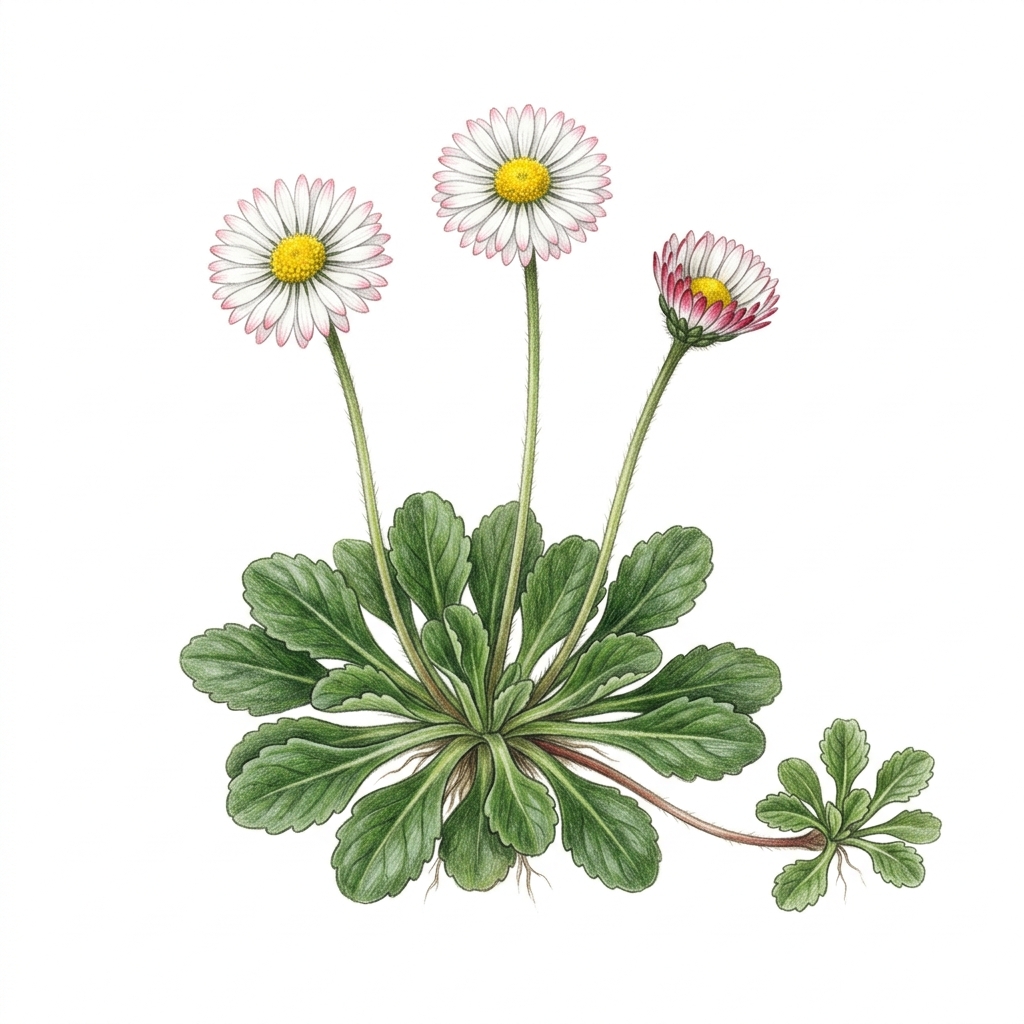
Illustration
The little white-and-yellow daisy that dots cool, moist lawns. The RHS says you don't have to remove it; if you want a clear lawn, dig out the rosettes and mow off the flowers before they seed.
How to spot it
- A flat rosette of spoon-shaped leaves, 1–3.5 cm long, with shallowly scalloped edges.
- One flower on each leafless stalk, 3–20 cm tall.
- Flower heads about 1.5–3 cm across: white petals, often tipped pink or red underneath, around a yellow centre.
- Rosettes linked by short runners into clumps.
- Flowers for most of the year in mild climates.
Easily confused with
Oxeye daisy
Much taller (usually 30–90 cm), with leaves up the stems and bigger flowers, 3–5 cm across.
Seaside daisy (Erigeron karvinskianus)
Nearly identical little flowers, but on long, thin, branching stems rather than from a flat rosette.
Native bottle-daisies (Lagenophora)
Australian and New Zealand natives with smaller heads (8–12 mm) and blue, purple or pale yellow petals.
Where it's a problem
- UK and Europe: Native. The RHS lists it as a common lawn weed but says there's no need to remove it.
- North America: Introduced and often grown as an ornamental; a lawn weed mainly in cool, moist or coastal areas.
- Australia: Naturalised in cooler districts, mainly Victoria, Tasmania and South Australia.
- New Zealand: Naturalised since the 1860s, and listed as an environmental weed.
What to do
- Decide first: the RHS suggests leaving a few to flower if you like them.
- Dig out each rosette with a hand fork or weeding tool, then reseed or re-turf the bare patch.
- Raise the mowing height and mow off flowers before they seed. Very close mowing makes its underground stems woody and tougher.
- For a badly infested patch, cut out the turf and re-lay it.
- Keep the lawn thick, so there's less room for new rosettes.
If you use a herbicide, choose one labelled for lawn daisy and follow the label and local rules. Several treatments are usually needed, and control is easier at higher mowing heights. The RHS says no weedkiller is needed; clippings from a treated lawn shouldn't go into compost or mulch.
Follow your local council's guidance for disposing of weeds. Councils usually advise against putting weeds like this in the green waste / vegetation bin or the compost.
Free account, no card needed. You sign up or sign in first, then the scanner opens.
Sources
- RHS: Lawn weed control
- RHS: Lawn and mini-meadow habitats
- Penn State Extension: English daisy
- University of California IPM: English daisy
- Washington State University Hortsense: English daisy
- PlantNET, Royal Botanic Garden Sydney
- VicFlora, Royal Botanic Gardens Victoria
- NZ Plant Conservation Network: Bellis perennis
- Oxford University Herbaria: Bellis
Facts checked Sunday 27 September 2026. General guidance only: follow your local council, agency and product label.