Home › Weed guide › Lantana
Weed guide
Lantana
Lantana camara · Verbena family (Verbenaceae)
Also called tickberry (South Africa), yellow sage (UK).
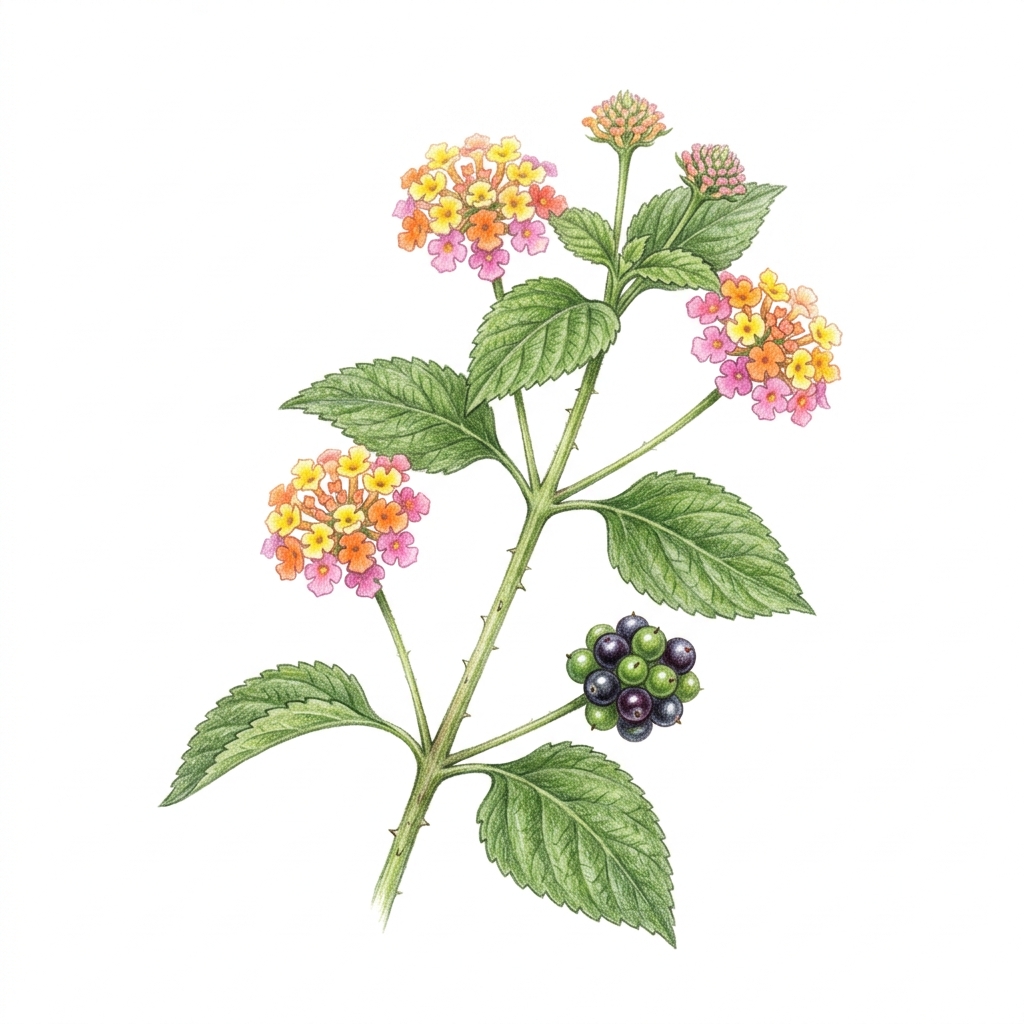
Illustration
A prickly shrub with colourful clustered flowers and black berries that has overrun bushland in Australia and southern Africa. All parts are poisonous if eaten, and it regrows unless the roots come out.
How to spot it
- A dense, many-stemmed shrub 2–4 m tall, or a scrambler climbing up into trees.
- Square young stems with short, curved prickles.
- Rough, oval, round-toothed leaves in pairs, 2.5–10 cm long, with a strong smell when crushed.
- Domed flower heads 2–3 cm across, made of many tiny flowers in mixed colours (cream, yellow, orange, pink, red) that change as they age.
- Shiny round berries, 4–7 mm, ripening from green to purple-black.
Easily confused with
Creeping lantana (Lantana montevidensis)
A low, spreading plant about 0.5 m tall with no prickles.
Bird's brandy (Lantana rugosa, southern Africa)
A native with smaller, wrinkled leaves and pink-purple flowers.
Where it's a problem
- Australia: A Weed of National Significance covering about 4 million hectares. It must not be sold anywhere in NSW, and in Queensland it is a restricted invasive plant that must not be given away, sold or released.
- New Zealand: A National Pest Plant Accord species: it can't be sold, propagated or distributed. In rural Auckland, report it to the council.
- Southern Africa: Seed-producing lantanas are a listed invasive species; no trade or planting is allowed.
- USA: Invasive in Florida, where only a few approved sterile varieties are recommended for gardens.
- UK and Europe: Sold as a tender ornamental in the UK; invasive in Portugal, the Azores and Madeira.
What to do
- Wear gloves, long sleeves and eye protection: it can irritate skin and eyes.
- Hand-pull small plants and grub out the roots with a mattock: stems and roots left behind regrow.
- Clear big infestations in stages, so the bare ground doesn't wash away, and replant.
- Check for regrowth and seedlings one to three months later, and keep following up.
- Don't rely on fire: it rarely kills lantana.
If you use a herbicide, choose one labelled for lantana and follow the label and local rules. Official guides pair spraying with thorough, persistent removal.
Follow your local council's guidance for disposing of weeds. Councils usually advise against putting weeds like this in the green waste / vegetation bin or the compost.
Take care: All parts are poisonous if eaten, to people, pets and livestock, and red-flowered forms are the most dangerous to stock. Touching it can irritate skin and eyes.
Free account, no card needed. You sign up or sign in first, then the scanner opens.
Sources
- NSW DPI WeedWise: Lantana
- Weeds Australia: Lantana
- Business Queensland: Lantana
- Northland Regional Council: Lantana
- Agricultural Research Council (South Africa): Lantana
- University of Florida IFAS: Lantana
- RHS: Lantana camara
Facts checked Sunday 27 September 2026. General guidance only: follow your local council, agency and product label.