Home › Weed guide › Japanese knotweed
Weed guide
Japanese knotweed
Reynoutria japonica · Knotweed family (Polygonaceae)
Also called Asiatic knotweed (New Zealand), itadori (USA).
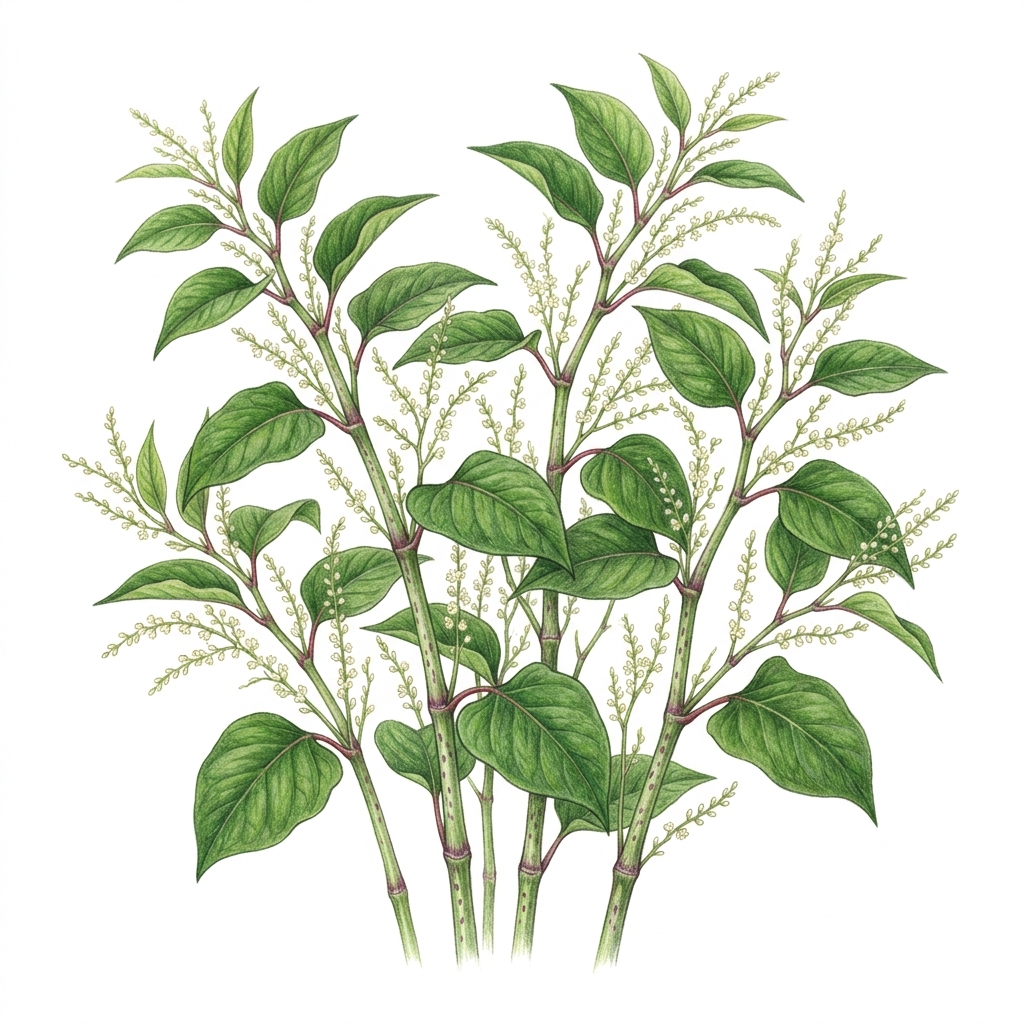
Illustration
A fast-growing, bamboo-like plant whose tiny root fragments can start new plants. It isn't something to dig out yourself: in the UK it's regulated waste, and in parts of Australia and New Zealand you should report it.
How to spot it
- Hollow, bamboo-like stems with raised joints and reddish-purple speckles, zig-zagging slightly from joint to joint.
- Spade- or shield-shaped leaves with a flat base and a pointed tip, alternating along the stem.
- Creamy-white flower spikes in late summer and autumn.
- Red-purple shoots in spring that can grow several centimetres a day; dead brown canes stay standing through winter.
- Usually 2–3 m tall. The roots are dark brown outside and orange inside.
Easily confused with
Giant knotweed
Much bigger leaves with a heart-shaped base.
Bamboo
Woody stems and papery leaves that stay green all year.
Himalayan knotweed
Long, pointed leaves and pinker flowers.
Bleeding heart (Homalanthus, Australia)
Solid, woody, grey-green stems.
Where it's a problem
- United Kingdom: It's an offence to plant it or cause it to grow in the wild. GOV.UK says you don't have to remove it from your own land unless it's causing a nuisance, but it is classed as controlled waste and must be declared when you sell a home.
- Australia: Victoria lists it as a State prohibited weed and asks people not to treat or dispose of it themselves (the state removes it free of charge); it is also declared in Tasmania and Western Australia.
- New Zealand: A National Pest Plant Accord species: it can't be bred, distributed, released or sold. Report it to your regional council.
- North America: Introduced in the late 1800s; a listed noxious weed in several states.
- European Union: Added to the EU list of invasive species of Union concern in 2025.
What to do
- Don't dig, cut up, strim or mow it: pieces as small as 1 cm can grow into new plants.
- In Australia and New Zealand, report it to your state agency or regional council first.
- In the UK, the RHS says a specialist firm is the easiest route, and one is often needed for mortgage purposes. Dug material is controlled waste and must go to a licensed site by a registered carrier.
- Expect treatment to take three years or more.
- Keep every part of it out of home compost, green waste and household bins.
Treatment usually means weedkiller over three or more growing seasons, and is best left to a specialist or your local authority; near water, extra permissions apply.
Follow your local council's guidance for disposing of weeds. Councils usually advise against putting weeds like this in the green waste / vegetation bin or the compost.
Free account, no card needed. You sign up or sign in first, then the scanner opens.
Sources
- GOV.UK: Prevent Japanese knotweed from spreading
- Wildlife and Countryside Act 1981, section 14
- RHS: Japanese knotweed
- Agriculture Victoria: Knotweeds
- NRE Tasmania: Japanese knotweed
- Auckland Council: Asiatic knotweed
- Washington State Noxious Weed Control Board
- Penn State Extension: Japanese knotweed identification
Facts checked Sunday 27 September 2026. General guidance only: follow your local council, agency and product label.