Home › Weed guide › Horsetail
Weed guide
Horsetail
Equisetum arvense · Horsetail family (Equisetaceae)
Also called field horsetail (UK, New Zealand and North America), mare's tail (Australia).
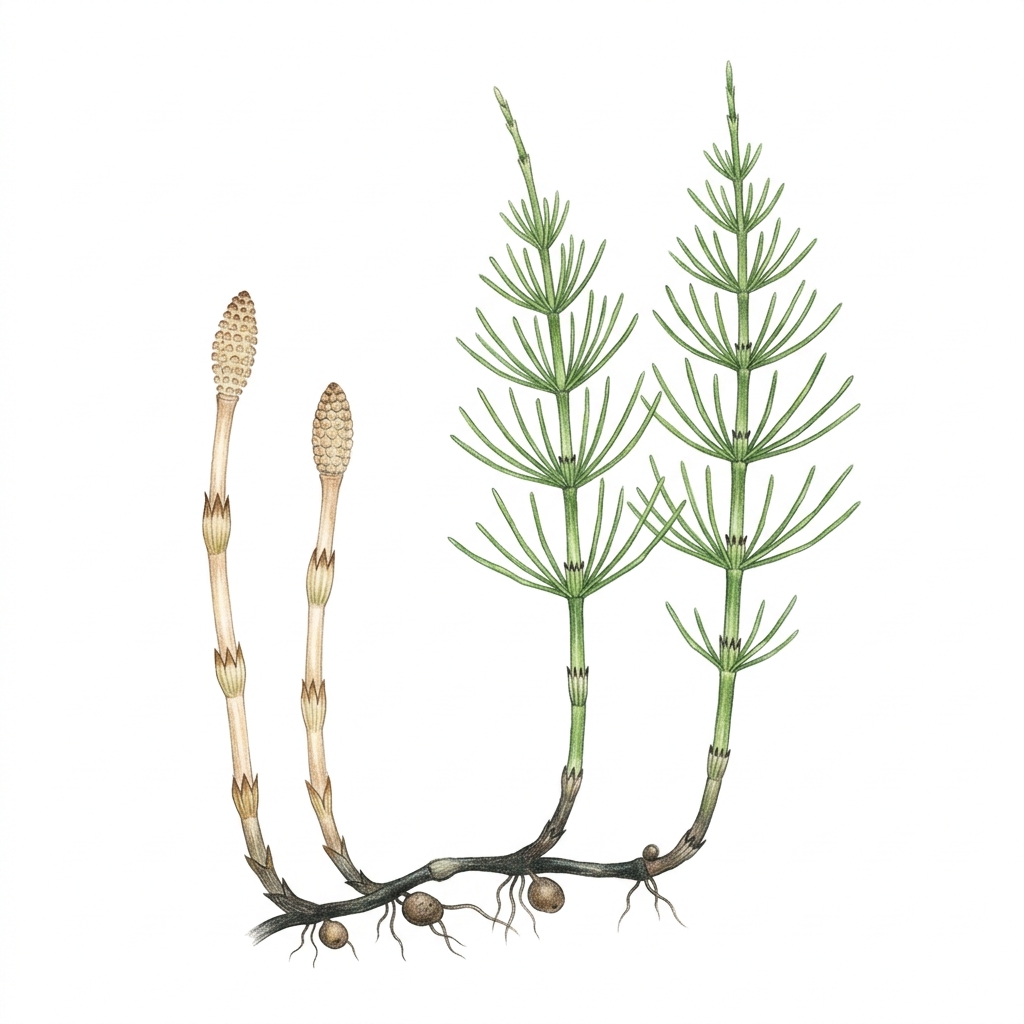
Illustration
A prehistoric-looking plant of jointed green stems with whorls of thin branches, and roots that can run metres deep. In the UK it's a famously stubborn garden weed; in Australia and New Zealand it's a banned plant you should report rather than tackle.
How to spot it
- In spring, pale brown unbranched shoots 15–30 cm tall, each topped with a cone that releases spores; they die off after a few weeks.
- Then green, hollow, jointed stems up to about 60–80 cm, with a whorl of thin green branches at every joint, like a bottle brush.
- No real leaves or flowers: each joint has a ring of small dark-tipped teeth instead.
- Rough, gritty stems that pull apart at the joints.
- It dies back in autumn and comes back from underground stems.
Easily confused with
Scouring rush (Equisetum hyemale)
Tall, unbranched stems 1–2 m high, like green bamboo.
Mare's-tail (Hippuris vulgaris)
Grows standing in water and has real flat leaves in whorls on smooth stems.
Horseweed, called marestail in the USA (Conyza)
An ordinary leafy plant with bristly, toothed leaves and small white flower heads.
Where it's a problem
- Australia: Declared across Australia. Queensland lists it as a prohibited invasive plant and asks for sightings to be reported to Biosecurity Queensland within 24 hours; Victoria lists it as a State prohibited weed, and it is also declared in NSW, South Australia and Tasmania.
- New Zealand: A National Pest Plant Accord species: it can't be sold, given away, moved or grown.
- UK and Europe: Native, and one of the most persistent garden weeds.
- North America: Native; a weed of gardens and pastures, and a problem in hay.
What to do
- In Australia and New Zealand, report it to your state or regional biosecurity agency before doing anything: authorities advise against trying to control it yourself.
- Elsewhere, pull or cut off shoots as soon as they appear, and keep doing it. This slowly weakens the underground stems, but it can take several years.
- Avoid digging or rotavating: broken pieces of underground stem grow into new plants.
- Smother bare ground for several years under cardboard and a thick layer of mulch, or under weed fabric.
- Improve drainage where you can: it favours wet, acidic soil.
If you use a herbicide, choose one labelled for horsetail and follow the label and local rules. Its gritty, waxy stems shrug off many weedkillers, so treatments usually have to be repeated over several years.
Follow your local council's guidance for disposing of weeds. Councils usually advise against putting weeds like this in the green waste / vegetation bin or the compost.
Take care: It is toxic to livestock, especially horses, when eaten in quantity, most often in hay.
Free account, no card needed. You sign up or sign in first, then the scanner opens.
Sources
- RHS: Horsetail
- Business Queensland: Horsetails
- NSW DPI WeedWise: Horsetails
- NRE Tasmania: Horsetail
- Weeds Australia: Horsetails
- Weedbusters NZ: Banned and notifiable plants
- Oregon State University: Horsetail
- Ontario Government: Equisetum toxicity in horses
Facts checked Sunday 27 September 2026. General guidance only: follow your local council, agency and product label.