Home › Weed guide › Himalayan balsam
Weed guide
Himalayan balsam
Impatiens glandulifera · Balsam family (Balsaminaceae)
Also called policeman's helmet (UK and USA), Indian balsam (UK).
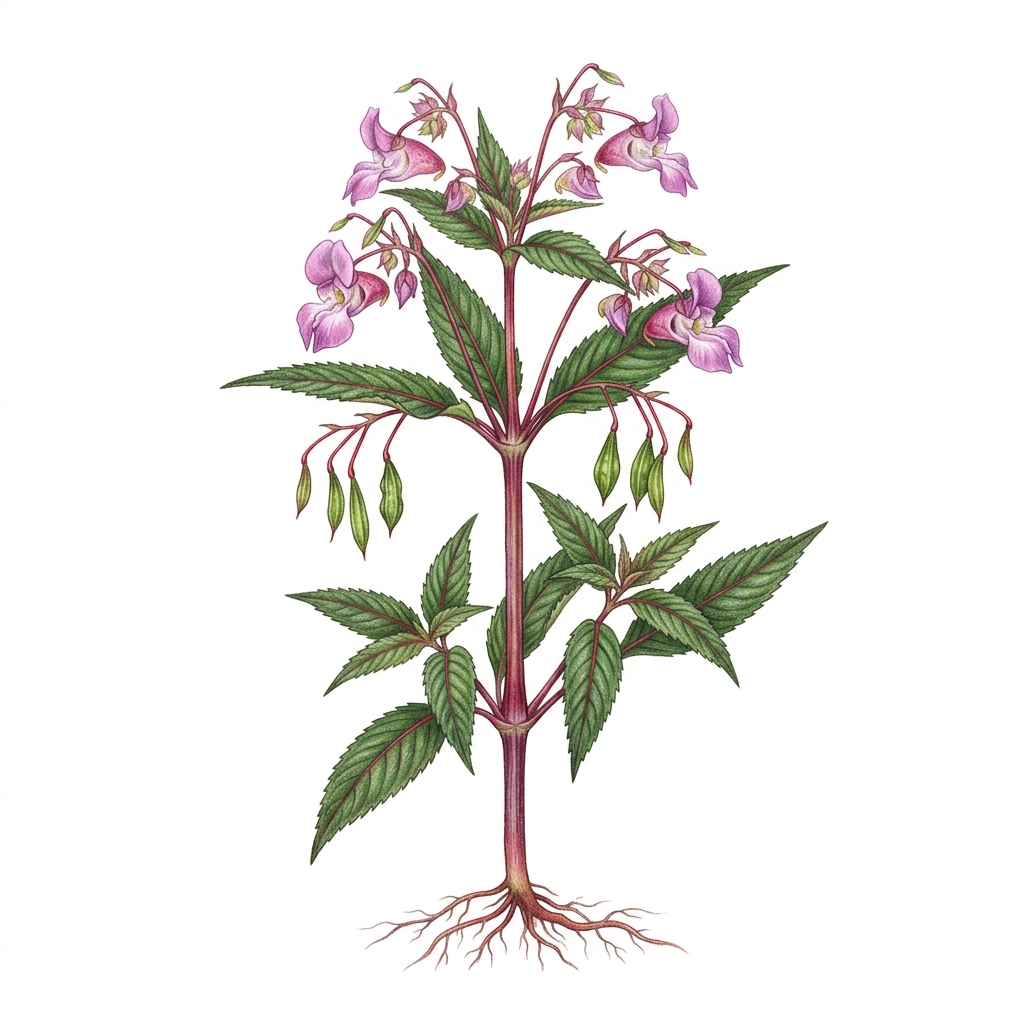
Illustration
A tall, fast-growing annual with pink helmet-shaped flowers that smothers riverbanks. It's shallow-rooted and easy to pull; the key is getting it out before the pods ripen and fire their seeds.
How to spot it
- Tall, up to about 2 m, with a hollow, brittle, green-to-reddish stem and swollen joints.
- Lance-shaped, finely toothed leaves in pairs or whorls of three, often with a red midrib, up to about 15–20 cm long.
- Pink-purple (rarely white) helmet-shaped flowers, 2.5–4 cm long, in summer and autumn.
- Club-shaped seed pods about 2.5 cm long on red stalks, which burst open when touched.
- Shallow roots, rarely deeper than 15 cm; crushed leaves smell unpleasant.
Easily confused with
Orange balsam
Orange flowers, and only about 1.2 m tall.
Shrub balsam (Impatiens sodenii, New Zealand)
A long-lived shrub with pale pink flowers 5–6.5 cm across.
Where it's a problem
- United Kingdom: It's an offence to plant it or cause it to grow in the wild. The RHS says having it in your garden already isn't an offence, but you must not let it spread.
- European Union: On the EU list of invasive species of Union concern.
- New Zealand: Listed as an environmental weed.
- North America: A listed noxious weed in Washington, and prohibited in Connecticut and Maine.
What to do
- Pull or cut plants before the pods ripen, cutting below the lowest joint: broken stems that are still rooted can regrow and flower.
- Don't touch ripe pods, which fire their seed.
- Hoe seedlings on dry days, or smother them with cardboard.
- Keep going for at least two years, as seed in the soil can last that long.
If you use a herbicide, choose one labelled for himalayan balsam and follow the label and local rules. The RHS doesn't support weedkiller use unless other methods fail, and sprayed flowering plants can still set seed.
Follow your local council's guidance for disposing of weeds. Councils usually advise against putting weeds like this in the green waste / vegetation bin or the compost.
Free account, no card needed. You sign up or sign in first, then the scanner opens.
Sources
- RHS: Himalayan balsam
- GB Non-Native Species Secretariat: ID sheet
- GOV.UK: Invasive non-native plants
- NZ Plant Conservation Network: Impatiens glandulifera
- Weedbusters NZ: Himalayan balsam
- Washington State Noxious Weed Control Board: Policeman's helmet
- CABI: Biological control of Himalayan balsam
Facts checked Sunday 27 September 2026. General guidance only: follow your local council, agency and product label.