Home › Weed guide › Hairy bittercress
Weed guide
Hairy bittercress
Cardamine hirsuta · Mustard family (Brassicaceae)
Also called flick weed or shotweed (USA), popping cress (Australia).
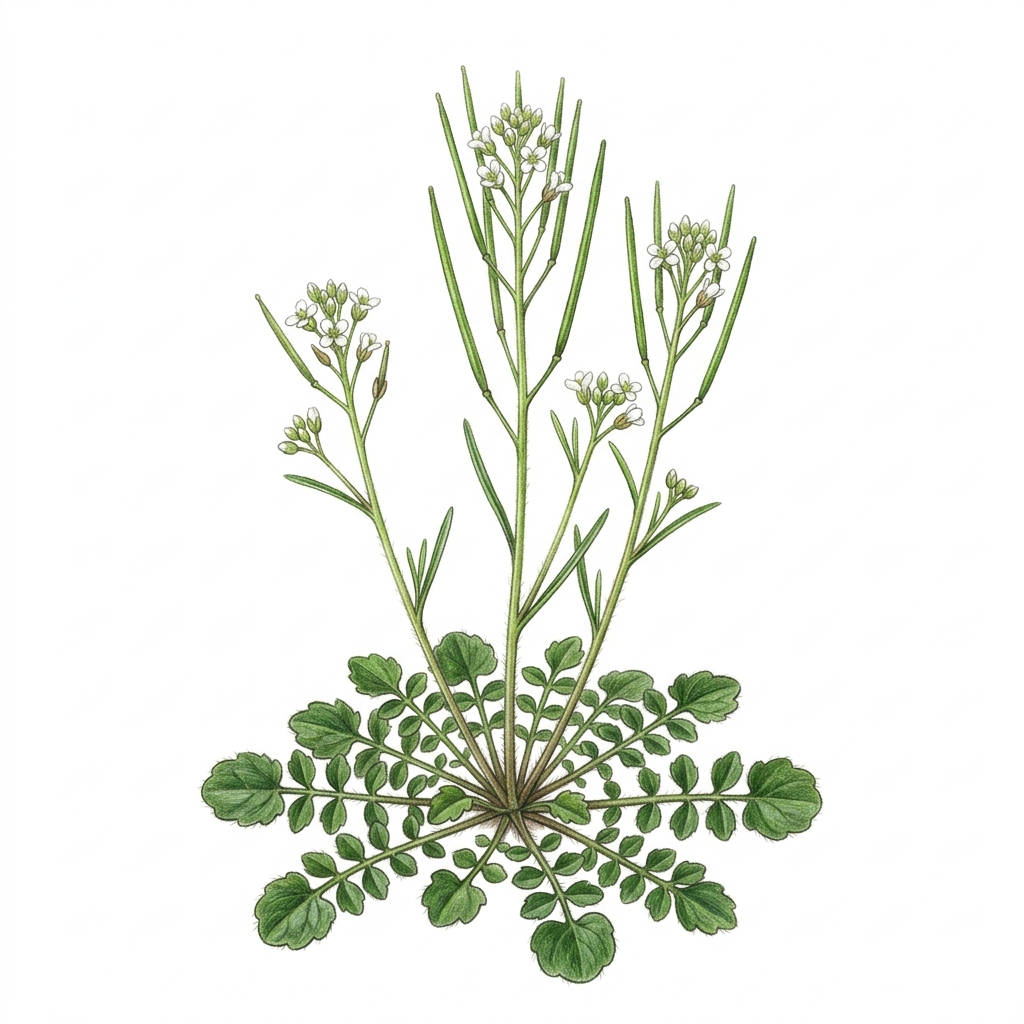
Illustration
A small, fast weed of beds, pots and paving cracks that can go from seed to seed in as little as five weeks. Its pods explode when touched, so pull it before it flowers.
How to spot it
- A flat rosette of leaves 2–8 cm long, each made of small rounded side leaflets and a larger kidney-shaped end leaflet.
- A few smaller leaves up the flower stems, with narrower leaflets.
- Tiny white four-petalled flowers, about 3 mm across, at the stem tips.
- Long, thin, upright seed pods (1.5–2.8 cm) that stand up above the open flowers and burst when touched.
- Usually 5–30 cm tall, branching from the base.
Easily confused with
Wavy bittercress
A zigzag stem, six stamens in each flower, and pods that don't rise above the flowers; it grows taller in damp spots.
Shepherd's purse
Flat, heart-shaped seed pods instead of long thin ones.
Where it's a problem
- UK and Europe: Native, and a common garden weed.
- North America: Introduced; a major weed of plant nurseries and pots.
- Australia: Naturalised in every state except the Northern Territory, in garden beds, paving cracks and lawns.
- New Zealand: Naturalised since 1901.
- Southern Africa: A naturalised weed.
What to do
- Pull or hoe plants before they flower. Once pods form, the slightest touch fires the seeds, so remove them gently and take them away.
- Mulch beds about 8 cm deep to stop new seedlings.
- Check the pots of new plants before planting them out, and wash reused pots.
- In lawns, mow early in spring to remove the flower stems, and keep the turf thick.
- Its seed lives in the soil for years, so expect a few more flushes.
If you use a herbicide, choose one labelled for hairy bittercress and follow the label and local rules. The RHS says there is no need to use a weedkiller on it; in lawns it usually seeds before spring weedkillers go on anyway.
Follow your local council's guidance for disposing of weeds. Councils usually advise against putting weeds like this in the green waste / vegetation bin or the compost.
Free account, no card needed. You sign up or sign in first, then the scanner opens.
Sources
- RHS: Bittercress
- University of Florida IFAS: Hairy bittercress
- Cornell University: Hairy bittercress
- Penn State Extension: Hairy bittercress
- Washington State University Hortsense: Bittercress
- VicFlora, Royal Botanic Gardens Victoria
- NZ Plant Conservation Network: Cardamine hirsuta
- Max Planck Society: Seed dispersal
Facts checked Sunday 27 September 2026. General guidance only: follow your local council, agency and product label.